
Ballet in the sky (Part II)
3 Feb 2012

Since "acrobats" began bolting together the pre-assembled arms of the pylons, work on the 400kV power line has provided some spectacular sights. © CEA/Corinne Guis
Installing a 400kV power line requires, in the following order: a crane, a team of acrobats, a truck-mounted winch and, finally, a helicopter.
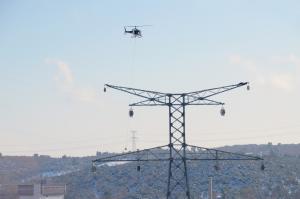
In difficult areas—such as the ridge that separates the ITER site from CEA-Cadarache to the east of the present Headquarters Building—helicopters are used to position temporary "pulling cables" that will later be attached to the actual power cables and pulled by a ground-based winch.


"Pulling cables", positioned by the helicopter hovering above the ridge were safely attached to the temporary pulleys. © Agence ITER France
Such an operation was organized last Wednesday 1 February after the sky had cleared following the previous day's heavy snowfall. "Pulling cables" were installed between pylon 18, located at CEA-Cadarache's highest point, and pylon 15, located close to canteen n°2.
The same operation, this time between pylons 15 and 10, is scheduled for 28 February.
Work on the 400keV power line, which began in September, continues to provide spectacular entertainment.