
ITER's cryolines to enter prototyping phase
16 Feb 2012
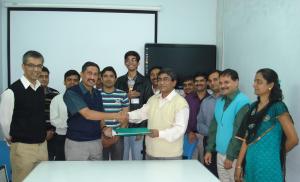

Shishir Deshpande (centre left) handing over the signed document to Biswanath Sakar from the ITER India project team...
The ITER cryolines are a system of complex, multi-process, vacuum-insulated pipes ranging from 2 to 8 process pipes that connect cryogenic components in the Cryoplant and Tokamak buildings—some 3.5 kilometres in all. They form part of the ITER cryogenic system comprising the cryoplant, the cryodistribution system and a system of cryogenic lines and manifolds. The main function of this cryodistribution system is to provide helium at 4.5 K and 80 K to the machine's superconducting magnet system, the thermal shields and the cryo vacuum pumps.
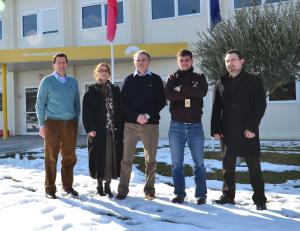

...while on the other side of the globe, the members of ITER's Cryogenic System Section brave the recent cold spell: Luigi Serio (left), head of the Plant Engineering Division, with Mihaela Francois-Rada, Michel Chalifour, Adrien Forgeas and Nicolas Navion-Maillot.
On 30 January this year the Procurement Arrangement for the delivery of the cryolines system was signed by the Indian Domestic Agency with the ITER Organization. ITER India has complete responsibility for the procurement, installation and performance of cold acceptance tests for the ITER cryolines.
In order to validate the design and manufacturing of this complex system, a prototype test has been proposed by the Domestic Agency, which will be carried out on a short length 1:1 scale model. A dedicated laboratory for performing the tests is under construction at the Institute of Plasma Research (IPR) in Gandhinagar.


The ITER cryogenic system: 50 cold boxes, 3.5 kilometres of cryolines, and 4,500 components. Cooling power will be distributed via a complex system of multi-pipe cryogenic transfer lines and cryogenic distribution boxes.
The two companies that have pre-qualified to participate in the tendering and manufacturing of the cryolines are M/s. Air Liquide Advanced Technologies from France and the consortium made up by M/s. INOX India Ltd., India and M/s. A S Scientifc Products, UK. The companies had already participated in the design of the prototype.
This article is largely based on inputs from Biswanath Sarkar, Project Manager for the cryolines and cryo-distribution systems, ITER-India.