August 1968: A revolution in fusion

In fusion too 1968 was a very exciting year. Ten years earlier, in the wake of the Atoms for Peace Conference, the veil of secrecy had been lifted from controlled fusion research. Scientists were now free to communicate, compare results and share their doubts and expectations. Every three years, the international "fusion community" would convene in a different city — in 1968, the Third International Conference on Plasma Physics and Controlled Nuclear Fusion Research, the so-called "Plasma Olympics", was to be held from August 1 to 7 in Akademgorodok, close to Novosibirsk, deep in the heart of Siberia.
"From a scientific point of view, it was a rather confused period", remembers Jean Jacquinot, former head of fusion research at French CEA, then a young physicist wrestling, like almost everyone else, with instabilities in the plasma. "Despite significant progress, pinch machines, stellarators, levitrons and superstators were still leaky or unstable, and plasma behaviour partly escaped our comprehension."
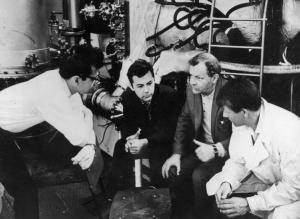
Russian tokamaks, a configuration suggested as early as 1951 by Andrei Sakharov and Igor Tamm, appeared to be faring much better. "Some preliminary results had been presented to the international community as early as 1965", remembers Valery Chuyanov, presently IO DDG for Fusion Science and Technology, who, at the time, was working on mirror machines at the Kurchatov Institute. Still, to all those present, young Jacquinot among them, Lev Arstimovitch's formal presentation at Akademgorodok, "came as a thunderclap": In T-3 and TM-3 tokamaks, the head of Soviet fusion research flatly announced, electron temperature of more than 10 million degrees had been attained and held in the plasma for 10 to 20 thousands of a second. This was considerably better than the Princeton stellarator had achieved, were plasmas had never been "hotter" than one million degrees, and confinement time never exceeded one thousandth of a second. Valery Chuyanov: "We were very careful not to overstate our results. Our figures were very cautious, lower than what our unsophisticated instruments had actually measured. In spite of these precautions, many people just could not believe what they were hearing." Jean Jacquinot has a "very vivid memory" of Mel Gottlieb, then the Director of the Princeton Plasma Physics Laboratory, and Artsimovitch, engaged in a heated discussion. "Gottlieb was saying: 'This is not possible! You must have measured the temperature of runaway electrons... Just put a wire in the plasma, you'll kill the runaways and see the temperature drop.'..."