Logo
You're currently reading the news digest published from 17 November 2025 to 25 November 2025.
Featured (5)
Of interest (2)
Press (20)
Featured

Third of the way there

They say good things come in threes, and this was the certainly the case this week at ITER as the third sector module was successfully inserted into the tokamak pit. The completion of the lifting operation for the almost 1,100-tonne component, which began on the afternoon of 24 November and ended on 25 November, means three of the vacuum vessel’s nine sector modules are now in place. Each sector module represents a 40° section of the plasma chamber and is composed of a vacuum vessel sector, its thermal shield, and two D-shaped superconducting magnets.Sector module #7 and sector module #6 were placed earlier this year, but the operation for sector module #5 was unique in a number of ways—it was the first European-built sector to be installed in the pit; it also presented some new technological challenges. A spectacular view of sector module #5 ready to pass the wall that separates the Assembly Hall from the tokamak assembly pit. Challenge one was to reduce the offset when the module was lowered into the pit. In June, when module #6 was lowered into place beside module #7, an offset of 100 mm was left between the modules—a gap that was closed later. The objective for module #5 was to achieve tighter margins during installation to prepare for future operations when the pit is more crowded and little space remains. The team initially aimed for an offset of 50 mm between sector modules #6 and #5, but complications with the metrology systems opened a window of opportunity to try to be even more precise. Relying heavily on human observation, the team was able to land the module with approximately 10 mm of offset.“It’s a big accomplishment,” says Mathieu Demeyere, the mechanical engineer at ITER who supervised the operation. “The team is tired but happy. It was a long night—with the modules so close to one another, we had a lot of decisions to make, but the experience was excellent preparation for future operations.” “We’ve achieved a semi-industrial approach that is very important for assembly,” said Jens Reich, who manages the Machine Assembly Program. The second challenge was to synchronize the lowering of the sector module with its vacuum vessel gravity support. Although nine are planned (for nine sector modules), the first gravity support was only installed last week, making sector module #5 the first test case. This meant that when sector module #5 was lowered the last few centimetres, the connection point of the gravity support had to be delicately angled to match with the interfacing component. The operation was successful and will be repeated for the next six sectors, while the two sectors already in place will have their gravity supports positioned retroactively.With sector module #5 in place, Mathieu Demeyere and his team are now turning their attention to sector module #8, which is the next in line for installation in January 2026.The sector module #5 lifting operation was closely observed by Jens Reich, ITER’s Machine Assembly Program Manager, who notes that efficiencies increase with every successful operation. “We’ve achieved a semi-industrial approach that is very important for vacuum vessel assembly and if it continues, we will complete sector installation on schedule in 2027.”

The decisive political push that launched ITER

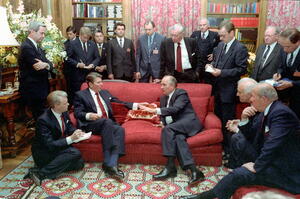
Forty years ago, on 19-21 November 1985, a long-running initiative of international collaboration in the field of fusion energy received a decisive political push. In Geneva, where they were meeting for the first time, US president Ronald Reagan and Secretary General Mikhail Gorbachev advocated in a final joint statement for “the widest practicable development of international cooperation in obtaining this source of energy, which is essentially inexhaustible, for the benefit for all mankind.” Fusion energy was the last item in a long list that ranged from the strategic ("a nuclear war cannot be won and must never be fought") to the trivial ("increased television coverage of sports events"). But it was an item that, in the long term, held the potential to change the course of civilization. By the time of the Geneva Summit, international collaboration in the field of fusion research was already a well-established practice. As early as the late 1950s, following Nikita Khrushchev’s visit to Harwell, the holy of holies of nuclear research in the United Kingdom, scientists on both sides of the Iron Curtain were sharing results, doubts, and expectations. In 1973, a formalization of these scattered exchanges was attempted. In an almost surreal anticipation of the Geneva Summit of 1985, an American president, Richard Nixon, and a Soviet Secretary General, Leonid Brezhnev, agreed that cooperating in the field of fusion science was a promising way of easing tensions between their two countries. Out of this shared vision, the first truly international effort to develop a large experimental fusion reactor was born. The INTOR—INternational TOkamak Reactor— project was very close to ITER in its concept but much looser in its organization. An INTOR Steering Group was established, teams from national fusion experiments would gather two to four times a year at the IAEA headquarters in Vienna, but the international venture never reached the actual design phase and “things started cycling,” remember the scientists who participated in the project. In 1987, INTOR was eventually folded into the nascent ITER.The fusion world in the mid-1980s was fundamentally different from what it had been two decades earlier. International collaboration at the European level had succeeded in actually building and operating a large tokamak—the Joint European Torus (JET), whose construction was launched in 1973—and global research was reaching the point where a much larger, more powerful machine was needed to demonstrate the feasibility of hydrogen fusion.The project that was incepted at the Geneva Summit added a geopolitical dimension to the technological and scientific expectations of the fusion community. As both Reagan and Gorbachev intended to find a way out of the Cold War tensions, the “widest practicable development of international cooperation” that they advocated for was a perfect “object” to illustrate their determination.Forty years later new tensions have risen, and few of the “agreements” in the Geneva Summit’s joint final statement have been implemented. Except for the last item on the list: the international effort to harness fusion energy “for the benefit of all mankind.”

Magnet protection system to step into the spotlight

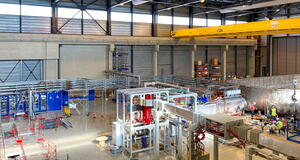
Engineers will soon have the opportunity to test the protection architecture of ITER’s superconducting magnets in high-energy conditions. A new experimental stage is taking shape at ITER—one that does not revolve around plasma, tritium, or even fusion power. Instead, it involves the protection architecture that will keep ITER’s massive superconducting magnets, and the investment they represent, safe from harm.This work is centered at ITER’s magnet cold test facility where—in addition to testing some of the ITER toroidal field coils at 4 K (minus 269 °C)—engineers will have the opportunity to qualify protection systems before the magnets are permanently installed in the tokamak. Though the test setup will operate with only one coil at a time, it marks the first occasion where ITER’s magnet protection controllers—the fast and slow “brains” that detect, respond to, and prevent fault conditions—will operate under real, high-energy conditions.“These magnets are captive components,” says Bertrand Bauvir, project leader of the Control Integration Project. “Once they’re installed on the sectors and the vacuum vessel and welded, it will take a tremendous amount of effort to replace them. So even if the risk of a manufacturing defect is very small, the potential impact would be catastrophic. The magnet cold test facility lets us verify that no systematic errors exist before we take irreversible steps.”Testing the first fully integrated protection chainThe facility also serves a broader organizational purpose. “It is the first time ITER will go through integrated commissioning,” Bauvir says. “If we can’t succeed at this smaller scale, it means we’re not yet ready for the full machine. It’s a rehearsal—not just for technology, but for the people and processes that will make ITER work.”The superconducting coils are among the most critical components in ITER. With almost zero resistance, they can carry enormous currents—up to 68 kA for the toroidal field coils with 41 GJ¹ of stored magnetic energy. If any part of a coil stops being superconducting, the sudden resistance generates intense heat, triggering what engineers call a quench.  The instrumentation and control (I&C) architecture for the test facility's central interlock system. Central interlock interfaces with various plant interlock systems to receive events and request appropriate actions—for example, requesting fast discharge from the power supply subsystem in the case of a quench. “The most important protection function in ITER is to detect a quench and safely remove the stored energy—and do it fast,” says Ruben Lopez, investment protection engineer and lead for the design of the magnet cold test facility protection strategy. “We have three complementary systems for that.”•    Primary quench detection is the fastest, using high-speed voltage measurements at coil and feeder taps. It samples at 1 kHz and must request discharge in less than 1.5 seconds.•    Secondary quench detection is slower, monitoring the thermo-hydraulic properties of the helium coolant. Quenches are detected by an abnormal increase in temperature, low helium flow or reverse helium flow. â€¢    Safety quench detection is the slowest but independent third layer of protection for the toroidal field coils, based on differential pressure switch sensors that detect reverse helium flow.If a quench occurs, coils must be discharged quickly by isolating them from their power converters and diverting the current into fast discharge resistors. “’Fast’ is no exaggeration,” Lopez says. “For the toroidal field coils, the current drops from 68 kA to about 5 kA in 30 seconds. That’s several gigawatts of power dissipated as heat in the resistors.” Because such rapid discharge puts stress on the coils, ITER’s protection strategy uses a defence-in-depth approach—discharging more gently (in a leisurely 30 to 120 minutes) when possible, but always fast enough to avoid damage.Fast reflexes, deep protectionITER’s protection architecture uses two types of controllers. Slow controllers, built on programmable logic controllers (PLCs), monitor thousands of signals related to helium flow, temperature, and pressure—conditions that evolve over seconds or minutes. Fast controllers, based on field programmable gate arrays (FPGAs), handle high-speed responses measured in microseconds. They detect events like an electrical arc or quench and trigger the appropriate action.“PLCs are robust and can manage large, distributed systems,” says Bauvir. “But they can’t react in less than a millisecond. FPGAs can—they’re unbeatable for executing simple logic extremely fast.”Reliability is critical. Many of the FPGA controllers operate in redundant pairs, performing the same computations independently and sometimes cross-checking results before acting. “This ensures the system doesn’t overreact because of a sensor glitch,” Bauvir explains. “We’re protecting not just against faults in the machine, but faults in the protection system itself.” Inside of the giant cryostat where a selection of toroidal field coils and one poloidal field coil will be tested at their operational temperature of 4 K (minus 269 °C). At the heart of ITER’s central interlock protection functions lies a hardware innovation called the discharge loop—a physical ring of FPGA-based electronic boxes known as discharge interface boxes. Each loop links all components involved in the magnet protection chain through a continuous current circuit.“When the quench detection system opens the loop, every system sees it almost simultaneously,” Lopez explains. “That ensures the discharge is coordinated and immediate.”Each loop originates in one of the Magnet Power Conversion buildings, interfaces with the Tokamak Complex housing the magnet systems, and ties together power converters, fast discharge resistors, and sensors. There are 21 discharge loops in total—one for the toroidal field system, five for the central solenoid, six for the poloidal field coils, and nine for the correction coils. The first two discharge interface cubicles were recently validated, marking a major milestone in the system’s rollout.This dual approach—using both industrial PLCs and hardwired discharge loops—reflects ITER’s commitment to redundancy and speed. As Lopez notes, “The discharge loops are simple, physical, and extremely reliable. They’re the last line of defence to protect the coils.”Each fast controller reports to a host controller, which Lopez likens to a “big brother.” While FPGAs handle real-time reactions, the host manages communications, firmware, and synchronization across the network.“Everything must share the same notion of time,” says Bauvir. “When a fault occurs, we want to correlate events across the entire machine—whether it’s a quench, a change in the cryoplant, or something else. That requires microsecond-level time alignment.”The magnet cold test facility is fully integrated with CODAC and the Central Interlock System, and uses the same high-performance network and data infrastructure as the main machine. “It’s essentially a mini-ITER,” Bauvir says. “Fewer components, but all the critical ones—the superconducting magnets, the cryoplant, the magnet feeder, the power supplies and the fast discharge units.”Commissioning will unfold in two phases—first verifying that temperature, pressure, and vacuum sensors (“slow protections”) respond correctly and that basic interlocks function as expected, then in a second phase, testing quench detection systems using a superconducting short circuit nicknamed the “jumper.” If all goes well, the first tests with a real coil will begin in early 2026.“This will be the first time we intentionally induce a controlled quench,” Bauvir says. “It’s our chance to prove that the entire protection chain—from sensors to fast discharge—behaves exactly as designed.”For Lopez, the stakes could not be higher. “These magnets represent decades of work,” he says. “Once installed, it will be very hard to replace them. We need to make sure we can protect them as if they were newborns.”¹ How large is 41GJ of energy? It’s the equivalent of 1) a 400-kilometre line of moving cars, one close to the other, travelling at 100km/h, or 2) the energy of the Statue of Liberty falling from a height of 20 kilometres.

Switzerland rejoins ITER

As part of an agreement signed by the European Union and the Swiss Confederation this month, Swiss nationals and companies will resume participation in the ITER project on 1 January 2026.  On 10 November 2025, Ekaterina Zaharieva, European Commissioner for Startups, Research and Innovation, and Guy Parmelin, Swiss Federal Councillor and Head of the Federal Department of Economic Affairs, Education and Research, signed an agreement that opens the way to Swiss participation in European Union programs Horizon Europe, Digital Europe, and Euratom Research & Training (R&T). These programs are part of a broader package of instruments to consolidate, deepen and expand cooperation in research and innovation.The agreement also establishes Switzerland as a member of Fusion for Energy starting in 2026, which will allow Swiss researchers and industry to once again¹ contribute to the ITER project.Renewed membership in Fusion for Energy, the European Domestic Agency for ITER, will make it possible for Swiss nationals to apply for ITER Organization staff positions (including ITER Project Associates and internships), for Swiss suppliers to take part in ITER Organization calls for tender and other procurement activities, and for the ITER Organization to sign agreements with Swiss partners and institutions from January 2026 forward.Read press releases from the European Commission and the Swiss federal authorities.  Â¹Switzerland participated in the ITER project through the European Joint Undertaking for ITER (Fusion for Energy) from 2014 to 2020.

Project performing to schedule and cost

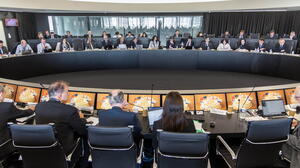
The ITER Council held its Thirty-Seventh Meeting from 19 to 20 November at ITER Headquarters.  The annual ITER Council meetings in June and November at the project's headquarters in southern France are as regular as clockwork in the ITER calendar. Delegations from the seven ITER Members—comprising high-level government representatives, heads of institutes, experts and specialists—meet for two days to assess the ITER project's performance over the previous six months on the basis of comprehensive briefings on progress in construction, manufacturing, assembly and licensing. The key outcome of the 37th Meeting of the ITER Council, which concluded on 20 November, is that the project's schedule and cost performance indices have remained above 1.0 for the past two years, demonstrating strong performance against Baseline 2024. ITER Council Chair Massimo Garribba (Europe) addresses Member delegations during the Thirty-Seventh Meeting of the ITER Council. In particular, progress in the assembly of the vacuum vessel—a key schedule driver—has been steady this year. Two completed sector modules (describing a vacuum vessel sector assembled with its thermal shield and two toroidal field coils) left assembly tooling in April and in June and were installed in the tokamak pit, and a third is scheduled to follow next week. The Council also cited progress in the assembly of the central solenoid, production underway on all divertor components, the installation of the first gyrotron, the completion of the bioshield penetrations, and progress in the construction of test benches that are important for project risk mitigation—the magnet cold test facility and the port plug test facility—as positive signs that the project is maintaining pace and performance.The Council welcomed the continuing engagement with private sector fusion efforts, including the open sourcing of ITER’s scientific simulation software and the planned release of the first volume of the ITER Design Handbook by the end of 2025.Read the IC-37 press release in English or French.
Of interest

Apply for an internship at ITER

https://www.iter.org/of-interest?id=33112
The ITER Organization has begun recruitment for its 2026 internship program.We invite students from across the ITER Members (the People's Republic of China, the European Union, India, Japan, the Republic of Korea, the Russian Federation, the United States) to apply for one of our exciting internship opportunities. All Bachelor’s, Master’s, or PhD students enrolled in a fully accredited degree program are eligible to apply. Internships are offered for up to six months and are extendable to up to one year under certain circumstances. The first wave of the campaign runs from 15 November 2025 through 6 January 2026, with the publication of 28 offers on the ITER website. A second-wave campaign will be advertised from 17 January 2026 through 28 February 2026.See this page to apply. The deadline for first-wave opportunities is 6 January 2026.

WEST kicks off a six-week campaign

https://www.iter.org/of-interest?id=33110
The WEST tokamak in France, with its tungsten divertor, is exploring the plasma physics of operation in a tungsten environment.Research on WEST is directly relevant to ITER, helping to answer questions such as "How will the actively cooled tungsten components of the ITER divertor behave after hours of plasma discharge?" or "Can performant plasmas be produced if plasma-facing components are damaged?" or "How can the monitoring system be optimized for these components?" In a six-week campaign that started on 7 November, the team is testing the performance of a tungsten coating on tiles in collaboration with ITER, running experiments to test the "I-mode" regime (an ELM-free improved confinement regime with low impurity content) in collaboration with American and Chinese collaborators, and studying the growth of deposits on the divertor under high particle fluence.The WEST tokamak (for W Environment in Steady-state Tokamak) is located at the Institute for Magnetic Fusion Research (IRFM) near ITER, part of the French Alternative Energies and Atomic Energy Commission's (CEA's) Cadarache Centre.See the article published on the CEA IRFM website.
Press

시계침 빨라진 핵융합발전 연구, 30년 뒤 국가운명 가른다[최준호의 사이언스&]

https://n.news.naver.com/mnews/article/025/0003484872

我国发布燃烧等离子体国际科学计划

http://www.ah.xinhuanet.com/20251125/e47fe8e2562a4af19404adcbfb8e1e61/c.html

Die Vorzüge des Multilateralismus in der Forschung am Beispiel von ITER

https://e2-news.ch/de/news/die-vorzuege-des-multilateralismus-in-der-forschung-am-beispiel-von-iter

The power of multilateral research: ITER

https://e2-news.ch/en/news/the-power-of-multilateral-research-iter

Firmado el acuerdo internacional que garantiza los 800 millones de presupuesto del acelerador de Granada

https://www.ideal.es/granada/italia-firma-acuerdo-internacional-garantiza-800-millones-20251121134229-nt.html?ref=https%3A%2F%2Fwww.ideal.es%2Fgranada%2Fitalia-firma-acuerdo-internacional-garantiza-800-millones-20251121134229-nt.html

IRB: Hrvatska u Madridu potpisala ključni sporazum za fuzijsku energiju

https://ipress.hr/vijesti/89569-irb-hrvatska-u-madridu-potpisala-kljucni-sporazum-za-fuzijsku-energiju

中国科技部副部长陈家昌率团出席 国际热核聚变实验堆(ITER) 计划理事会第三十七届会议

https://www.iterchina.cn/impnews/info/2025/14161.html

China launches international scientific program in field of fusion

https://www.globaltimes.cn/page/202511/1348918.shtml

EUROfusion scientists set research priorities for the coming fusion experiments

https://euro-fusion.org/eurofusion-news/ef-scientists-research-priorities/

Spain signs the International DONES Multilateral Agreement (MIDA) with Croatia, Japan, Italy, and Fusion for Energy to advance fusion energy development at the particle accelerator in Escúzar

https://ifmif-dones.es/dones-updates/spain-signs-the-international-dones-multilateral-agreement-mida-with-croatia-japan-italy-and-fusion-for-energy-to-advance-fusion-energy-development-at-the-particle-accelerator-in-escuzar/

Multilateral International DONES Agreement signed

https://fusionforenergy.europa.eu/news/multilateral-international-dones-agreement-signed/

Россия поставила ключевое оборудование для международного термоядерного реактора ИТЭР

https://rosatom.ru/journalist/news/rossiya-postavila-klyuchevoe-oborudovanie-dlya-mezhdunarodnogo-termoyadernogo-reaktora-iter/

Russia Delivers Key Equipment for the ITER International Fusion Reactor

https://rosatom.ru/en/press-centre/news/russia-delivers-key-equipment-for-the-iter-international-fusion-reactor/

Are we finally about to crack fusion energy? (paywall)

https://www.spectator.co.uk/article/are-we-finally-about-to-crack-fusion-energy/

Centre of Construction Law and Dispute Resolution contributes to new collaborative contract for the nuclear fusion industry

https://www.kcl.ac.uk/centre-of-construction-law-and-dispute-resolution-contributes-to-new-collaborative-contract-for-the-nuclear-fusion-industry

First of Russian test rigs delivered to ITER construction site

https://www.world-nuclear-news.org/articles/first-russian-test-rigs-delivered-to-iter-construction-site

Celebrating Europe’s Fusion Talent: EUROfusion Awards 2026 Researcher and Engineering Grants

https://euro-fusion.org/eurofusion-news/2026-researcher-and-engineering-grants/

Upgraded UC San Diego Facility Accelerates Efforts to Develop Materials for Fusion Reactor Walls

https://today.ucsd.edu/story/upgraded-uc-san-diego-facility-accelerates-efforts-to-develop-materials-for-fusion-reactor-walls

Russia supplied key equipment for ITER — Rosatom

https://tass.com/economy/2044767

ИТЭР: поставлен первый стенд для порт-плагов

http://www.atominfo.ru/newsz09/a0043.htm