Logo
You're currently reading the news digest published from 8 December 2025 to 15 December 2025.
Featured (4)
Press (20)
Featured

First coil ready to face deep-space cold

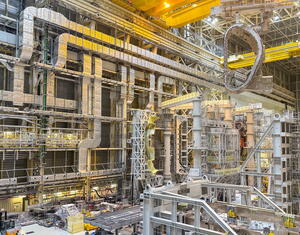
For toroidal field coil #7 (TF07), winter will be short but exceedingly harsh. For one full month, the ~ 300-tonne component will be enclosed in a steel cocoon, its temperature brought down to 4 K (minus 269 degrees Celsius)—an environment as cold as that of deep space. On Monday 15 December, the big red tower crane that had handled the ITER poloidal field coils in the final stages of their fabrication carefully deposited TF07 in the sardine-box-shaped cryostat, the central element of the recently finalized magnet cold test facility. Toroidal field coils have already experienced extreme cold. Once finalized, in Japan or in Europe, most of them were tested at 80 K (minus 194 degrees Celsius) before being shipped to ITER. Testing at 80 K is a relatively simple operation that provides precious information on the thermal and mechanical constraints that a coil will be exposed to during its lifetime. Testing at 4 K, which is the operating temperature of the ITER superconducting magnetic system, is a completely different operation that requires a massive infrastructure: a large insulated cryostat, powerful cooling and power systems connected to the coil by a real ITER feeder, and all the required command and control instrumentation.“At 4 K, the winding inside the coil becomes superconducting, which allows us to circulate a strong electrical current and thus generate an intense magnetic field,” explains David Grillot, ITER manager for the integrated commissioning program. While parameters inside the magnet cold test facility do not completely reproduce the conditions the coil will face during the machine's operational phase, they come close enough to enable, in David’s words, “a partial but real-scale commissioning of the tokamak's magnetic system. Thierry Schild, leader of the Magnets Cold Test Facility Project (centre), oversees the insertion of toroidal field coil TF07 in the cryostat. He is seen here with a team that includes metrologists, crane operators and various ITER specialists. An effort that began more than two years ago has reached its culmination. The magnet cold test facility, along with the cryostat that constitutes its most spectacular feature, and the bespoke spreader beam that interfaces with the tower crane were built and delivered in record time. As 4 K testing requires time, and vacuum vessel sector module assembly is progressing particularly fast (each module comprises two toroidal field coils), the teams anticipate the possibility of testing 4 to 5 coils, including the smallest poloidal field coil PF1 which can fit into the cryostat without major adaptations. Along with minimizing risks, this partial commissioning of the coil ecosystem will be like a general rehearsal that will save the project a considerable amount of time.

3 cold valve boxes for neutral beam heating

Cold valve boxes are compact yet highly complex assemblies that regulate the flow of supercritical helium to the ITER cryopumps. Eight units are required for the large cryopumps that will establish the vacuum conditions needed for plasma operation within the vacuum vessel and cryostat, while an additional three will manage helium distribution to cryopumps on ITER’s neutral beam injectors. Europe has now completed the delivery of all units. The successful reception inspection of the final three units at ITER in December marks the conclusion of a 20-year adventure for the ITER Organization, Fusion for Energy (the European Domestic Agency), and contractor Research Instruments (Germany) and its partner Cryoworld (Netherlands).The manufacturing experience acquired with the first batch of eight, delivered in 2022, allowed production to move swiftly on the second set of cold valve boxes, which are larger in size due to the fact that each box serves two neutral beam cryopumps and therefore includes more piping. Cold valve box assemblies are an intricate jigsaw puzzle of pipes, sensors and dozens of special valves per unit. Each cold valve box is paired with a cryopump, supplying them with precise doses of helium across a wide temperature range, from -269 °C up to 210 °C.  The larger neutral beam injection cold valve boxes are now stored at ITER next to the first set, received in 2022. See a related article on the Fusion for Energy website.

Keeping the project humming

At the sixth annual ITER Awards ceremony last week, six prizes were presented to teams and individuals in recognition of outstanding project execution in 2025. The ITER Director-General also took the opportunity to express appreciation to all project participants—and the families who support them—for their dedication in ensuring the on-time implementation of the project’s baseline.  At a China-themed gala on Thursday, 11 December, the ITER community celebrated its superstars—four teams nominated and elected by their peers to receive a 2025 award for exceptional performance. In addition, ITER Director-General Pietro Barabaschi exercised his “Director’s prerogative” to name two recipients of the Director’s Choice Award, both recognized for their role in achieving a series of remarkable vacuum vessel assembly milestones in 2025.The ITER vacuum vessel is now one-third installed in the tokamak pit and, if the project continues apace there will be six sectors in the pit one year from now. The specialists involved with these milestones—and the unified team they form—are “worthy of special recognition” according to the ITER Director-General.“They have accomplished what I was told could not be accomplished—working to, and sometimes even ahead of, the schedule we established.”The ITER Organization and the Domestic Agencies continue to make excellent progress in the implementation of Baseline 2024. From January 2024 through September 2025, the ITER construction project has achieved schedule performance and cost performance indices of greater than 1.0—meaning that ITER is somewhat ahead of schedule while spending less than anticipated in the baseline.The evening’s special guests—HE Youlin, Chinese Consul-General in Marseille, and GUO Xiaolan, Minister-Counsellor for Science and Technology at the Chinese Embassy of Paris—celebrated the international nature of ITER and the global efforts toward fusion energy.   2025 award resultsThe Component Delivery Team Award went to the magnet cold test facility team, which oversaw the procurement of equipment in record time, including the giant cryostat chamber delivered from China in October. The first magnet to be tested, TF07, was inserted today in the test chamber (see this article).The Installation/Assembly/Construction Team Award went to the transversal team for the rotation of vacuum vessel sectors 1 and 4 for repair, which developed and executed a novel handling approach (rotating the sectors outdoors) to enable the repair of the inaccessible side of vacuum vessel sectors #1 and #4, and in this way supported the project’s critical path by avoiding bottleneck in Assembly Hall tooling.The Best Support of the ITER Project Award went to the ITER cleaning staff team for consistently taking care of buildings and offices across the ITER site, providing the highest quality of service with kindness and courtesy. The Special Contribution Team Award went to the nuclear safety team for its track record in rebuilding trust with the French nuclear safety regulator ASNR, for working through issues of licensing strategy, and for the instillation of nuclear safety culture across the project. (Recognized as part of this group is the transversal unit working to exempt the ITER vacuum vessel from nuclear pressure equipment.)The Director's Choice Award this year went to the vacuum vessel sector module installation team/machine assembly team, including the CNPE consortium for doing, in the words of Director-General Pietro Barabaschi, “what I was told by others that it was impossible to do”—that is, install three sector modules in 2025. (The installation of another three is programmed in 2026.)For the first time during an ITER Awards ceremony the Director-General also chose to recognize an individual—Head of the Construction Project Sergio Orlandi—for his contributions to the project.The large crowd (1,600 registrations) enjoyed demonstrations of martial arts, juggling, diabolo prowess, and dancing by the French Wushu Martial Arts group Kung-Fu Academy and the Guizhou Acrobatic Troupe before dinner and dancing.

A giant, slow-motion game of musical chairs

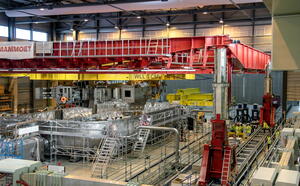
One component leaves sector sub-assembly tooling, another arrives ... the intricately coordinated transfers of large components in the ITER Assembly Hall resemble a slow-moving game of musical chairs. Just a few weeks after one of the vacuum vessel sector sub-assembly tools was liberated, a "bare" vacuum vessel sector has arrived to claim the space. From now until mid-2027 when all nine sectors of the ITER vacuum vessel have been positioned in the tokamak pit, the twin assembly tools will be in continuous use.The giant tools have been conceived for one purpose: to associate a vacuum vessel sector with its thermal shield plus two D-shaped toroidal field coils, creating a sector module that can be installed in the tokamak pit. The tools stand six storeys high, with lateral wings spreading 20 metres. They weigh 800 tonnes and support the weight of the finalized sector module (approximately 1,100 tonnes). A "bare" sector arrives. A "sector module" departs.On Wednesday 10 December, it was the turn of sector module #4 to be transported across the Assembly Hall by the overhead bridge cranes and inserted into SSAT 1 (sector sub-assembly tool #1). In approximately six months, for this tool, it will be time for musical chairs again. The "bare" sector is seen here suspended inside of an assembly tool. When it is extracted from the tool, some six months down the road, it will be a completed "sector module," after the addition of its thermal shield and two D-shaped magnet coils.
Press

ITER builds global, high-speed data backbone for remote scientific participation

https://www.computerweekly.com/feature/ITER-builds-global-high-speed-data-backbone-for-remote-scientific-participation

European factories in motion for ITER first wall panels

https://fusionforenergy.europa.eu/news/iter-first-wall-panels-tests-manufacturing-europe/

Clean, Limitless Energy Exists. China Is Going Big in the Race to Harness It

https://www.nytimes.com/2025/12/13/climate/china-us-fusion-energy.html?unlocked_article_code=1.808.KyLU.y3bRnb2xGkSk&smid=nytcore-ios-share

中核工程联合体团队荣获ITER总干事特别奖

https://www.iterchina.cn/impnews/info/2025/14181.html

UK scientists unveil new facility to boost fusion effort for limitless clean energy goal

https://interestingengineering.com/energy/uk-elsa-facility-fusion-effort

Fusion technologies generate impressive socio-economic benefits. Now is the time for Europe to show ambition

https://www.euractiv.com/opinion/2337899/

Funding For Fusion Energy Jumped By 30% From June-Sept, With US And China Dominating (paywall)

https://www.nucnet.org/news/funding-for-fusion-energy-jumped-by-30-from-june-sept-with-us-and-china-dominating-12-4-2025

Fusion: ITER installerar Europas första vakuumkärlsmodul med hög precision

https://www.industrinyheter.se/20251211/44935/fusion-iter-installerar-europas-forsta-vakuumkarlsmodul-med-hog-precision

World’s largest stellarator turns ten: How W7-X cracked code for steady fusion plasma

https://www.msn.com/en-us/news/technology/world-s-largest-stellarator-turns-ten-how-w7-x-cracked-code-for-steady-fusion-plasma/ar-AA1SajDm

FOTO Tonči Tadić javio se iz srca najvažnijeg energetskog projekta u europskoj povijesti – reportaža s gradilišta ITER-a!

https://www.vecernji.hr/vijesti/foto-tonci-tadic-javio-se-iz-srca-najvaznijeg-energetskog-projekta-1915424

Controlling tritium inventory in ITER plasma-facing components

https://irfm.cea.fr/en/2025/11/controlling-tritium-inventory-in-iter-plasma-facing-components/

ITER Achieves Precision Milestone with Installation of Europe’s First Vacuum Vessel Sector

https://metrology.news/iter-achieves-precision-milestone-with-installation-of-europes-first-vacuum-vessel-sector/

Росатом приглашает молодых ученых на Зимнюю школу по управляемому термоядерному синтезу и плазменным технологиям

https://www.atomic-energy.ru/news/2025/12/09/161697

FuseNet 15 Years! (video 4:04)

https://www.youtube.com/watch?v=pdcKqbj-9rs

核融合実験炉ITER トロイダル磁場コイルの製作 16年に亘る挑戦の完遂

https://www.jstage.jst.go.jp/article/jaesjb/67/12/67_708/_article/-char/ja/

China's 'artificial sun' moves faster toward reality

https://news.cgtn.com/news/2025-12-09/China-s-artificial-sun-moves-faster-toward-reality-1IWyUOD56xy/share_amp.html

Fusion energy industry presses US government for billions in support (paywall)

https://www.reuters.com/sustainability/climate-energy/fusion-energy-industry-presses-us-government-billions-support-2025-12-09/

Kazakhstan aims to reclaim its nuclear legacy with fusion energy

https://cen.acs.org/energy/nuclear-power/Kazakhstan-aims-reclaim-nuclear-legacy/103/web/2025/12

U.S. Fusion Industry Asks for Federal Help

https://oilprice.com/Latest-Energy-News/World-News/US-Fusion-Industry-Asks-for-Federal-Help.html

Dos proyectos de fusión nuclear planean ya plantas piloto de generación de energía

https://elpais.com/tecnologia/2025-12-09/dos-proyectos-de-fusion-nuclear-planean-ya-plantas-piloto-de-generacion-de-energia.html