Logo
You're currently reading the news digest published from 2 February 2026 to 9 February 2026.
Featured (2)
Of interest (2)
Press (14)
Featured

The story behind the coffee mug

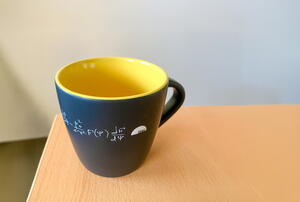
At ITER, it’s common to see whiteboards covered with physics equations. What’s less ordinary in the offices, although increasingly prevalent, is a dark blue coffee mug with one of these equations handwritten along its side. It is not the formula most closely associated with fusion—the one that describes the deuterium-tritium reaction. So what’s the story behind it? The rather elegant formulation, aesthetically pleasing even to the unscientific eye, is known as the Grad–Shafranov equation. In the very simplest terms, it is the equation that allows scientists such as Yuri Gribov at ITER to set the right conditions for keeping the position of the burning plasma stable and keeping the gap between the plasma and the walls of the tokamak chamber sufficiently far apart.In rather more detail, Grad–Shafranov is a mathematical equation that describes the balance between magnetic forces and plasma pressure in an axisymmetric plasma like those in tokamaks—the “equilibrium equation in ideal magnetohydrodynamics (MHD) for a two-dimensional plasma” (read more here).It is fitting that the equation on the ITER mug is in Gribov’s handwriting, as there is a direct connection between him and Vitaly Shafranov. After graduating from Moscow State University in 1977 Yuri joined the Kurchatov Institute, first working under the supervision of Valery Chuyanov, who went on to lead the Fusion Science and Technology Department at ITER from 2006 to 2012, and later joining the Theoretical Department headed by Vitaly Shafranov.“The Grad–Shafranov equation is the foundation for modelling the magnetic control of tokamak plasma,” Gribov explains. “Derived from fundamental physical principles, it has been repeatedly verified through experiments, and this is precisely what makes our calculations of the plasma’s position and shape in the tokamak so reliable.” Source: Wikipedia Gribov remembers Shafranov as a sensitive, gentle, and highly intelligent man—a “genius.” “For so much of his early career, his work in fusion was kept secret. When the secrecy classification was lifted, it began to be published in scientific journals. Later in life, he was very highly regarded as a teacher and mentor, and students loved to work with him. He prepared many, many students for their PhDs, and many went on to establish careers for themselves—such as Leonid Zhakharov, at Princeton, and Vladimir Pustovitov, at the Kurchatov.”So where does the ‘Grad’ part of the equation come from?“The equation bears both names because Grad and Shafranov derived it independently, and almost simultaneously, but using different approaches,” explains Gribov.Harold Grad was an American applied mathematician, working on the general theory of plasma equilibrium in magnetic fields using MHD equations. His approach used a variational principle: finding a magnetic flux function that minimizes the system’s energy for fixed pressure and current¹.Shafranov for his part was focused on practical plasma confinement in a torus explicitly accounting for toroidal geometry in which the magnetic field is non-uniform and varies along the radius and height of the torus (as in a tokamak). He derived the equation for the force balance in a toroidal magnetic field².  Yuri Gribov (closest to the camera at right, enjoying a lunch in February 2024 with his Experiments & Plasma Operation colleagues) retired in December 2025 after working for more than 18 years in the ITER Science Division. Thankfully, retirement does not mean loss of Yuri’s expertise and experience—he will continue to work as an ITER Emeritus Fellow. Shafranov’s results turned out to be mathematically equivalent to Grad’s more general formulation, but with a direct focus on toroidal configurations. This equation was later applied by Shafranov and Vladimir Mukhovatov to a specific tokamak configuration (with circular plasmas) for which it could be solved analytically. This provided simple formulas for key parameters for the equilibrium of a plasma in the tokamak, the so-called Shafranov shift and the Shafranov vertical field. â€œAlthough the Grad–Shafranov equation provides a reliable model for the magnetic control of the plasma current, position, and shape,” says Gribov, “unfortunately, there are still no equally reliable models for controlling the plasma’s kinetic parameters such as the magnitude and profile across the plasma of its temperature.” The problem is the same as in accurately predicting the weather. “Like the weather, plasma has an infinite number of degrees of freedom, and its kinetic parameters nonlinearly depend on many conditions. And that’s what makes our jobs in plasma control so interesting!”And what makes the ITER mugs so popular… (See the item here.)¹Grad’s equation was published in 1958 in H. Grad and H. Rubin, Hydromagnetic Equilibria and Force-Free Fields, Proceedings of the Second United Nations International Conference on the Peaceful Uses of Atomic Energy, 1-13 September 1958, Geneva, P/386.²Shafranov’s paper ‘On magnetohydrodynamic equilibrium configurations’ was published in 1957 in the Russian in Journal of Experimental and Theoretical Physics (U.S.S.R.) 33 (1957) 710-722. The paper was translated into English in 1958 in Soviet Physics JETP 6(33) (1958) 545-554.

High hydrogen + low density = top protection

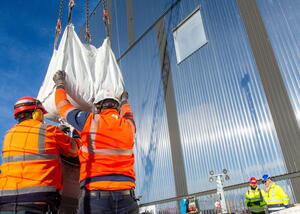
To protect machinery from possible radiation damage, ITER has applied a layer of first-of-its-kind protective mortar to the floors of rooms housing sensitive electronics. High up in the Tokamak Building are special rooms with electronics that require protection from the neutron and gamma ray radiation that could degrade them over time or cause software errors. The solution? A brand-new twist on the type of mortar that is familiar to any home improvement enthusiast.“When it isn’t feasible to relocate sensitive equipment away from the tokamak or implement radiation hardening on electronic components and circuits, our main strategy is extra shielding to mitigate radiation risks,” says Moustafa Moteleb, Construction Engineer in the Civil Engineering Interface Project. “As a result, we created the specialized mortar.” In January, this new made-for-ITER mortar was poured for the first time at two SIC (Safety Important Component) rooms located on Level 5 of the Tokamak Building. These rooms will house instrumentation and control equipment and are now protected against radiation. ITER Construction Engineer Moteleb Moustafa monitors the pumping of the mortar into one of the two rooms that require extra radiation shielding to protect electronics. ITER contracted Lemer Pax, a French radiation protection company, to develop a first-of-its-kind mortar, Borated MORTAR 075. While the mortar uses standard cement, it features a groundbreaking aggregate mix that has an optimized hydrogen content to slow down the neutrons and a level of boron that enhances neutron absorption rate. It also has a much lower density than standard mortar to meet the building’s load constraints at the basement level.“The mix is a very special combination,” explains Fady El Haber, the materials science expert from Lemer Pax who participated in the development of the mortar. “In fusion, the neutron is in a high flux, so you need a high hydrogen content for efficient radiation protection. We also had to maintain fire resistance and respect a specific low density per square metre for the weight limits.”In total, 48 cubic metres of mortar were poured to provide a 20-centimetre-thick layer of radiation-shielding mortar on the floors of the two rooms. The work was subcontracted by Lemer Pax to the Italian company Monsud and began in early January 2026 with a tower crane hoisting 100-kilogram bags of the aggregate mix to the roof of the Tritium Building, where it was mixed with water and cement. It was then pumped along a 100-metre tube down into the SIC rooms. The project was completed in late January and the final step will be to add a 3- to 5-millimetre layer of hydrophobic coating in March. The first-of-its-kind mortar is applied in a 20-centimeter layer on the floor of one of the Safety Important Component rooms that will house electronics.
Of interest

The ITER Podcast: Season 3, Episode 6

https://www.iter.org/of-interest?id=33881
In Season 3, Episode 6 of the ITER podcast, we meet the "guardian of fusion"—the extraordinary blanket system that shields our "star in a bottle." Guided by warrior and dragon imagery inspired by Chinese legend, and some very down to earth engineering, podcast hosts Kruti Fayot and Julia Ponomareva explore how ITER’s blanket and tungsten first wall protect the machine, tame furious neutrons, and quietly turn a raging plasma into something as familiar as hot water in a kettle.Mechanical engineer Jinke Fu introduces Nezha, a mythical Chinese rebel guardian, while ITER experts Ryan Hunt, Sophie Carpentier, and Silvia di Sarra reveal how real world guardians are built: from armor like tungsten tiles and ultraprecise assembly to world record plasma shots and global collaborations from EAST to WEST. If you’ve ever wondered how you stop particles that could reach the Moon and back in seconds, or why choosing the “right” wall material is like choosing a life partner, this episode is for you—part myth, part cutting-edge science, and a love letter to the star that started it all: the Sun.Tune into Episode 6, "The Guardian of Fusion," on the ITER website's podcast page or open it directly here. You can also find this episode and all past episodes of the ITER podcast at Spotify, Amazon Music, Apple Podcasts, and Podbean. 
Monaco_Fellow_OK_small.jpg

Final month: ITER postdoctoral campaign closes 6 March

https://www.iter.org/of-interest?id=33883
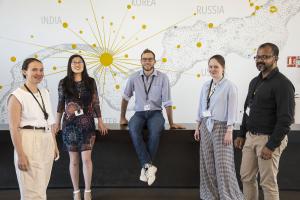
Candidates holding a PhD in science, technology, or engineering whose expertise aligns with the needs of the ITER project may be eligible for a two-year postdoctoral position at the ITER Organization.For the 2026 recruitment campaign, seventeen research topics have been published across a wide range of fields, including integrated plasma scenario design and transport modelling, artificial intelligence and digital twin technologies for fusion systems, diagnostics calibration and validation, and robotics and automated handling (see the full list here).Selected fellows will work closely with ITER specialists during a two-year appointment and contribute to the project through original, cutting-edge research.The current selection process aims to fill eight postdoctoral fellowships—five Monaco-ITER fellowships and three Korea-ITER fellowships—and to establish a reserve list of qualified candidates for future openings.The deadline for applications is 6 March 2026. To apply, see the JOBS page of the ITER website, or consult the Postdoctoral Fellowships page for detailed information about the program. 
Press

Making magnetized plasmas in the lab

https://physicstoday.aip.org/features/making-magnetized-plasmas-in-the-lab

总台央视新闻频道、中文国际频道、新闻客户端报道驻马赛总领馆联合总台举办的春节活动

https://mp.weixin.qq.com/s/oOC9T-qTTIeruyzUlYWL9A

[中国新闻]春晚有约 中国驻法科研人员:过年最期待看总台春晚

https://app.cctv.com/special/m/livevod/index.html?vtype=2&guid=b42971f107184ee2a95747a478385ac5&vsetId=C10336

全球看春晚!总台“春晚序曲”法国专场活动在马赛举行

https://news.cnr.cn/native/gd/20260208/t20260208_527519875.shtml

LLNL offers tools to model the economics of inertial fusion power plants

https://www.ans.org/news/article-7735/llnl-offers-tools-to-model-the-economics-of-inertial-fusion-power-plants/

Zagreb hosts Europe’s fusion elite, tackling a key bottleneck in today’s most ambitious energy endeavour

https://www.irb.hr/eng/News/Zagreb-hosts-Europe-s-fusion-elite-tackling-a-key-bottleneck-in-today-s-most-ambitious-energy-endeavour

Godzilla is helping ITER prepare for tokamak assembly

https://www.ans.org/news/article-7732/godzilla-is-helping-iter-prepare-for-tokamak-assembly/

The Cask Transport System, an automated vehicle ready for ITER assembly

https://fusionforenergy.europa.eu/news/cask-transport-system-final-acceptance-tests/

Bringing fusion energy to the grid using artificial intelligence

https://www.pppl.gov/news/2026/bringing-fusion-energy-grid-using-artificial-intelligence

Imaginary Energies allows users to design futuristic fission and fusion power plants

https://www.ans.org/news/article-7730/imaginary-energies-allows-users-to-design-futuristic-fission-and-fusion-power-plants/

CIEMAT strengthens its leadership in fusion energy by reinforcing its collaboration with IFMIF-DONES

https://ifmif-dones.es/dones-updates/ciemat-strengthens-its-leadership-in-fusion-energy-by-reinforcing-its-collaboration-with-ifmif-dones/

CIRCE: a toolkit for the preliminary design of magnetic systems for tokamaks and stellarators

https://irfm.cea.fr/en/2026/01/circe-a-toolkit-for-the-preliminary-design-of-magnetic-systems-for-tokamaks-and-stellarators/

How AI is powering the energy transition – from smart grids to fusion

https://www.reuters.com/sustainability/climate-energy/how-ai-is-powering-energy-transition-smart-grids-fusion--ecmii-2026-02-02/

[인터뷰] AI와 핵융합의 조우, 2030년 ‘K-에너지 패권’의 문을 열다! 한국핵융합에너지연구원 오영국 원장

https://blog.naver.com/nfripr/224161556850