Logo
You're currently reading the news digest published from 9 February 2026 to 16 February 2026.
Featured (3)
Of interest (1)
Press (11)
Featured

3rd Public-Private Fusion Workshop: Register now

In January, ITER released a save-the-date and survey for its Spring 2026 Public-Private Fusion Workshop, which is taking place on Tuesday and Wednesday, 28-29 April. The response was strong and enthusiastic. Survey results and follow-up discussions have shaped a stimulating workshop program, viewable on the event website.* The goal of these workshops is, after all, to serve private sector fusion initiatives by optimizing the benefits offered by ITER’s Private Sector Fusion Engagement (PSFE) Project. ITER’s joint workshops with private sector fusion companies are, by design, technical and candid. They are designed as venues for showcasing achievement but, equally, they offer a prime setting for honesty about efforts to address fusion’s remaining challenges—in the presence of peers representing the best of the global fusion research community, setting the stage for networking, brainstorming and mutually supportive plans for progress.As the website notes:“Fusion: a Joint Quest” reflects the reality that progress toward fusion energy is neither linear nor uniform, but pursued through multiple technical approaches, institutional models, and timelines. Across public and private efforts alike, divergent visions coexist with genuinely complementary strengths—in science, engineering, manufacturing, and systems integration.At ITER, where large-scale construction and operation depend on sustained cooperation across sectors and geopolitical boundaries, engagement is not a matter of persuasion or consensus, but of disciplined, practical collaboration: the exchange of data, designs, expertise, and hard-won experience. This workshop embraces healthy disagreement as an ongoing feature of the fusion landscape and treats engagement itself as an asset—one that, when pursued seriously and respectfully, yields tangible value for all participants. The aim is not to resolve differences prematurely, but to ensure that they sharpen, rather than fragment, the collective effort.This year’s agenda will feature discussions on lessons learned—positive and negative—in ITER’s Engineering Basis Handbook, as well as more recent project management insights on construction and assembly. Eight sessions will cover the latest progress, private and public, in key areas of fusion innovation. By popular request, the global fusion supply chain will continue to feature prominently: on Tuesday evening, fusion supplier companies will be able to exhibit their latest technologies (limited by available space).On the days before and after the workshop (Monday 27 and Thursday 30 April, respectively), workshop participants will again have the chance to take general and specific tours of the ITER worksite, and to consult with ITER experts on a variety of topics.Registration for the workshop as well as for tours and consultations is now open here. Workshop capacity is limited, and priority as always is given to participants representing private sector fusion initiatives.*The workshop agenda (click on Program and scroll down) may be adjusted in the coming weeks, based on additional feedback—which is always welcome. For many agenda topics, presenters have already been identified, but some slots remain open. If you would like to be a speaker/presenter on one of the listed agenda topics, or on a related topic, please send an email with your formal or informal proposal to @email. 

Creative solutions implemented on site

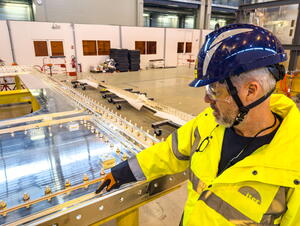
How to replace critical cooling circuits on thermal shield panels that are hard to access or too large to easily transport off site?  As part of the ongoing project to replace the cooling piping on ITER’s vital thermal shield system, two crucial repair initiatives are underway on site.The role of the ITER thermal shield is to block thermal loads from being transferred from warm components to the superconducting coils and other structures operating at cryogenic temperatures. One layer is installed between the vacuum vessel and the superconducting magnets (the vacuum vessel thermal shield); another is installed between the magnets and the cryostat (the cryostat thermal shield). After microscopic cracks were discovered in the piping of three elements of the vacuum vessel thermal shield in 2021, the decision was made to replace all the cooling pipes on the vast thermal shield system. While the repair of the vacuum vessel thermal shield, as well as some other thermal shield elements, is underway at the INOX-CVA facility in Vadodara, India, two crucial sets of pipe replacements on the 530-tonne cryostat thermal shield system are being handled on site at ITER, a choice that was made to overcome specific constraints. The ITER thermal shield measures 25 metres at its tallest point. This diagram shows the parts of the overall system that are currently being repaired on site (numbers 2 and 5). For the 18 main panels that form the equatorial cryostat thermal shield cylinder (see #2 on the diagram), the size of the panels—each one measuring approximately 5 x 7 metres and weighing 4 tonnes—means they would be classified as a “highly exceptional load” and complex logistics would be required to ship them to India. Instead, space was found in the former poloidal field coil winding facility for on-site repair.The repair project, which began in January 2026 and should be completed by the first quarter of 2027, requires the existing pipes to be removed and the areas where the pipes were attached to be buffed to ensure there are no remaining corrosive residues and that the stringent requirements for low surface roughness are achieved to preserve low emissivity. Then, the new pipes will be attached in a pattern that avoids fragilities associated with double welding in the same location.“It was a complex project to do 3D modelling for an entirely new design that re-routes the pipes while providing the same level of cooling and having them arrive at the same interfaces to the main cooling network,” says Patrick Petit, the ITER Project Leader overseeing the repairs.  Kevin Bhadaniya of INOX India organizes the new pipes that will be attached to the lower cryostat thermal shield with thermal straps. For the lower cryostat thermal shield cylinder (see #5 on the diagram), repair has to be carried out directly in the tokamak pit because the component cannot be moved from its installed position. Due to cleanliness constraints, work such as cutting, buffing, and welding must be kept to a minimum; as a result, the old piping system will be left in place and a new system of piping will be attached alongside it. To avoid excessive welding, the new cooling pipes will be bolted in place with copper thermal straps that are optimal for conducting the cold generated by the helium cooling fluids in the pipes to the thermal shield.“The main challenges with the lower cryostat are cleanliness and also access, because the work is being done in a very restricted space,” says Guillaume Vitupier, the contract responsible officer for both the equatorial cryostat thermal shield and lower cryostat thermal shield cylinder repairs. Because parts of the lower cryostat thermal shield cylinder are currently blocked by the temporary position of poloidal field coil #5, the repairs are being done in two batches. The first batch will be completed by the end of 2026 and the second is scheduled for 2028, when poloidal coil #5 is moved to its final position and the rest of the lower cryostat becomes accessible. Both on-site pipe repair projects are being carried out by the Indian company INOX. Stud welding tools are being tested in the ITER tokamak pit to prepare for attaching new cooling pipes to the lower cryostat thermal shield with thermal straps. The old pipes that can be seen on the panel behind the workers will be left in place.

Pair of “safe hands” strikes again

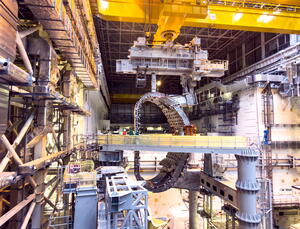
With the acceleration of ITER machine assembly, ITER's bridge cranes are seldom idle. Just over two weeks ago, the main ITER bridge cranes worked together to transfer a 1,300-tonne vacuum vessel sector module into the machine assembly pit. Shortly after that, they were upending a new sector module to vertical (see photos from 6 to 9 February in this gallery).Last week, ITER's "pair of safe hands" was at it again, carefully transporting the 400-tonne sector module across the Assembly Hall to sub-assembly tooling in a sequence that involved lifting, pivoting, re-pivoting, and finally lowering into the V-shaped SSAT2. "Safe hands" is how the European Domestic Agency Fusion for Energy described the bridge cranes when it signed the procurement contract back in 2013. This has proven to be an apt description as, operation after operation, the 750-tonne bridge cranes have carried ITER components safely and reliably to their destinations.
Of interest

Nominations open: 2026 Fusion Technology Award

https://www.iter.org/of-interest?id=33903
The IEEE Nuclear Plasma Science Society (NPSS) Fusion Technology Standing Committee is pleased to announce that the nomination period for the 2026 Fusion Technology Award is now open. The award will be presented during the 32nd Symposium on Fusion Engineering (SOFE 2027) in San Diego, California, in June 2027.The Fusion Technology Award recognizes individuals who have made outstanding contributions to research and development in the field of fusion technology. The awards each consist of a USD 3,000 cash prize, a plaque, and an invited talk at SOFE 2027.Equal consideration will be given to innovation across all fusion approaches and outstanding leadership in the fusion community. Any person, regardless of Society affiliation, is eligible for the award, with the exception that no current member of the IEEE/NPSS Standing Committee on Fusion Technology may be nominated. The nomination package should be sent to the Fusion Technology Committee Awards Chair, Dr. Trey Gebhart (gebhartge@ornl.gov), and it should consist of a letter describing the technical contributions on which the nomination is recommended and a current resume of the candidate. Other supporting endorsements are encouraged.For more detailed information on eligibility criteria, the basis for judging, nomination process and a list of past award recipients, please visit this IEEE webpage and go to the “Fusion Technology Awards” section. The nomination deadline for the 2026 Fusion Technology Award is 13 March 2026. 
Press

Nuclear fusion: The science behind the energy technology, explained

https://www.weforum.org/stories/2026/02/nuclear-fusion-science-explained/

Godzilla, Robô gigante de 4 metros e 5 metros de alcance levanta até 2,5 toneladas para preparar 20.000 componentes

https://clickpetroleoegas.com.br/conheca-o-robo-gigante-godzilla-o-mais-poderoso-do-mundo-flpc96

Godzilla: Giant robot helps assemble parts of world’s largest fusion tokamak

https://interestingengineering.com/ai-robotics/iter-unleashes-godzilla-robot

Simplified targets advance pulsed fusion

https://www.neimagazine.com/news/simplified-targets-advance-pulsed-fusion/

Nuclear fusion: the new energy frontier?

https://www.theinsurer.com/sustainable-insurance/news/nuclear-fusion-the-new-energy-frontier-2026-02-11/

Fusion funding deals hit record as start-ups move from labs to listings (paywall)

https://www.ft.com/content/ff24f3af-3b7a-4469-bd8b-9eb183d7c415

Iter, impossibile dire quando fusione nucleare sarà disponibile

https://www.ansa.it/ansa2030/notizie/energia_energie/2026/02/10/iter-impossibile-dire-quando-fusione-nucleare-sara-disponibile_1bc30f46-02f6-4898-ab73-2e34aee3d41f.html

Joining forces to build the future fusion energy supply chain

https://www.innovationnewsnetwork.com/joining-forces-to-build-the-future-fusion-energy-supply-chain/66229/

New UK manufacturing initiative to support fusion energy

https://www.nottingham.ac.uk/news/new-uk-manufacturing-initiative-to-support-fusion-energy

国際核融合プロジェクトITER向けブランケット用初期組立機器の製作に着手

https://www.qst.go.jp/site/press/20260209.html

Research Brings Results in Search for ‘Holy Grail’ of Clean Energy

https://www.powermag.com/research-brings-results-in-search-for-holy-grail-of-clean-energy/