More than 2,000 supports per sector
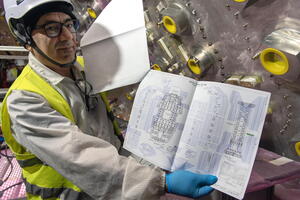
The blueprint says it all. Pointing at precise locations inside the vacuum vessel sector, hundreds and hundreds of arrows—each with a unique reference number—indicate where the anchoring features for diagnostic sensors, called “bosses,” need to be welded.
Down in the tokamak assembly pit, sitting, crouching, or lying flat on the staging platforms inside the vacuum vessel sectors, workers concentrate on their delicate task. One by one, on the inner surface of each sector, they are precisely positioning and welding more than 2,000 bosses for the in-vessel sensors devoted to magnetic field measurement, as well as for sensor cabling. “The magnetic field is the heartbeat of the ITER machine. Monitoring its intensity, geometry and variations is absolutely critical,†explains ITER Magnetic Development Officer Yunxing Ma.Magnetic sensors form “a big family,†with a dozen different types based on five different technologies. Transmitted to the machine’s control systems, the data they collect not only provides precious scientific insight on plasma behaviour, it also enables real-time feedback control of the plasma equilibrium position and the mitigation of plasma disruptions.
One by one, the bosses for magnetic sensors are welded to the vacuum vessel’s inner surface. There are approximately 2,000 such supports per sector.
The first phase of diagnostics-related installation activity began five years ago, soon after the first vacuum vessel sector was delivered to ITER. On their outer skin, or “ex-vessel,†every sector on site at ITER (four of which have already been installed in the tokamak pit and two which are being prepared for installation later this year) are now fully equipped with magnetic sensors and instrumentation cables. On their inner skin (“in-vesselâ€), operations began in January this year. The procedures are the same but the conditions are slightly different: the sectors were resting on the ground in the horizontal position when the ex-vessel components were installed; they are now vertical, inside the tokamak pit, which adds constraints due to restricted workspace and coactivity.
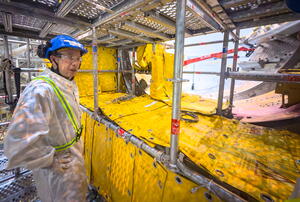
Workers, and particularly welders, operate within the constraints of coactivity in a restricted workspace.
In order to position each support with the required precision, coordinates are extracted from the machine’s 3D CAD model and fed to a laser pointing device. The laser beam outlines the support’s nominal position, which is marked on the sector’s surface—an innovative technique called “laser templating.†The welder’s skills and experience do the rest and, progressively, small bosses find their assigned place in the dense “in-vessel forest,†amid the much larger support pads onto which the massive shield blocks will be attached.
The small bosses for the magnetic sensors progressively find their assigned place in the dense “in-vessel forest,†amid the much larger support pads (yellow) onto which the massive shield blocks will be attached.
Once welded, every anchoring feature is submitted to careful endoscopic examination. Beginning in June this year, base plates will be attached to the bosses, followed by connector boxes and eventually by the sensor modules themselves. Phase one of this major operation will last until mid-2027, when all nine sectors are positioned in the tokamak pit. Installation is foreseen to resume in early 2029 (phase two) after all sectors have been welded together.