Logo
You're currently reading the news digest published from 23 February 2026 to 2 March 2026.
Featured (3)
Of interest (1)
Press (6)
Featured

Preparing the next JT-60SA campaign to support ITER

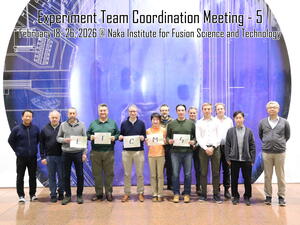
The experiment team at the joint Japan/Europe international fusion experiment JT-60SA in Naka, Japan, is thinking now about how its 2026-2027 campaign can address ITER priorities. JT-60SA, the largest operating tokamak in the world, is progressing at a good pace with an extensive set of upgrades that is preparing the device for a new round of experiments later this year. The enhancements, which began in 2024, include heating and current drive systems, in-vessel control coils, diagnostics, and plasma-facing components. One of the key objectives of JT-60SA is to support ITER—and to formulate this support, a specific agreement between the ITER Organization, the European Domestic Agency Fusion for Energy (F4E), and the National Institutes for Quantum Science and Technology (QST) of Japan was set up in 2020. Time has now come to define the experiments that will be conducted in the experimental campaign (OP2) foreseen to start next winter and extend into 2027. To this end, a call for proposals was launched by the Experiment Leaders to researchers in Japan, the European Union and the ITER Organization in autumn 2025. The call resulted in the submission of more than 150 proposals. Participants to the 5th Experiment Team Coordination Meeting are in the JT-60SA Torus Hall observing progress on upgrades. To review these proposals and discuss the main strategic lines of the 2026-2027 experimental campaign in detail, a coordination meeting of the experiment team took place in Naka from 18 to 26 February with representatives from Japan and the European Union. The ITER Organization was invited to attend the meeting to ensure that the campaign addresses ITER’s priorities, especially in the context of the new ITER baseline. Experiments in OP2 are therefore planned to address issues related to asymmetries in the magnetic configuration to support ongoing ITER assembly, disruptions and associated electromagnetic forces on the vacuum vessel and in-vessel components, negative neutral beam shine-through loads, and edge and pedestal physics in a wide range of H-mode plasma conditions, to cite a few key items. ITER Organization staff who are also members of the experiment team will participate in the execution of the experiments both on site in Japan as well as remotely. In addition, it is expected that ITER Organization staff will participate in operation training activities that are being organized by the JT-60SA team in support of the 2026-2027 OP2 experimental campaign.

China’s ENN joins the ITPEA physics activities

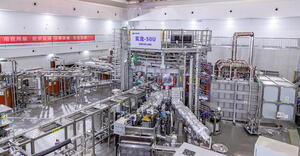
A major private fusion company in China, ENN Science and Development Co. Ltd, is joining the ITPEA physics activities—the second private sector fusion firm to do so. The International Tokamak Physics and Engineering Activity (ITPEA) provides a framework for internationally coordinated fusion research activities among the ITER Members. Replying to the ITER Council’s request in late 2023 to engage with private sector fusion initiatives, the ITER Organization and Members continue their efforts to encourage private sector initiatives to access ITPEA . Under the existing framework, staff from ENN Science and Technology Development (ENN), a major private company in China developing fusion along the spherical tokamak line, will join ITPEA physics activities from April 2026 on the same basis as staff from publicly funded research institutes that are located in the ITER Members.In December 2025, the Coordinating Committee of the ITPEA made the formal decision to invite ENN to join its coordinated physics research activities. ENN completed all of the formal steps in February and will join ITPEA physics activities from April. This will allow its staff to participate, on an equal basis to ITER Members’ staff from public research institutes, in the Topical Group meetings that are planned to take place in spring 2026. ENN is the second privately funded fusion company to join the ITPEA after Commonwealth Fusion Systems (CFS) joined ITPEA physics activities in spring 2025.The ITPEA has provided a framework for internationally coordinated fusion research activities for ITER Members since 2001. Since 2008, it has operated under the auspices of the ITER Organization. ITER Members provide experts from their national fusion research institutions to carry out research in a wide range of physics and engineering areas. The physics research is implemented by seven topical groups under the chairmanship of an ITER Member expert and the co-chairmanship of two experts, one coming from the ITER Organization.Until 2025, the experts and institutions participating in ITPEA activities came exclusively from publicly funded research centres. Staff from privately funded initiatives could be invited to attend individual topical group meetings on an ad-hoc basis, but they were excluded from long-term involvement in ITPEA research activities. To facilitate the participation of staff from privately funded companies, modifications were implemented in 2025 in the ITPEA Charter and the International Energy Agency (IEA) Technology Collaboration Programme on Tokamak Programmes (CTP-TCP), which provides the legal basis for the implementation of ITPEA activities. By the beginning of 2026, the scope of the ITPEA was revised to include engineering activities in addition to physics R&D.  Camera view inside the EXL50-U tokamak during a 1 MA plasma discharge (left). Time traces of main plasma parameters (right). Taking advantage of these new possibilities, ENN recently completed all of the formal steps to join the IEA CTP-TCP agreement and the ITPEA. At its campus in Langfang, Hebei Province, ENN is developing fusion research based on the proton-boron process following the spherical tokamak line. In 2018, ENN initiated the design and construction of its first medium-sized spherical torus experimental device, EXL-50 (Xuanlong-50), which demonstrated first plasma in August 2019. In 2022, ENN embarked on the upgrade of the device to EXL-50U (Xuanlong-50U), which has since achieved significant experimental results, including a plasma current of 1 MA, a central magnetic field of 1.2T sustained for seconds, an electron temperature of 100 million degrees, an ion temperature of 40 million degrees, and operation in H-mode. Also in 2022, ENN commenced the design phase for EHL-2 (HeLong-2), planned to operate with a plasma current up to 3 MA. This device will be completed in 2027.The ITER Organization and the ITER Members look forward to fruitful collaboration between public labs and the privately funded initiatives such as ENN and CFS—in the framework of both the ITPEA and other channels for knowledge transfer—for mutual benefit and to speed up the development of fusion as a practical energy source.

Collective strength

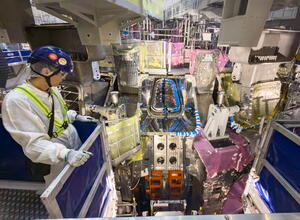
Assembly teams are making the connections that link ITER’s toroidal field coils into a unified structure engineered to withstand extreme electromagnetic forces. Like the steel hoops that bind the wooden staves of a barrel, ITER’s intercoil connection system links the tokamak’s 18 toroidal field coils into a continuous mechanical framework that prevents coil movement and preserves the magnetic field stability required for plasma confinement. The system is now taking shape as assembly teams complete the first intercoil structures in the tokamak pit.“This is a crucial step for assembly, and a complex one,” says Christelle Boyer, the ITER magnet assembly engineer, who oversees part of the intercoil connection project. “Intercoil activities must be carefully sequenced with other activities because the connections are being made in highly constrained spaces with very tight tolerances.”The 18 toroidal field coils of the ITER tokamak generate the magnetic field used to confine the plasma. During operation, the coils will experience electromagnetic loads on the order of several hundred meganewtons—the equivalent of tens of thousands of tonnes of force per coil. To manage these forces, the coils must be connected by an intricate intercoil structure that creates a single mechanical entity capable of resisting shear, compression, and tensile loads.The coils are connected in three distinct zones (see diagram below). On the inboard side, closest to the centre of the machine, two inner intercoil structures (IIS) connect adjacent coils at both the top and the bottom. On the outboard side, outer intercoil structures (OIS) are installed at the top and bottom, while two intermediate outer intercoil structures (IOIS) are positioned at mid-height. To ensure the strength of the overall structure, the toroidal field coils are connected in multiple locations. The assembly teams use inner intercoil structures (IIS), outer intercoil structures (OIS), and intermediate outer intercoil structures (IOIS). Intercoil connections are executed in two phases. The first connections can be made between two toroidal field coils as they are assembled into a sector module with a vacuum vessel sector and thermal shields in Assembly Hall tooling. Then, as the resulting sector modules are lowered one by one into the tokamak pit, toroidal field coils from adjacent sector modules can be connected. This in-pit phase began at the end of July 2025, as the right-hand toroidal field coil of sector module #7 was connected to the left-hand toroidal field coil of sector module #6.“The biggest challenge is ensuring the sector modules are aligned properly so the connections can be made,” says Kenji Gomikawa, the ITER assembly engineer overseeing the structural connections in the pit. “These modules are extremely heavy components with connection points that must be matched within a few millimetres of precision.”The connections are executed using different methods depending on the structure. For the intermediate outer intercoil structure, precision-drilled plates are positioned on either side of the mating surfaces and fastened with high-capacity studs and a pin weighing 300 kg. For the outer intercoil structure, a shim is inserted between the mating surfaces for insulation purposes and then the coils are secured with superbolts, shear bolts, and clamping bolts. These are massive items, with a single superbolt weighing as much as 26 kg. Christelle Boyer checks in on intercoil structure work on sector module #4, which is currently in a sector sub-assembly tool in the Assembly Hall. There is, quite literally, no wiggle room. To protect against the immense shear forces generated during operation, the bolts must fit perfectly into the bore holes. In certain cases, specialized “sleeves” are used to compensate for microscopic misalignments. Because these sleeves are produced to fit within a clearance of less than 0.1 mm, they are immersed in liquid nitrogen to contract slightly prior to installation. Once inserted, they expand to achieve a precise fit, ensuring a movement-free connection.Work is currently underway in the tokamak pit to connect the toroidal field coils between sector modules #6 and #5 and between sector modules #7 and #8. The connections must be completed before sector module #4 is lowered into the pit in the spring of 2026, as its weight will shift the other modules during the landing process and cause the metrology, alignments, and sleeves prepared for the intercoil connections to no longer correspond to the actual position of the toroidal field coils.Once all sector modules are installed in the tokamak pit and the 18 toroidal field coils are fully connected, the final elements of the magnetic structure—the pre-compression rings—will be installed at the top and bottom of the intercoil assembly to provide additional stability.

Of interest

15th ITER International School: pre-registration open

https://www.iter.org/of-interest?id=34052
The program for this summer's 15th ITER International School is now available and pre-registration is open on the event website.Since its launch in 2007, every ITER International School has focused on a specific theme. The 15th School, to be held in Chengdu, China, from 20–24 July 2026, will explore the engineering of heating and current drive systems as well as the physics processes undergirding their use for plasma heating, current drive, and the control of plasma scenarios in ITER and other magnetic fusion devices.The organizers of the event—the Engineering & Technical College of Chengdu University of Technology and the Southwestern Institute of Physics (SWIP)—have now opened the webpage for pre-registration. The program for the five-day event is also consultable on the website. Visit the 15th ITER International School website for all information or to pre-register.Download the 2026 School poster here.
Press

FuseNet PhD Event 2026 announced

https://www.unitus.it/en/magazine/eventi-en/fusenet-phd-event-2026/

IPP, Bayerische Staatsregierung, Proxima Fusion und RWE unterzeichnen Memorandum of Understanding

https://www.ipp.mpg.de/mou26

IPP, Bavarian State Government, Proxima Fusion and RWE sign memorandum of understanding

https://www.ipp.mpg.de/mou26en?c=5594164

핵융합 조기실증 목표로 '한국형 혁신 핵융합로' 설계 전담조직 신설

https://n.news.naver.com/article/584/0000036533

European fusion modelling community met in Garching

https://euro-fusion.org/events/european-fusion-modelling-community-met-in-garching/

Metromecánica wins Fusion Technology Transfer Award

https://fusionforenergy.europa.eu/news/metromecanica-wins-fusion-technology-transfer-award/