Logo
You're currently reading the news digest published from 9 March 2026 to 16 March 2026.
Featured (3)
Of interest (4)
Press (11)
Featured

Purpose-designed insertion tool passes the test

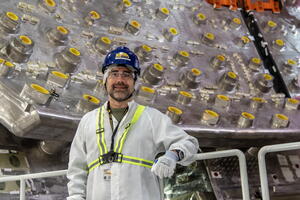
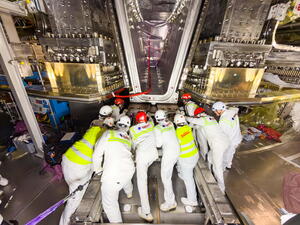
With a pioneering manoeuvre resembling a mine cart being squeezed into the narrowest of tunnels, assembly teams have successfully positioned a vacuum vessel gravity support under a sector module in the tokamak pit. This complex process—carried out to within tolerances of just 0.75 mm—was part of the ongoing work to install supports for the plasma chamber so it can handle the massive loads and forces it will undergo during plasma operations. The nine vacuum vessel sectors that make up ITER’s steel plasma chamber will each be supported by a specialized component known as a vacuum vessel gravity support. These supports will carry the vertical load of the sectors (8,500 tonnes in total, including components installed inside the vessel) and, thanks to an intricate hinge system, accommodate radial movement caused by thermal expansion during plasma experiments.The vacuum vessel gravity supports are being placed in the tokamak pit in two different ways. If the dedicated support is ready before the sector module is inserted into the pit, then the process is straightforward: it is lowered into the pit and secured in place before the sector module is landed on top. This was the case with sector modules #5 and #8.However, as part of the accelerated assembly schedule, the first two sector modules—#6 and #7—were installed in the pit ahead of their gravity supports. This meant that ITER’s engineering and design teams were required to develop a novel process for sliding the supports into place under the sectors. Before being positioned beneath the vacuum vessel, the gravity support had to be carefully lowered into the tokamak pit while navigating the tight space between the outside of sector module #6 (right) and the cryostat wall (left). “The teams showed creativity and flexibility in finding the solution to this assembly challenge that was possible to execute in the constrained environment of the tokamak pit,” says Sebastien Koczorowski, the deputy head of the ITER Machine Assembly Program. “This successful operation represents a big accomplishment that maintains the pace of assembly.”The first challenge facing the teams was to design a tool that could both fit into the tight space of the tokamak pit and successfully slide the 11-tonne vacuum vessel gravity support under sectors #6 and #7. The result was an insertion and alignment tool that transfers the vacuum vessel gravity support into position along a short section of rails. Designers from ITER and contractor Simic S.p.A. (Italy) began developing the tool in 2025 and the plans were finalized in January 2026. Then, Simic worked three shifts a day, seven days a week to produce the tool and have it shipped to ITER by early March. On the left, a diagram of the insertion and alignment tool designed by ITER and Simic to position the vacuum vessel gravity support under a sector module. To the right, the position of the vacuum vessel gravity support under a sector module is indicated by a red arrow. “It was a full team effort to manufacture the tool on schedule,” says Philippe Piluso, the construction manager at Simic who also oversaw the first installation operation at ITER. “It was an intense period, but extraordinary circumstances require extraordinary efforts.”The installation of the vacuum vessel gravity support under sector module #6 required both technological precision and brute strength. On the technological side, the hinge of the support was adjusted so it took up as little vertical space as possible to fit under the component and then advanced metrology was used to identify its final position with a margin of only 0.75 mm.“Incredible precision is required because if the gravity support isn’t in exactly the right place, the weight of the vacuum vessel won’t be evenly distributed and this could cause imbalances that could affect machine operations,” explains Simon Neumueller, the ITER engineer helping to manage the vacuum vessel gravity support project. ITER’s Simon Neumueller and Simic’s Philippe Piluso examine the vacuum vessel gravity support after it was attached to the insertion and alignment tool. On the “brute strength” side, once the vacuum vessel gravity support was on the insertion tool, a team of 10 Simic workers pushed the 11-tonne component into place using good old-fashioned muscle power.The vacuum vessel gravity support reached its final position on Friday 13 March, arriving in place with a tolerance of merely 0.25 mm compared to its target position. Now, stainless steel shims will be placed on top of the support and it will be attached to the lower port stub extension of sector module #6. Once this is done, the process will begin to detach the sector module from the radial beam that is currently supporting its weight and transfer the load to the vacuum vessel gravity support.With one support now under sector module #6, the specialized tool will be moved to sector module #7 to repeat the same operation. The Simic team puts their backs into it to slide the 11-tonne component into place along the rails of the insertion tool.

Coordinating the invisible work that will make ITER function

As work progresses on core machine assembly in the tokamak pit, a parallel effort led by the Plant Installation Coordination Project is ensuring that the surrounding plant systems are installed without clashes or delays. Inside the central theatre where machine assembly is underway, major ITER components are arriving by overhead crane with increasing frequency. But outside the boundary of those concrete walls an equally critical effort is unfolding—without which the reactor could never operate. That responsibility falls to the Plant Installation Coordination Project, led by Claudio La Barbera, who since this month has also taken on coordination of machine assembly, giving him oversight of the full construction site.La Barbera describes the distinction with a simple image. If the reactor is a city such as Aix-en-Provence (just 40 km from ITER), then the plant is the region of Provence. The â€œplant” includes all the auxiliary systems, buildings and infrastructure surrounding the machine—cooling systems, power distribution, ventilation and a dense web of interconnected services. â€œIf the plant systems are not installed,” he explains, â€œthe reactor will not work.”The scale of this work is vast, and its complexity increases as construction advances. Dozens of systems must be installed in confined spaces, often crossing or overlapping one another. What appears as a single line on a high-level project schedule typically hides a series of interdependent subtasks. If the sequence is wrong, one activity can block another—or, in the worst case, force teams to dismantle and reinstall equipment. Anticipating and preventing those conflicts is at the heart of plant installation coordination. Deep in the Tokamak Building, coordination teams are overseeing work in the drain tank room. La Barbera and his integrated team of 25 oversee work carried out by approximately 500 workers. As project leader, La Barbera manages an integrated team of around 25 people, combining ITER Organization staff and contractor personnel. His role is both strategic and hands-on. He distributes responsibilities, ensures the right skills are in place, prioritizes tasks and intervenes when conflicts cannot be resolved at lower levels, often reminding people that schedule pressure can never override safety.At peak activity, more than 500 workers are active across the areas that La Barbera’s team oversees. Each zone is mapped and assigned to a dedicated coordination lead, creating a clear reference point for contractors working in that space. Daily and weekly coordination meetings allow teams to track progress, resolve issues and ensure contractors have the services they need—from scaffolding and power to access routes and logistics support.Teams use a structured planning process to break down long-term installation goals into smaller tasks. Using the master schedule as a starting point, workplace planners analyze sequences in the 3D model and develop detailed work-phase plans. These plans look three weeks ahead for short-term coordination and up to six months ahead for medium-term anticipation. The outputs then guide daily area preparation, task allocation and contractor coordination. Welding activities underway on bundled cooling water piping in the Tokamak Building. Coordinating plant system installation means anticipating possible clashes in installation sequences that could result in having to undo work. Digital tools play a central role. Primavera provides schedule visibility, while 3D models are accessed through platforms such as Catia and Navisworks. For more advanced analysis, the team uses 4D simulation tools that combine the 3D model with time. These assessments allow planners to visualize how the site evolves, simulate equipment handling paths and detect spatial clashes before work begins. For La Barbera, a typical day starts early. He arrives on site well before his first meeting at 7:30 a.m., using the quiet hours to handle documentation and planning. His calendar may include 60 to 70 meetings in a week, ranging from daily coordination briefings to contractor reviews and site visits. Drawing on more than 20 years of experience in nuclear power plant construction, he emphasizes the importance of daily interaction with his team: â€œI prefer constant contact in order to listen, understand progress and address problems as early as possible.”Perhaps the greatest challenge today is managing co-activity: multiple contractors installing different systems in the same area. When milestones are achieved, often after months of preparation, La Barbera takes particular pride in recognizing individual contributions. â€œA project leader without his team will never achieve results like this,” he says.Unforeseen situations are also part of daily life on a construction project of this scale, requiring rapid decisions to keep work moving safely. “Recently, for example, the temporary cargo lift suddenly became unavailable just as we needed to handle the final piping bundle for the tokamak cooling water system at Level L3 of the Tokamak Complex. Almost in real time we checked whether a mobile crane was available on site, prepared a new lifting plan with the contractor, got it approved by the lifting team, and executed the lift through one of the temporary openings of the Tritium Building.”Moments like this illustrate the essence of installation coordination at ITER: anticipating problems where possible, but also being ready to mobilize the right expertise quickly when the unexpected occurs.

A welcome seminar for newcomers

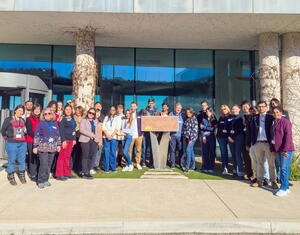
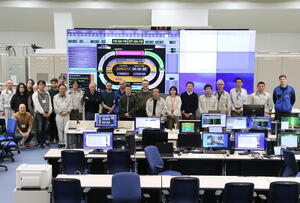
A welcome day designed to help new team members and their spouses discover ITER and navigate life in France. For many employees, arriving at ITER means more than starting a new job—it marks the beginning of life in a new country and a new community. To help ease that transition, the Welcome Office of the Agence Iter France hosted an event last week at ITER headquarters for new employees and their families.In total, 31 people participated in the program that combined practical guidance on administrative formalities—such as schools, healthcare, and driving licences—with a personal greeting from Director-General Pietro Barabaschi and a convivial lunch. The spouses of the new employees were also given a tour of the Assembly Hall to get a glimpse of work underway.The Welcome Office is funded by France to support the ITER project by providing assistance to staff and their families for everything from visas to language lessons to accommodation. It organizes a newcomer welcome seminar at ITER twice a year. The newcomer welcome seminar includes a tour of the ITER Assembly Hall for the spouses of the new employees.
Of interest

Data-driven plasma science

https://www.iter.org/of-interest?id=34180
The 7th International Conference on Data-Driven Plasma Science (ICDDPS 7) will take place in Kiel, Germany, from 3–7 August 2026.ICDDPS is an international conference that intends to be the premier forum for researchers from academia and industry to discuss current and future directions in Al and machine learning applied to plasma science and technology, including but not limited to topics such as plasma processing and nuclear fusion.The conference will bring together researchers working on AI, machine learning, and data-driven approaches applied to plasma science, fusion, and plasma technologies, with a focus on the latest advances in extracting knowledge from large experimental and simulation datasets.More information is available on the conference website. Registration is open now.

A letter to China—and a reply from the President

https://www.iter.org/of-interest?id=34171
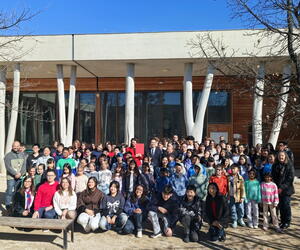
In December, timed to coincide with a state visit of French President Emmanuel Macron to China, students in the Chinese language section at the Provence-Alpes-Côte d'Azur International School (EIPACA), near ITER, decided to put their growing language skills to use. With the help of their teachers, they wrote a letter to Chinese President Xi Jinping, sharing their enthusiasm for the language and describing how, in a unique international school in southern France, they are learning more each day about Chinese history and culture.They had no way of knowing whether the letter would ever receive a reply—or even reach the president's desk.So the surprise was considerable when a formal response arrived in March. In his letter, President Xi extended his best wishes to the students, the teachers and the entire school. He encouraged them to become “pillars of friendly cooperation” between China and France, and between China and Europe. He added that they would be welcome in China for study, exchanges or visits, and expressed the hope that the Chinese language would become their “lifelong friend.”The Provence-Alpes-Côte d'Azur International School was established in 2007 to serve the needs of the ITER project, but it also benefits the local community. From the outset, its mission has been to provide bilingual education—in French plus one of the ITER languages. Currently, six language sections are offered: Chinese, English, German, Italian, Japanese and Spanish. From junior high school onward, English-speaking students may also join the European Section, where about 80 percent of courses are taught in English.--EIPACA students and teachers from the Chinese language section.

Reminder: sign up for the April Public-Private Workshop

https://www.iter.org/of-interest?id=34152
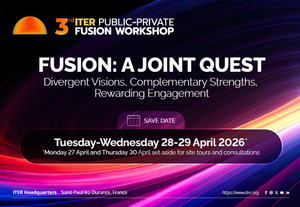
On 28 and 29 April 2026, the ITER Organization will host its third annual Public-Private Fusion Workshop—an event dedicated to the dynamic fusion ecosystem across the ITER Members and the importance of public-private collaboration. Over two days at ITER, experts will present innovations in robotics, AI, fusion diagnostics, and heating technologies. Panel discussions will also address key challenges, including tritium breeding, scaling up high-temperature superconducting magnets, and progress in liquid metal wall technology.This year’s agenda will also feature discussions on lessons learned—positive and negative—in ITER’s Engineering Basis Handbook, as well as more recent project management insights on construction and assembly. By popular request, the global fusion supply chain will again feature prominently, with fusion supplier companies showcasing their latest technologies at an exhibition on Tuesday night.Registration for the workshop, as well as for tours and consultations, is open at this address. Scroll down to see the current program (still very much in flux and subject to change as speakers refine their proposals and private sector fusion firms refine their topics of interest).

Commissioning underway at JT-60SA

https://www.iter.org/of-interest?id=34123
Following a shutdown period dedicated to the installation of an extensive set of upgrades, the joint Japan/Europe international fusion experiment JT-60SA in Naka, Japan, is now taking the progressive commissioning steps that will lead to the re-start of the device this year.  Enhancements to JT-60SA's heating and current drive systems, in-vessel control coils, diagnostics, and plasma-facing components have positioned the device for a new experimental campaign, OP2, that is foreseen to start at the end of this year and extend into 2027. ITER representatives were recently on site in Naka to participate in the 5th Experiment Team Coordination Meeting to discuss how the new campaign can address ITER priorities. ITER Organization staff are planning to participate in experiments both on site in Japan as well as remotely. Read more about the JT-60SA device, which is currently the largest operational tokamak in the world.See this related story on the European Domestic Agency (Fusion for Energy) website.
Press

Race for fusion intensifies as UK opens flagship project to investors

https://www.ft.com/content/b21a5e34-b5d3-4462-a30a-7704b7b520bd

Swedish Nuclear Companies Team Up To Support Nordic Fusion Reactor Development (paywall)

https://www.nucnet.org/news/swedish-nuclear-companies-team-up-to-support-nordic-fusion-reactor-development-3-1-2026

Xi Jinping Replies to Letter from Teachers and Students of an International School in France

https://www.fmprc.gov.cn/eng/xw/zyxw/202603/t20260313_11874165.html

习近平复信法国国际学校中文班师生

https://www.news.cn/politics/leaders/20260312/316a53e4b96646d09658e1ff0cc163f8/c.html

Europe and Japan restart JT-60SA

https://fusionforenergy.europa.eu/news/europe-and-japan-restart-jt-60sa/

プラズマ加熱実験に向けたJT-60SA統合試験運転の開始

https://www.qst.go.jp/site/press/20260313.html

Commencement of Integrated Commissioning of JT‑60SA For Plasma Heating Experiments

https://www.qst.go.jp/site/news/20260313.html

Kernfusion: Wolfgang Biel zum Stand der Fusionsforschung

https://www.spektrum.de/news/kernfusion-wolfgang-biel-zum-stand-der-fusionsforschung/2314139

La fusión nuclear, la energía llamada a revolucionar la producción energética mundial

https://www.lavanguardia.com/internacional/vanguardia-dossier/revista/20260312/11388731/fusion-nuclear-energia-llamada-revolucionar-produccion-energetica-mundial.html

IAEA details fusion waste strategies

https://www.neimagazine.com/news/iaea-details-fusion-waste-strategies/

Godzilla, el robot de 36 toneladas que reemplazará al que ya es el robot industrial más grande del mundo en el reactor de fusión

https://computerhoy.20minutos.es/tecnologia/godzilla-robot-36-toneladas-que-reemplazara-que-ya-es-robot-industrial-mas-grande-mundo-reactor-fusion_6943672_0.html