Logo
You're currently reading the news digest published from 23 March 2026 to 30 March 2026.
Featured (4)
Of interest (3)
Press (4)
Featured

Practice makes precision

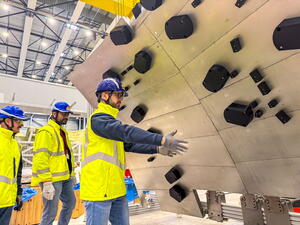
With the installation of the first interface panel, the Trial, Test and Training Facility is moving closer to hosting full-scale practice sessions for in-vessel assembly. Just like every major football team has both a home stadium and a practice field, ITER will have a one-to-one-scale replica of the inside of three vacuum vessel sectors where teams can train for vital tasks such as installing in-board diagnostic cables (“looms”), welding sector modules, and attaching blanket shield blocks.“Having this facility onsite means we can train for complex, first-of-a-kind installation activities in an environment that matches the specific space constraints of the tokamak,” explains Claudio Fichera, the ITER mechanical engineer in charge of overseeing the Trial, Test and Training Facility. “Practicing will improve efficiency and help assess how much time each installation activity requires so we can have a more accurate assembly schedule.”A first version of the test facility was built in partnership with the industrial solutions company CNIM, and the testing and training took place at its site near Toulon in the south of France. In 2024, the decision was made to bring the facility to ITER to facilitate access for installation teams and improve oversight of training activities. The “bare-bones” steel structure was disassembled, shipped to ITER, and then, with support from the contractor Cegelec, reassembled inside the former Cryostat Building, only about two hundred metres away from the actual tokamak. The Trial, Test and Training Facility features three replica vacuum vessel sectors for different types of training. At the back, there is a replica port cell and port extension. The move of the structure to ITER was also an opportunity to adapt the facility so that a more diverse range of training activities could be conducted. In the current configuration, the 500-metre-square facility will feature three replica vacuum vessel sectors that have been customized to meet different training needs:- One sector will be configured for the in-vessel diagnostic, fuelling, and instrumentation team to allow it to test the installation of components such as in-vessel looms, thermocouples, and diagnostic sensors.- One sector will be reserved for the in-vessel coils and blanket team to practice installing components such as blanket modules, shield blocks, and in-vessel coils. This set-up will include a tower crane and cherry picker for handling components as well as tracks at the bottom of the sector for the movements of these tools.- One sector will be dedicated to the delivery, repairing, and welding team to practice welding activities. This sector will be equipped with D-shaped rails so that the automated LINAC (linear accelerator) tool can move across the full inner surface to perform radiographic testing on the welds.  The test facility is located in the former Cryostat Building, only about two football fields away from the ITER tokamak. The Trial, Test and Training Facility also has a replica port cell and port extension to allow training on the “through port” transfer system and its monorail that will bring components into the vacuum vessel.On 27 March, the first purpose-built panel was installed on the structure devoted to in-vessel diagnostics to replicate the environment the operators will face in the upper outboard region of the vacuum vessel. Equatorial outboard panels and inboard panels will follow, and teams will start practicing with the installation in-vessel looms in June. These cables will carry diagnostic information from inside the tokamak and they need to be crimped and installed in meticulous patterns on the interior surface of the sectors.“We need all personnel who are installing in-vessel components to be fully trained and qualified because these are unique processes,” says magnet engineer Davide Macioce, who is supervising in-vessel diagnostic, fuelling, and instrumentation training. “We don’t want people installing a loom cable in the tokamak if it is the first time in their lives that they are picking one up.”The Trial, Test and Training Facility is scheduled to host training until the early 2030s and may welcome other types of practice installations as well. “This facility is a valuable asset for ITER,” says Claudio Fichera. “It is adaptable, so we expect there will be requests from other teams to practice their assembly techniques.” The Trial, Test and Training Facility interface panel being installed (left) is designed to perfectly replicate the configuration needed for diagnostics installations in the inside of the vacuum vessel sector (right).

“Even better in real life”

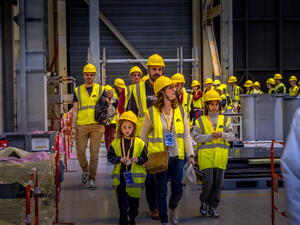
One of the ways ITER shares knowledge about science and fusion is to welcome the general public to the site twice a year to take tours with experts and see the tokamak. Driven by his love for physics and engineering, 17-year-old Jake Makarov decided to use his programming skills to make a series of interactive web simulations and games so people could learn more about fusion energy and the ITER tokamak. But even though he had spent dozens of hours creating virtual fusion adventures, it didn’t prepare him for seeing ITER.“The scale of the place is just insane,” says Jake, who is in his final year of high school at Lycée Saint-Cricq in Pau, France, and hopes to attend the INSA Toulouse engineering school for university. “I had seen the pictures of ITER on TV when I was designing my computer simulations, but this was very different. It’s even better in real life.”Jake was one of nearly 700 visitors who toured ITER on Saturday 28 March for the latest edition of Open Doors Day, the free event that has been organized since 2011. Guests were able to explore the visitor centre and participate in experiments and presentations given by members of ITER staff. There were also activities organized by fusion and science enthusiasts from outside ITER, including the RadioVolts amateur fusion community and the local chapter of the Les Petits Débrouillards tech education association. Jake Makarov applied his programming skills to create educational games about virtual tokamaks; here, he sees one in real life for the first time. But the big event was the tour of the ITER Assembly Hall and the opportunity to see the tokamak itself from a special visitor viewpoint. With four of the nine sector modules now installed in the tokamak pit, the view was especially spectacular for visitors to this edition of Open Doors Day.“This event helps fulfil our mission to share news of our progress and it builds people’s trust and enthusiasm for fusion,” says Julie Marcillat, ITER’s Local Outreach Coordinator who has been organizing Open Doors Day since 2013. “It’s also a good opportunity for the ITER staff members who volunteer as guides to share their passion for fusion. It’s really rewarding to see people with stars in their eyes after their visit.”This same spirit of sharing knowledge is what inspired Jake Makarov to create his web simulations. You can try Fusion Forge, Fusion Reactor Simulator, or Tokamak Core Assembly for yourself.See some scenes from the day in the gallery below.Watch a short video of the day here.

ITER representatives visit China

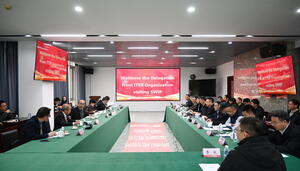
A delegation from ITER has just returned from a visit to China’s Southwestern Institute of Physics (SWIP) in Chengdu. Home in its history to more than 20 experimental devices for controlled nuclear fusion research, including the advanced-divertor tokamak HL-3 that has become a satellite device for ITER, SWIP is also an important contributor for Chinese participation in ITER construction, providing key technologies and components. For five days in March, ITER Deputy Director-General Yutaka Kamada and ITER Strategy and Coordination Officer Su Mingxing visited China, making stops at the Southwestern Institute of Physics (SWIP), the China Fusion Energy Co., Ltd. (CFEC), and the ITER divertor assembly integration workshop located at the Qinshan Branch of the CNI23 Company, near Shanghai. At SWIP, they were joined by Luo Delong, ITER Deputy Director-General for Corporate. Wang Min, the Deputy Director-General of ITER China, also accompanied the delegation. ITER Deputy Director-General for Science & Technology Yutaka Kamada gave a keynote report on ITER progress at SWIP, in which he presented a series of recent major construction and assembly milestones. In welcoming the group from ITER, SWIP and CFEC Chairman Liu Ye highlighted recent scientific and technological innovation achievements in the field of fusion and the important cooperation underway with the ITER Organization. China's HL-3, as an advanced tokamak device, has become an important experimental platform for international fusion research. In 2023, the ITER Organization and SWIP signed an agreement for academic, scientific and technical cooperation including on the HL-3 device to provide support for physics research and future ITER operation. Cooperation intensified during the 2025 campaign on HL-3, where several ITER priorities were addressed. Last week, the parties discussed key scientific and engineering issues for the next-stage ITER experiments, as well as the issues of global fusion talent training and future trends in fusion development. The delegation also visited the headquarters of the China Fusion Energy Co., Ltd. (CFEC) in Shanghai and SWIP’s nuclear fusion technology R&D base to learn in detail about forward-looking plans to tackle key fusion challenges.

Power system validated for magnet testing

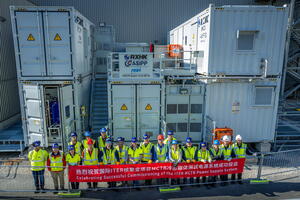
Another step forward for the ITER magnet cold test facility. At ITER’s magnet cold test facility, the spotlight often falls on the extreme cooling required to bring superconducting magnets down to 4 K (minus 269 °C). But behind the scenes, a powerful and precisely controlled electrical system delivering currents of up to 68 kA is essential for recreating the high-energy conditions these magnets will face during plasma operations.With the successful site acceptance testing of the facility’s power supply system at the end of March 2026, that capability has now been validated. The cooldown of toroidal field coil #7 will start late April, with magnet testing scheduled to start in May.
Of interest

15th ITER International School: pre-registration closes 6 May

https://www.iter.org/of-interest?id=34260
Pre-registration is open for the 15th ITER International School, which will be held in Chengdu, China, from 20–24 July 2026.The deadline for pre-registration is 6 May 2026. Selected students will be informed on 11 of May so that they can complete the registration process. This year's ITER International School will explore the "Physics and engineering of heating and current drive systems for magnetic fusion plasmas." The organizers of the event—the Engineering & Technical College of Chengdu University of Technology and the Southwestern Institute of Physics (SWIP)—have opened the webpage for pre-registration. The program for the five-day event is also consultable on the website. Visit the 15th ITER International School website for all information or to pre-register by 6 May.Download the 2026 School poster here.

New report in Europe on fusion investment impact

https://www.iter.org/of-interest?id=34254
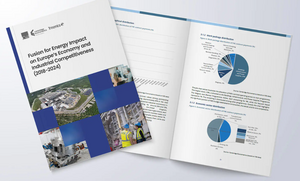
According to an independent study conducted for the European Domestic Agency for ITER (Fusion for Energy) by CSIL, Trinomics and Cambridge Econometrics, the European Union’s investment in fusion between 2018 and 2024 has created a strong positive impact on Europe’s economy and industrial competitiveness.Since its creation in 2007, Fusion for Energy has invested over EUR 7 billion to provide Europe’s contribution to ITER and other international projects through more than 1,400 contracts. This has helped shaped the largest fusion supply chain in the world, with at least 2,700 companies and 75 R&D organizations involved. Besides the infrastructure and technologies delivered, the analysis shows the far-reaching benefits in terms of knowledge, growth and jobs. For instance, 66% of firms reported that their staff had acquired new skills and 77% acknowledged enhanced know-how, driven by ITER’s complex requirements. Around half of surveyed firms noted improvements to their products or processes, with some reporting patents or spin-offs towards sectors like fission, medicine or aerospace. See this article on the Fusion for Energy website for more analysis or download the report directly here.

2027 grant opportunity for fusion researchers

https://www.iter.org/of-interest?id=34245
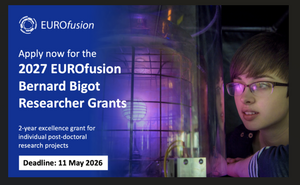
Applications are open now for the 2027 EUROfusion Bernard Bigot Researcher Grants. These grants fund individual post-doctoral research projects for two years (beginning 2027) by contributing to the salaries, research and training activities of up to nine outstanding early career researchers. Researchers and engineers of all nationalities who have completed their PhD and defended their thesis in the two years preceding the application deadline are eligible. The candidate must be employed by a EUROfusion Consortium member or one of their Affiliated Entities during the grant period. Interested candidates should jointly prepare their application with an institute or institutes affiliated with EUROfusion, who will submit the application and offer to employ the candidate for the proposed duration of the project.For details and to see all application documents, visit this EUROfusion website. The application deadline is 11 May 2026.
Press

After record-breaking results in fusion research, this highly successful project is winding down to make way for new experiments

https://www.pppl.gov/news/2026/after-record-breaking-results-fusion-research-highly-successful-project-winding-down-make

Europe’s economy benefits from F4E activities according to new study

https://fusionforenergy.europa.eu/news/annual-assessment-study-f4e-economic-impact/

世界初、核融合炉のプラズマ予測・制御のための高頻度リアルタイム通信の実現

https://www.qst.go.jp/site/press/20260325.html

World’s First Realization of Fast Frequent, Real‑Time Communications for Fusion Plasma Prediction and Control

https://www.qst.go.jp/site/news/plasma-prediction.html