Logo
You're currently reading the news digest published from 30 March 2026 to 7 April 2026.
Featured (3)
Of interest (1)
Press (14)
Featured

Getting ready to flex

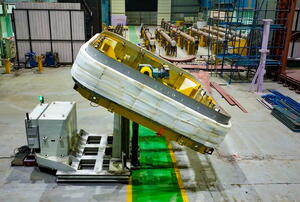
Preparations for the installation of bellows in the Tokamak Building are now underway with the completion of the first welds in the port cells and a customized installation tool sailing towards ITER. The ITER tokamak is a machine of utmost precision with components positioned within a fraction of a millimetre and meticulous technical specifications to ensure everything fits perfectly together in compact spaces. But it is also a machine that is designed to move around.Whether it is thermal expansion during plasma operation, the natural settling of the Tokamak Building, or minor seismic activity, the vacuum vessel chamber will undergo a subtle dance with expected vertical and horizontal movements of up to 2.5 centimetres. This motion, relative to other systems and to the surrounding concrete wall, will be accommodated by the ITER bellows system.“Bellows will allow the machine to breathe,” explains Sébastien Koczorowski, ITER’s Deputy Program Manager overseeing the ports and bellows installation project. “We will be dealing with movements from a few millimetres to a few centimetres and the bellows help provide the flexibility for the structure to adapt to these loads.” Left: Circular bellows (red arrow) will be located where diagnostic neutral beam lines and the heating neutral beam lines enter the tokamak. Right: rectangular bellows will accommodate movements between the plasma chamber and the cryostat (port duct bellows) and the cryostat and the Tokamak Building (port cell bellows). There will be two shapes of bellows used in the ITER tokamak: rectangular and circular. Rectangular port cell bellows will connect the cryostat’s lower and upper cylinders to the Tokamak Building, compensating for structural movements and adapting to seismic activity, while rectangular port duct bellows will form an interface between the vacuum vessel chamber and the inner surface of the cryostat wall, accommodating thermal expansion and mechanical loads generated during operation. Each rectangular unit measures approximately 4 x 4 x 1 metres and can weigh up to four tonnes.The circular bellows will be placed at the entry points for diagnostic neutral beam lines and heating neutral beam lines. As with the rectangular bellows, the circular bellows will accommodate movements both between the cryostat and the building and between the cryostat and the vacuum vessel chamber.In total, the ITER tokamak will be equipped with 8 circular bellows and 85 rectangular bellows, all of which are being manufactured in China. There are currently close to 20 bellows already received and in storage at ITER. ITER engineer Elena Rodilla, Larsen & Toubro’s Rajkumar Suwalka, ITER Machine Assembly Program Manager Jens Reich, and Deputy Head of Machine Assembly Sébastien Koczorowski oversee the first welds to prepare for bellows installation. The installation of the bellows has been entrusted to the Indian firm Larsen & Toubro through a contract signed in 2024. As Larsen & Toubro also delivered the ITER cryostat, they have a valuable familiarity with the interfaces that will facilitate the process.In recent weeks, two key benchmarks have been reached. First, the custom installation tool designed to position bellows ahead of welding operations has passed its factory acceptance test and has performed well in mockup tests that have been run in Hazira, India. The remote-controlled tool—known as the bellows transportation, upending and alignment trolley—was developed by Larsen & Toubro with support from Tata Consultancy Services and input from ITER designer Karsten Friedel so it can navigate the constrained environments of the Tokamak Building’s galleries and port cells. Interchangeable interfaces will allow it to adapt to the components with different shapes and fixation frames. The installation tool is expected to arrive at the Port of Marseille Fos in early May. â€œThe mockup tests have gone well, and we are pleased with the progress of the project,” says ITER Tokamak Assembly Engineer Nirbhay Naik, the deputy technical responsible officer for the project. “The completion of this tool means installation can stay on schedule or even move more quickly than anticipated, so it’s another step along the path for the ports and bellows project.” The huge rectangular bellows measure 4 x 4 x 1 metres and can weigh up to four tonnes. ITER engineer Nirbhay Naik checks some of the bellows stored on site at ITER. The large boxes contain two bellows while the smaller box contains one. Meanwhile, on Tuesday 31 March, the first embedded plate corner joints were welded on the B1 level of the tokamak pit, clearing the way to start installation of the bellows in the first port cell. These corner joints will permit full installation work to begin in late May or early June. The initial installation phase will involve the lower bellows at the B1 level of the Tokamak Building, a process that should take about one year. The other bellows will be installed after all the sector modules are in the tokamak pit and vacuum vessel welding has started. The target date for beginning this second phase of bellows installation is 2028.All the bellows at equatorial (L1) and upper level (L2) will be installed with a slight vertical offset and horizontal pretension, allowing them to align horizontally with the port cells and reach normal state as the vacuum vessel expands during operation.

EU delegation: ITER drives jobs and investment

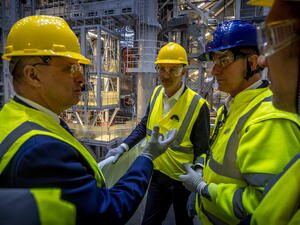
European Union lawmakers heard about ITER's positive impacts on the fusion economy and workforce. A visit by a delegation of European lawmakers on 1 April highlighted ITER’s role in Europe’s long-term energy strategy and its growing impact on the European economy. ITER Director-General Pietro Barabaschi told the politicians that the project is training the future fusion workforce while sharing expertise to support the private fusion ecosystem. Meanwhile, Leonardo Biagioni of Fusion for Energy, the European Domestic Agency, noted that the project’s funding has resulted in EUR 7.2 billion invested in the European supply chain between 2007 and 2025, with a projected 4,500 full-time jobs per year between 2025 and 2039. Following the visit, Swedish MEP Jörgen Warborn said the delegation had received a clear message: the project is “on track” in terms of both schedule and budget—an important signal for Europe’s future competitiveness and energy ambitions.

France and Japan align on fusion energy goals

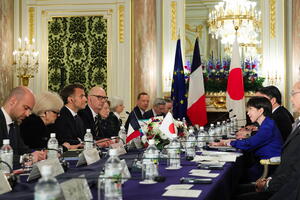
Paris and Tokyo strengthen ties with a renewed commitment to nuclear energy development, including fusion. At the invitation of the Japanese government, French President Emmanuel Macron visited Japan from 31 March to 2 April 2026. He met with Prime Minister Takaichi Sanae in Tokyo on 1 April, where they reaffirmed shared values and welcomed progress on the Franco-Japanese Cooperation Roadmap (2023–2027).Both leaders committed to strengthening cooperation in key areas, particularly nuclear energy. They endorsed a joint declaration highlighting the importance of collaboration on fusion energy projects, including ITER and JT-60SA.The declaration confirms plans to commission the JT-60SA tokamak by the end of 2026 (the device is currently preparing for a new experimental campaign) and to begin ITER’s initial research operations in 2034. It also reiterates support for broader joint initiatives such as the International Fusion Materials Irradiation Facility (IFMIF-EVEDA) and the International Fusion Energy Research Center (IFERC).See statements from the Prime Minister’s Office of Japan and from the website of the French Presidency (the joint declarations, in French, on cooperation and nuclear energy).
Of interest

An award for Europe’s heavy transport and logistics for ITER

https://www.iter.org/of-interest?id=34336
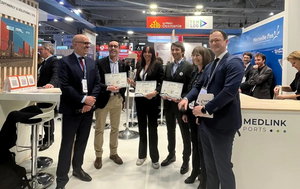
The European Domestic Agency for ITER, Fusion for Energy (F4E), the logistics group Daher, and the industrial river transport company CFT have received the “Green Shipper” award, recognizing the low-emission transport of ITER’s largest components across southern France’s inland sea Étang de Berre. Presented at the SITL logistics exhibition in Paris, the prize highlights the use of inland waterways as a cleaner alternative to road haulage for some of Europe’s most demanding cargo operations. The award concerns the movement of “Highly Exceptional Loads” (HEL)—components weighing hundreds of tonnes, such as vacuum vessel sectors and superconducting coils. These outsized pieces require bespoke trailers, reinforced infrastructure and multi-day, tightly coordinated transport operations. After arriving at the Mediterranean port of Fos-sur-Mer, the loads are transferred onto a specially designed barge to cross the inland sea, before continuing along the 104-km ITER itinerary by road to the construction site. A milestone—the 200th HEL shipment—will be passed in April.See the full story on the Fusion for Energy website.--Representatives from F4E, Daher, and CFT receiving the "Green Shipper" award from Medlink Ports at SITL Paris.
Press

Stellarators are among the leading fusion energy candidates

https://physicstoday.aip.org/news/stellarators-are-among-the-leading-fusion-energy-candidates

Expanding America’s role in fusion systems in France and Japan

https://www.pppl.gov/news/2026/expanding-america%E2%80%99s-role-fusion-systems-france-and-japan

An award for Europe’s heavy transport and logistics for ITER

https://fusionforenergy.europa.eu/news/f4e-daher-cft-iter-heavy-transport-award/

日仏首脳、核融合やレアアースで協力 エネルギーの安定調達めざす

https://www.nikkei.com/article/DGXZQOUA012G30R00C26A4000000/

Seoul to host IAEA Fusion Energy Conference in 2027

https://koreajoongangdaily.joins.com/news/2026-04-02/business/tech/Seoul-to-host-IAEA-Fusion-Energy-Conference-in-2027/2559850

2027년 ‘핵융합 올림픽’ 서울 개최 확정…17년 만에 한국 개최

https://v.daum.net/v/20260402120325176

GLADIS mit Jubiläumspuls und erweiterten Fähigkeiten

https://www.ipp.mpg.de/gladis26

GLADIS with anniversary pulse and expanded capabilities

https://www.ipp.mpg.de/gladis26en?c=5594164

How fusion reactions make the plasma’s heart beat

https://irfm.cea.fr/en/2026/04/comment-les-reactions-de-fusion-font-battre-le-coeur-du-plasma/

Miniature magnets break field strength record

https://physicsworld.com/a/miniature-magnets-break-field-strength-record/

Connecting classrooms with fusion research: Commission welcomes school teachers from across Europe to ITER

https://energy.ec.europa.eu/news/connecting-classrooms-fusion-research-commission-welcomes-school-teachers-across-europe-iter-2026-03-30_en

Korean Steel Becomes Global Standard for Fusion Reactors... Opens Door to Future Power Plant Supply Chains

https://www.asiae.co.kr/en/article/science/2026033110314057343

국산 철강재, 전 세계 핵융합로 공급 길 열렸다

https://n.news.naver.com/mnews/article/014/0005500055

Fusion energy: Strategic imperatives for government-private partnerships

https://www.openaccessgovernment.org/article/fusion-energy-strategic-imperatives-for-government-private-partnerships/207414/