Logo
You're currently reading the news digest published from 13 April 2026 to 20 April 2026.
Featured (4)
Press (12)
Featured

Feeder milestone: first-phase assembly achieved

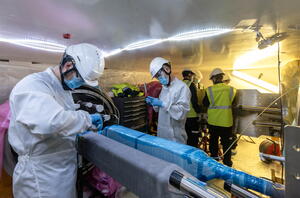
The first stage of feeder assembly—connecting feeder line components in the Tokamak Building galleries—has been completed. Work will now move to the tokamak pit, where tighter spatial and schedule constraints will make the team’s experience a key asset. If you were to look inside an ITER magnet feeder, whether at its box-like starting point in the galleries or at the more tapered and circular ends near the magnets, you would have the impression of a busy multilane thruway, with different “lanes” carrying the power, cryogens and instrumentation needed by the superconducting magnets. These thruways span distances of up to 35 metres, delivering services from outside the machine in to the vacuum environment of the magnets.Nothing as large as a 35-metre component could ever be installed in one piece on ITER—or even transported to the worksite. Instead, the Chinese Domestic Agency and its subcontractor ASIPP (Institute of Plasma Physics, Chinese Academy of Sciences) have delivered each feeder line in three fully instrumented segments. At ITER, these segments must be installed and joined together—a job that requires assembling large mechanical structures, but also connecting all of the internal “lanes”—from the busbars and current leads that transport electricity to the cryogenic fluid transport pipes and the high- and low-voltage conduits containing instrumentation wires. Two out of three of the segments required to build a magnet feeder—coil termination boxes and cryostat feedthroughs—are installed on supports outside of the ITER cryostat and are considered “gallery components,” while the in-cryostat feeders connect directly to the magnets. Poloidal field coils and the individual modules of the central solenoid module are each served by their own feeder, while pairs of toroidal field coils share a feeder and the 18 correction coils are supplied by five feeders. Connecting the busbars is a particularly challenging task, says ITER manufacturing and assembly engineer Vladimir Tronza, who is coordinating feeder assembly works. “The busbars are superconducting and their joints need to have extremely low electrical resistance and very strong reliable high voltage insulation. The problem is—we cannot test either in real operating conditions.”To address this, the ITER team developed a process designed to be both reliable and robust. The procedures for the on-site works were written directly by the IO engineers and technicians who had conducted multiple R&Ds to ensure the process soundness.    Special process teams gather around a feeder joint that is being prepared for a Paschen voltage test. From left to right: (front) Jaromir Farek, Ying Zhang, Nicholas Clayton, (back) Hyungjun Kim, Egor Marushin. “The joint process we created is backed by extensive R&D, and it is carried out on site by specialized workers who have completed mandatory qualification training, with supervision and verification at every stage.”Since 2021, qualified teams from ITER machine assembly contractor CNPE have been carrying out feeder connection work in the Tokamak Building, where two out of three of the segments required to build a magnet feeder—coil termination boxes and cryostat feedthroughs—have been positioned. In this first phase, 50 superconducting busbar joints were successfully completed. The feeder team poses in front of a completed connection for the feeder line that will deliver essential services to toroidal field coils TF08 and TF09. The next stage will take place on the other side of the cryostat barrier—inside of the tokamak pit. There, cryostat feedthroughs that cross through the concrete bioshield that surrounds the machine must be connected to in-cryostat feeder segments, and in-cryostat segments must be connected to the magnets. This work can only begin upon the completion of toroidal field coil installation, although preparations are already underway.“Future work will move mostly to the tokamak pit and will take place in a significantly more challenging and congested environment,” says Tronza. â€œIt will also be more demanding in terms of schedule, as we will need to complete 180 superconducting joints—more than three times the number achieved in the first phase—in less time.”

Key ruling on ITER vessel strengthens fit-for-purpose fusion regulatory approach

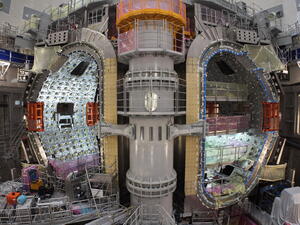
On 14 April 2026, the French Authority for Nuclear Safety and Radiation Protection (ASNR) approved the ITER Organization’s request to exclude the ITER vacuum vessel from French and European pressure equipment rules. By recognizing that electromagnetic forces—not coolant pressure—drive the ITER tokamak vessel design, the decision marks a significant step toward a regulatory framework tailored to tokamak fusion devices. ITER’s vacuum vessel is a large metallic structure designed to provide the first confinement, stabilize the fusion plasma and support the blanket and divertor systems. Its mechanical design is driven primarily by electromagnetic loads, while the pressure loads associated with the coolant fluid in its double-wall structure are comparatively minor and do not constitute a determining factor for structural dimensioning.In the early phases of the ITER project, the vacuum vessel was classified as Nuclear Pressurized Equipment (ESPN) under French law implementing the European directive. With this decision, ASNR has now agreed that this classification—derived from fission light water reactor practice where pressure is the dominant load—is not appropriate for a fusion device.“This change will not only be very important for the timely progress of the ITER project but will also contribute to the consolidation of appropriate technical standards for tokamak magnetic confinement fusion devices, including guidelines for maximum allowable defect size during fabrication and welding,” commented ITER Director-General Pietro Barabaschi, who had made this issue a priority shortly after taking office in 2022. “It ensures that requirements remain coherent and proportionate, while fully supporting robust nuclear quality and safety objectives.”As the first confinement barrier, the ITER vacuum vessel remains classified as a Protection Important Component (PIC) under the French legal framework applicable to nuclear facilities. Accordingly, its design, manufacture, and in-service surveillance remain subject to ASNR oversight within the nuclear safety framework, while the associated technical requirements and quality management program will be adjusted to appropriately address the specific characteristics of the vacuum vessel.This decision reflects the outcome of a constructive and sustained technical dialogue between the ITER Organization and ASNR aimed at developing a fit-for-purpose regulatory framework and technical standards for fusion facilities.“Following this very positive decision for the project, we are now organizing the transition away from manufacturing under the pressure equipment directive,” says Gilles Perrier, head of ITER’s Safety and Quality Department. “Our priority is to define and submit to ASNR updated technical criteria and monitoring arrangements for the ITER vacuum vessel.”Read or download the ASNR decision in French.

ITER Post-Graduate Program opens

A new initiative from the ITER Organization offers early-career professionals a valuable opportunity to gain hands-on experience through structured 24-month assignments. Several positions are currently open, with applications accepted until 17 May. The ITER Post-Graduate Program is designed for recent graduates holding engineering or Master’s degrees, with no more than two years of professional experience (excluding internships). It is ideal for those looking to strengthen their technical foundations while developing professional skills alongside leading experts in their field.Participants will undertake 24-month assignments at the ITER site in southern France, with the possibility of extension for up to an additional 24 months. The program offers:A defined role with clear objectives and deliverablesOnboarding and integration supportMentoring and professional guidanceLearning and training opportunities aligned with the assignmentRegular feedback and progress reviews Applications must be submitted online through the ITER Open Positions webpage, where positions are currently advertised in mechanical engineering, electrical engineering, and information technology. The selection process aims to not only fill these positions, but also to establish a roster of qualified candidates for future vacancies.Applicants must hold a valid passport from one of the ITER Members: China, the European Union, India, Japan, Korea, the Russian Federation, or the United States.For full program details, visit this ITER webpage.Consult the open post-graduate positions here.

Sector #3 completed in Europe

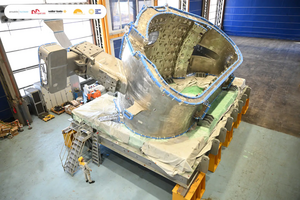
The penultimate sector of the ITER vacuum vessel is on its way.  Sector #3, expected on site early next month, is the second-to-last sector required to complete the ITER vacuum vessel.Europe, through Fusion for Energy (F4E), has been working since 2010 with the AMW consortium to deliver its share of these complex components. It delivered sector #5 in 2024, followed by #4 in 2025 and #9 last month.When it reaches ITER, a well-oiled assembly line is waiting to turn sector #3 into a "sector module" that can be installed in the tokamak pit—that is, fully equipped with its thermal shield and a pair of toroidal field coils. To help streamline the production line process at ITER, some of the work typically carried out on site—for example, the welding of outer shell "bosses" (small studs that can be used to attach components)—was carried out by the European teams before shipment.  Vacuum vessel assembly is on the project's critical path. Only after all nine sectors have been installed in the tokamak pit can the welding of the torus begin. See the full report on the Fusion for Energy website. Sector #3 is loaded at the port of Ortona, Italy, on 17 April.
Press

F4E launches the 2026 Technology Transfer Demonstrator Call

https://fusionforenergy.europa.eu/news/f4e-launches-the-2026-technology-transfer-demonstrator-call/

JET uses robot workforce to undertake world-first decommissioning of a fusion plant

https://eandt.theiet.org/2026/04/17/jet-uses-robot-workforce-undertake-world-s-first-decommissioning-fusion-plant

British expertise helps harness the power of a star

https://www.bbc.com/news/articles/cx2ee7kg05wo

Parliamone un Po'dcast - Episodio 17 - Pietro Barabaschi (video 26:25)

https://www.youtube.com/watch?v=9tRozSVQExA

UKAEA sets out fusion strategy for coming years

https://www.world-nuclear-news.org/articles/ukaea-sets-out-fusion-strategy-for-coming-years

Europe’s fourth Vacuum Vessel sector is ready for ITER

https://fusionforenergy.europa.eu/news/europes-fourth-vacuum-vessel-sector-is-ready-for-iter/

V Krškem nastajajo cevi za hlajenje največjega fuzijskega reaktorja ITER

https://www.posavskiobzornik.si/gospodarstvo/v-krskem-nastajajo-cevi-za-hlajenje-najvecjega-fuzijskega-reaktorja-iter-109600

Andalucía aspira con el IFMIF-DONES a convertirse en un referente internacional en fusión nuclear

https://novaciencia.es/andalucia-aspira-con-el-ifmif-dones-a-convertirse-en-un-referente-internacional-en-fusion-nuclear/

广州南沙企业再获全球“人造太阳”核心订单

http://www.chinahightech.com/yuanqu/2026-04/16/content_503092.html

UKAEA unveils 2026 to 2030 fusion roadmap

https://www.ukaea.org/news/ukaea-unveils-2026-to-2030-fusion-roadmap/

Global fusion sector scaling up, creating UK SME opportunities

https://www.ukaea.org/news/global-fusion-sector-scaling-up-creating-uk-sme-opportunities/

ITER, 핵심 제어기술 첫 실증 무대로 KSTAR 선택 세계 표준 검증 플랫폼 입증···韓 핵융합 기술 경쟁력 재확인

https://www.hellodd.com/news/articleView.html?idxno=111480