Logo
You're currently reading the news digest published from 20 April 2026 to 27 April 2026.
Featured (5)
Of interest (1)
Video (1)
Press (10)
Featured

Japan is developing tooling for initial blanket assembly

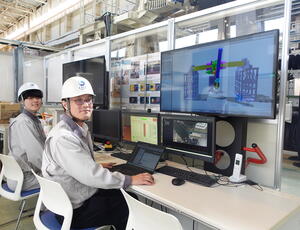
A specific set of robotic tools is being developed in Japan to support the initial assembly of ITER blanket components. Designed to operate within tight space constraints, these tools can grip, fasten, tighten, weld, and cut with exceptional precision. In this interview, team leader Tanaka Takeyuki from the Japanese Domestic Agency discusses the challenges of creating these multifunctional robotic tools and explains how insights gained during early assembly operations will help shape the remote handling strategy for blanket maintenance during ITER operation. Can you describe what “initial assembly” of the ITER blanket entails, and what types of remote handling tools will be required?In ITER, the initial assembly of the blanket is scheduled to take place over several months starting in 2032 and will mark a critical step on the path to starting plasma operation in 2034. During this phase, 440 blanket shield blocks must be transported to their specific positions inside the vacuum vessel and bolted to the structure through interfacing components such as flexible cartridges and key pads. The heavy shield blocks will be transported using conveying equipment such as tower cranes, while precision tasks—such as bolt tightening and loosening, or pipe welding and cutting—will be carried out using technologies similar to those used in remote maintenance. In Japan, we are developing the end effectors (peripheral devices that are attached to a robotic arm) and tools for gripping, fastening, and cooling pipe welding and cutting.Rather than being limited to simple handling, the grippers are designed as multifunctional end effectors capable of securely holding blanket modules while also performing temporary bolt tightening. This versatility is essential during early-stage assembly, when multiple tasks must be executed within confined spaces.Once the blanket modules are temporarily secured, the bolts must be tightened with a very high torque so they can withstand the forces of plasma operation. In addition, the cooling water pipes—either between adjacent blanket modules or between modules and the main cooling channels—must be welded. For these initial assembly activities, we need dedicated bolt-tightening tools and welding tools. Team leader Tanaka Takeyuki points to the gripper prototype developed for the blanket remote handling system, which is supporting gripper and tool applications for the initial assembly of the blanket. How can the development and the implementation of these initial tools inform work underway on the blanket remote handling system—the robotic system that will be used for the maintenance of the ITER blanket when the machine is operating?Japan has been working on the development of the blanket remote handling system under a Procurement Arrangement signed with the ITER Organization and is bringing this experience to bear in the development of tools for initial blanket assembly.In contrast to the blanket remote handling system—which will carry out the remote maintenance of blanket modules under high‑radiation conditions—the grippers and tools for initial assembly will be used inside the vacuum vessel in a non-radiological environment. Because this phase takes place before plasma operation, operators can work in close proximity to the equipment, allowing direct observation of tool behaviour and performance in confined spaces. This hands-on access during pre-activation assembly provides a unique opportunity to gather practical insights that would not be available once the system becomes activated. These observations can then be systematically applied to improve tool maintainability, refine remote handling strategies, and guide design improvements for future high-radiation environments, ultimately strengthening ITER’s long-term remote maintenance approach. Prototype manufacturing has been initiated in a phased manner for the items that have received manufacturing authorization from the ITER Organization. Pictured is a prototype tool for cutting cooling water pipes. What are some of the challenges that are inherent to developing this type of high-precision, multifunctional robotic equipment? Among the many engineering challenges, one stands out as particularly demanding—achieving reliable welding from an extremely confined workspace, the interior of a bore hole. Unlike conventional pipe welding that is typically performed from the outside, the spatial constraints in fusion reactors makes this approach unworkable. Instead, we are developing technology that involves the insertion of tools into the narrow interior of the cooling pipes (inner diameter = 43.7 mm) and welding or cutting the pipe from the inside.The limited space in the blanket assembly environment imposes strict constraints on tool size and articulation, approach angles, and stability during welding. Designing a mechanism that can manoeuvre with sufficient precision—without compromising structural rigidity—requires the careful balancing of mechanical complexity, robustness, and operational reliability. We must also plan for a high level of cleanliness: at no time can metal shavings be allowed to drop into the vacuum vessel.To conclude, the end effectors and tools for blanket initial assembly that we are developing will serve as a testbed for integrating advanced robotic functions, process-by-process workability, and human operational expertise into ITER’s assembly strategy. I strongly believe that the hands-on experience gained during the initial assembly phase will be invaluable for future remote handling maintenance and for the broader development of fusion reactors. [Interview conducted by Chiaki Shiraishi, from ITER Japan.]See this press release (in Japanese) from the National Institutes for Quantum Science and Technology.

Welcoming the fusion ecosystem to ITER

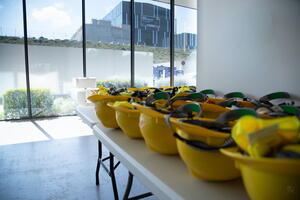
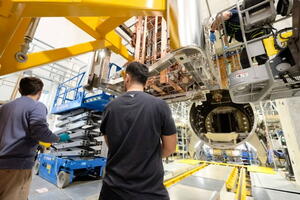
The 3rd ITER Public-Private Fusion Workshop takes place this week at ITER Headquarters in southern France.   For the third time, the ITER Organization is opening its doors to private fusion companies, as researchers, industry leaders, and innovators gather this week to explore how collaboration across the fusion ecosystem is taking shape in practice.At the inaugural event in 2024 we asked, "How can ITER help?" Last year, discussions focused on new mechanisms for knowledge sharing, including supply-chain capacities that could help private companies avoid "reinventing the wheel." This year's program builds on those foundations with a practical emphasis on aligning capabilities, identifying gaps, and accelerating the transition from experimental success to deployable systems.Some 350 people are expected to attend. Early arrivals spent Monday afternoon meeting with machine assembly and plant systems experts on the worksite, setting the stage for discussions grounded in real-world technical challenges.

Third operation campaign beginning on SPIDER

The world’s most powerful negative ion source is entering a new operational campaign at the ITER Neutral Beam Test Facility in Italy, where it is expected to demonstrate stable, high-performance operation at ITER parameters. Following a major upgrade and maintenance campaign at the ITER Neutral Beam Test Facility* in Padua, the ITER-scale negative ion source SPIDER has been re-installed inside of the testbed in preparation for a new experimental phase, SO-3. In operation since 2018, SPIDER successfully completed its first campaign in 2021. During a second phase of experiments from 2024 to mid-2025, the ion source reached a record extracted current density of approximately 240 A/m², representing approximately 70% of the target density required for hydrogen neutral beam injection operations at ITER and marking a notable progression in beam performance. The campaign also identified clear ceilings imposed by the existing hardware and allowed engineers to identify a series of necessary design refinements. The work carried out during the latest shutdown focused on improving the machine’s reliability and performance. Scientists and engineers completed a broad program of repairs, upgrades and system improvements designed to make SPIDER more robust and flexible and to prepare it for more demanding conditions ahead. The work is expected to improve day-to-day performance while also supporting the long, stable runs needed for ITER’s future neutral beam system. By resolving issues identified in earlier operational phases and strengthening the platform ahead of more demanding experiments, the upgrades have prepared SPIDER to move closer to demonstrating the capabilities required for ITER-scale negative ion source operation. Courtesy of Consorzio RFX “The latest upgrade of SPIDER represents an important step toward the objectives defined as part of the ITER Research Plan. As we approach the start of the third experimental campaign, this progress reinforces the Neutral Beam Test Facility’s central role in de-risking the neutral beam injectors for ITER,” says ITER’s Pierluigi Veltri, head of the Neutral Beam Project. “With the forthcoming integration of the radiofrequency solid-state power supplies, we are well positioned to deliver key results aligned with ITER’s neutral beam performance requirements.”The new campaign will focus on demonstrating performance under conditions relevant to ITER and moving closer to proving the capabilities required for full-scale fusion applications.*The Neutral Beam Test Facility is hosted by the Italian research laboratory Consorzio RFX and funded by the ITER Organization, the European Domestic Agency and the Italian government. The European, Japanese and Indian Domestic Agencies have all contributed with in-kind components; the European Consortium for the Development of Fusion Energy (EUROfusion) is also participating under the terms of a Cooperation Agreement signed in 2020. See the full report on the Consorzio RFX website in English or Italian.         

US ITER completes central solenoid procurement package

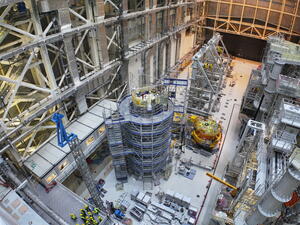
US ITER has completed final deliveries for the central solenoid, the world’s most powerful pulsed superconducting magnet.  The most recent deliveries included busbars and leads for electrical connections between the modules; earlier, all magnet modules, support structures, and tooling components had been delivered. US ITER will now receive credit* from the international project for the full magnet scope and is in process of closing out this project area.The 18-metre-tall magnet is now under assembly at the ITER site. Five of six modules are stacked, with the final module to be added later this year. Assembly is the responsibility of the ITER Organization, with additional technical support provided through an agreement with the US ITER project team based at Oak Ridge National Laboratory. The dedicated area for the ITER central solenoid can be seen in the back right of this photo. The sixth (and last) module will be added to the stack this year. “The completion of the central solenoid magnet highlights the capability of the United States to design and deliver the world’s most complex fusion systems,” said Kevin Freudenberg, US ITER Interim Project Director. “Congratulations to the entire team who contributed, including those here at Oak Ridge National Laboratory who led the work, and our suppliers who fabricated critical components.”Key information about the design and fabrication of the central solenoid magnet can be shared with other US fusion efforts through the US ITER Information Access portal at https://www.ornl.gov/iterinfo and by the ITER Organization Private Sector Fusion Engagement effort (contact @email for more information).*A Domestic Agency receives credit for specific in-kind deliveries when all the terms of the Procurement Arrangement have been fulfilled. 

Charles Baker, 1943-2026

The ITER Organization is saddened to learn of the passing of Charles C. Baker, an ITER “Home Team Leader" during the launch of Engineering Design Activities, responsible for coordinating American technical contributions to the international effort to design the ITER machine and plant. Dr. Baker’s distinguished career as a nuclear engineer and fusion-energy leader spanned national laboratories, academia, and the ITER program, and left a lasting mark. Before becoming Home Team Leader during the ITER Engineering Design Activities, Dr. Baker had already devoted more than two decades to fusion research. Beginning in 1972 as a senior physicist in the Fusion Division at General Atomics, he went on to serve in leadership roles as Fusion Technology Department Manager and Project Manager. From 1977 to 1989 he directed the Fusion Power Program at Argonne National Laboratory, also serving as leader of the Blanket Design Unit during the ITER Conceptual Design Activities from 1988 to 1989.In 1989, he joined Oak Ridge National Laboratory as Associate Director for Technology in the Fusion Energy Division, later serving as Technology Manager of the US Home Team, then Home Team Leader from 1992 to 1994. He was also appointed as Research Program director in the Fusion Energy Division.After moving in 1994 to the University of California San Diego, Dr. Baker served as engineering leader, Deputy Director of the Center for Energy Research, and Director of the Department of Energy’s Virtual Laboratory for Technology. Over the course of his career, he helped guide advances in fusion reactor design and enabling technologies, including materials, magnets and tritium systems. For several years, Dr. Baker was also the Principal Editor of the Journal of Fusion Engineering and Design. A Fellow of the American Nuclear Society and recipient of the US Department of Energy’s Distinguished Associate Award, he was widely respected for his technical vision, leadership and dedication to advancing fusion energy.ITER Director-General Pietro Barabaschi paid tribute to Dr. Baker as “a remarkable leader who strongly contributed to the ITER project through his technical knowledge, management skill, and friendly personality.”The ITER Organization sends its condolences to his family, friends and former associates.See the obituary published on the Fusion Power Associates website. 
Of interest

Last call to register for the 15th ITER International School

https://www.iter.org/of-interest?id=34510
The 15th ITER International School will be held in Chengdu, China, from 20–24 July 2026.The deadline for pre-registration is 6 May 2026. Selected students will be informed on 11 May so that they can complete the registration process. This year's ITER International School will explore the physics and engineering of heating and current drive systems for magnetic fusion plasmas. The organizers of the event—the Engineering & Technical College of Chengdu University of Technology and the Southwestern Institute of Physics (SWIP)—are accepting pre-registration now on the event website. The detailed program is also available. Visit the 15th ITER International School website for all information or to pre-register by 6 May.Download the 2026 International School poster here.
Video

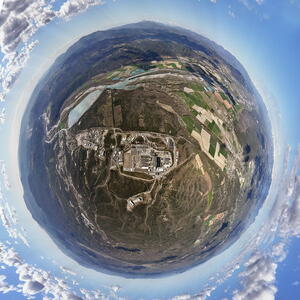
ITER by drone - April 2026

Press

法国核安全与辐射防护局批准 ITER托卡马克真空室排除欧洲压力容器 监管

https://www.iterchina.cn/picnews/info/2026/24303.html

El escarabajo verde - Fusión por fisión (video 28'58")

https://www.rtve.es/play/videos/el-escarabajo-verde/fusion-fision/17041748/

マクロン大統領との交流

https://www.metro.ed.jp/toyama-h/news/2026/04/ssh_2.html

核融合はなぜ実用化が難しいのか 鍵を握る「材料」の壁

https://news.toremaga.com/economy/ewhole/4063346.html

ITER vacuum vessel exempted from fission-based regulation

https://www.ans.org/news/article-7971/iter-vacuum-vessel-exempted-from-fissionbased-regulation/

Není malta jako malta

https://www.3pol.cz/cz/rubriky/jaderna-fyzika-a-energetika/3405-neni-malta-jako-malta

Defining key physics gaps towards stellarator reactor

https://euro-fusion.org/eurofusion-news/defining-key-physics-gaps-towards-stellarator-reactor/

SPIDER pronta a ripartire: completati upgrade e manutenzione, si apre una nuova fase operativa

https://www.igi.cnr.it/news/spider-pronta-a-ripartire-completati-upgrade-e-manutenzione-si-apre-una-nuova-fase-operativa/

SPIDER back in vacuum: a new phase begins after upgrade and maintenance

https://www.igi.cnr.it/en/news/spider-back-in-vacuum-a-new-phase-begins-after-upgrade-and-maintenance/

Global fusion sector scaling up, creating UK SME opportunities

https://www.gov.uk/government/news/global-fusion-sector-scaling-up-creating-uk-sme-opportunities