ITER magnet test facility now operational
Operations have begun at the ITER magnet cold test facility, where selected superconducting magnets will be tested at their operating temperature of 4 K and up to full current before installation in the machine.
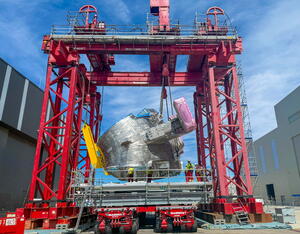
The successful cooldown of the first magnet coil to 4 Kelvin (K), or minus 269 °C, was announced on Thursday 21 May. Members of the ITER Council Management Advisory Committee attending a May meeting on site joined the technical teams in the ITER control room for a small ceremony marking the achievement.The first magnet coil to undergo testing is 330-tonne ITER toroidal field coil #07 (TF07). Additional toroidal field coils from different manufacturers will follow, along with one ring-shaped poloidal field coil—ITER’s smallest, PF1.Although no external test can fully reproduce operating conditions inside the ITER machine, tests in the magnet cold test facility will provide essential information on magnet behaviour, cryogenic performance, electrical interfaces, instrumentation, and the critical joints that connect the layers of wound superconductor inside of the magnet coils, and strengthen ITER’s risk mitigation and readiness.Specific objectives include the validation of high-voltage ground insulation at different temperatures, the demonstration of critical quench* detection capabilities, and the verification of coil performance at nominal current (68 kA for the toroidal field coils and 48 kA for PF1). The campaign will also test instrumentation chains, control logic systems, and key magnet protection functions.
On Thursday 21 May, members of the ITER Council Management Advisory Committee visit the ITER control room and meet the team supervising the operation of the ITER magnet cold test facility.
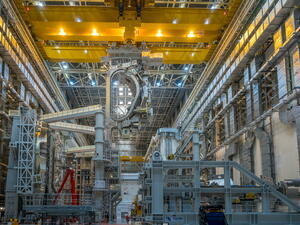
The ITER magnet cold testing program was launched in 2023 as part of ITER’s revised approach to assembly and commissioning. The facility, built in record time, is located in a building previously used by the European Domestic Agency to manufacture ITER’s four largest poloidal field coils, and it takes advantage of the building’s scale, lift equipment, and proximity to the cryoplant. “ITER as a first-of-a-kind project requires ingenuity as well as discipline,†said ITER Director-General Pietro Barabaschi. “By repurposing existing infrastructure, using the capabilities of our cryoplant, and mobilizing a multidisciplinary team, we have created a practical way to reduce risk before integrated commissioning. This is important for ITER as well as an example of how ITER can support the wider fusion ecosystem by creating knowledge, infrastructure, and operational experience that others can use.â€Following the testing of multiple ITER magnet coils, the magnet cold test facility will be made available to other fusion stakeholders as part of the ITER Organization’s knowledge-sharing and engagement initiatives with the private fusion sector. (See more about the Private Sector Fusion Engagement program here.)*Superconductivity can be maintained in the magnet coils as long as certain threshold conditions are respected (cryogenic temperatures, current density, magnetic field). Outside of these boundary conditions, a magnet will return to its normal resistive state and the high current will produce high heat and voltage. This transition from superconducting to resistive is referred to as a quench. See the press release issued on 21 May.
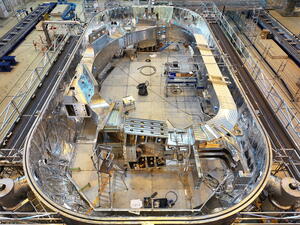
Once the lid was placed over the cryostat, it took 12 days to reach the nominal magnet operating temperature of 4 K (-269 °C). Next, the first coil to be tested will be progressively energized up to full current (68 kA).