Galloping ahead in the Year of the Horse
Vacuum vessel assembly is continuing ahead of schedule at ITER, as one of the most complex activities of machine assembly is showing the benefits of experience, coordination, and continuous process improvement. Among the teams contributing to this progress is the CNPE Consortium, whose role in machine assembly has expanded over time.
In the days leading up to the start of the Chinese New Year in February 2026, a ceremony was held to mark another successful sector module transfer to the tokamak pit. Project leaders, engineers, technicians, and contractors from across the ITER ecosystem were jubilant: after delays accumulated earlier in the decade due to the pandemic and then the repair of key components, vacuum vessel assembly was not just back on track, it was ahead of schedule. Amid the hum of conversation, ITER Director-General Pietro Barabaschi, Head of the Construction Project Sergio Orlandi, and Machine Assembly Program Manager Jens Reich took a moment to highlight the contribution of the CNPE Consortium, one of the industrial teams supporting machine assembly activities.“It is fitting that we are about to start the Year of the Fire Horse,†Jens Reich told the assembled crowd. “In the Chinese zodiac, the horse is associated with moving forward and rapid progress and this is something we have been able to achieve together at ITER with the support of the CNPE Consortium.â€
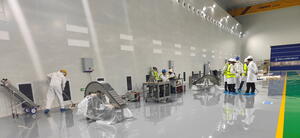
As part of the CNPE Consortium, France's Framatome focuses on quality assurance and regulatory oversight. Here, members of Framatome team can be seen in front of a nearly completed sector module that is scheduled to be transferred to the tokamak pit in July.
The CNPE Consortium became part of the ITER machine assembly project in 2019 when it signed the TAC1 machine assembly contract, with responsibility for installing major components such as the cryostat and the magnets. At the time, the international consortium was composed of four partners from China (China Nuclear Power Engineering Co., China Nuclear Industry 23 Construction Company, the Southwestern Institute of Physics, and the Institute of Plasma Physics of the Chinese Academy of Sciences) and one from France (Framatome). Since that contract kicked off, the consortium’s scope and impact have continuously expanded. The consortium is now also responsible for sector module sub-assembly, sector module assembly in the pit (excluding welding), and the pre-welding positioning and preparation of the sectors in the pit. In parallel, its presence has grown from 90 to 220 people on site and it has added new industrial partners along the way, such as the Italian industrial firm SIMIC.“I think we have arrived at this point because of our strong track record,†says Tai Jiang, the outgoing head of the CNPE Consortium. “I credit two main factors. The first is the support of ITER’s management, because we depend on engineering, procurement, equipment supply, problem-solving, and rapid decision-making. The second is that our consortium brings together a strong team with complementary expertise, ranging from nuclear construction and equipment assembly to fusion expertise and a deep understanding of the French regulatory and industrial context.â€
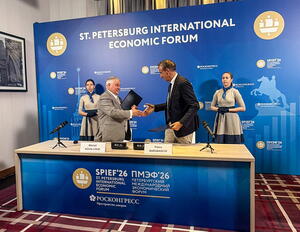
Tai Jiang, the outgoing head of the CNPE Consortium, says they adopted a "Three Ones" principle to adapt to the different cultures and ways of working: one goal, one team, one voice.
The consortium has played a significant role in efforts to optimize the sector module assembly process. When the team took over module assembly through a contract signed in February 2024, it was able to review past experience and use lessons learned to improve systems for everything from document management to adding diagnostic attachments to the outer and inner surfaces of the sectors.“We optimized the critical path activities as much as possible and performed much more work in parallel rather than sequentially. This allowed us to shorten the overall duration significantly,†says Wang Peng, the Deputy Project Manager of the CNPE Consortium who oversaw the sector-sub assembly contract for the first two years. Indeed, while it took 7.4 months for the consortium to complete its first module—from the arrival of the sector in tooling to its landing the tokamak pit—that process is now down to 5.5 months.
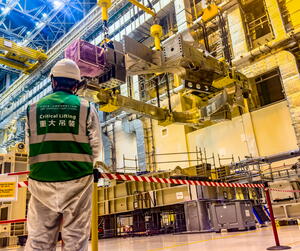
Machine assembly requires meticulous coordination between ITER and contractors: here, ITER's Mathieu Demeyere (centre) discusses the final details of a sector module landing with Philippe Piluso (SIMIC) and Gael Hardy (Framatome).
As assembly efficiencies have improved, the expected date for transferring the final sector module into the pit has been advanced from December 2027 to June 2027. “This is a very good accomplishment because these extra six months create flexibility for the overall baseline and will serve as a margin to deal with any future technical challenges,†explains Jens Reich.Lessons learned are also creating a virtuous cycle as the CNPE Consortium becomes involved in other parts of ITER machine assembly. The core team has now been with the project for nearly seven years, accumulating both technical expertise and project knowledge. For Framatome, which focuses primarily on health, safety, environmental oversight, and quality assurance, this continuity is one of the keys to success.“We have been able to apply that acquired knowledge and experience to all our activities at ITER,†says John-Morgan Coulet, Framatome’s project leader for ITER. “Keeping the same teams together and evolving together is important when dealing with such a long-term project.â€This continuity will be essential moving forward. After the last sector module lands in the pit in 2027, other critical benchmarks await the CNPE Consortium such as the continued load transfer of vacuum vessels and the pre-compression of the toroidal field coils. Even when the Year of the Horse comes to an end, tokamak assembly will continue at a full gallop.
One important factor in the optimization of sector module assembly is the efficient welding of thousands of instrumentation and diagnostic attachments on the inner and outer shells of the vacuum vessel sectors. The CNPE Consortium's welding team is shown here marking the final weld on sector module #4 before it was lifted into the tokamak pit in May 2026.