Logo
You're currently reading the news digest published from 29 June 2026 to 6 July 2026.
Featured (4)
Press (8)
Featured

Two days, two high-level visits

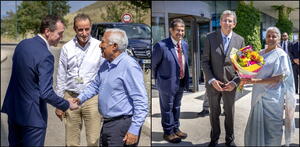
The ITER Organization hosted visits by European Council President António Costa and Indian Minister for Finance and Corporate Affairs Nirmala Sitharaman over two days in early July. The dignitaries and their delegations received briefings on project progress and toured the principal machine assembly areas—the Assembly Hall and the tokamak pit—in the company of ITER officials. In early July, the ITER Organization welcomed two high-level international delegations, highlighting the growing strategic importance of fusion energy as the project advances through a critical phase of machine assembly.European Council President António CostaOn Friday 3 July, ITER Director-General Pietro Barabaschi, European Domestic Agency (Fusion for Energy, F4E) Director Marc Lachaise, and Chair of the F4E Governing Board Francesco Sette welcomed European Council President António Costa and members of his cabinet to the ITER site.The visit included briefings at ITER headquarters and a tour of the construction site, where President Costa received updates on the status of machine assembly and Europe's contribution to the international fusion project.As the host member of ITER, Europe is responsible for nearly half of the project's construction contributions. During discussions with the delegation, representatives from Fusion for Energy highlighted the role of fusion research and advanced industrial capabilities in strengthening Europe's long-term technological competitiveness and energy innovation capacity.Earlier in the day, President Costa participated alongside European Central Bank President Christine Lagarde in a discussion at the Aix Economic Forum (Les Rencontres Économiques d'Aix-en-Provence) on navigating economic and geopolitical uncertainty. In the ITER Assembly Hall, where large-scale machine components are pre-assembled, ITER Director-General Barabaschi exchanges with European Council President Costa on the long-term importance of ITER and fusion. Credit: European Union Indian Finance Minister commends India's contributionsIndian Minister for Finance and Corporate Affairs Nirmala Sitharaman visited ITER on Saturday 4 July as part of a four-day official visit to France to participate in a series of high-level bilateral engagements aimed at strengthening the India-France Strategic Partnership, enhancing economic cooperation and promoting investment, technology collaboration and innovation.Minister Sitharaman and her delegation were welcomed by ITER Chief Scientist Alain Bécoulet and Head of the Office of the ITER Director-General Kattalai Ramachandran Sriram. Following presentations on construction progress and India's contribution to the project, the delegation toured the ITER worksite. Indian Minister for Finance and Corporate Affairs Nirmala Sitharaman visits the ITER site on Saturday 4 July 2026. She is photographed here with ITER’s Chief Scientist Alain Bécoulet. During the visit, Minister Sitharaman praised the efforts of engineers, scientists, and industrial partners, describing ITER as “one of the most ambitious nuclear fusion energy projects in the world, and a significant step toward sustainable and limitless clean energy for the future.” Minister Sitharaman also highlighted the contributions of Indian scientists, engineers and associates, as well as Indian companies such as Larsen & Toubro, Inox India, Tata Consultancy Services, Tata Consulting Engineers, HCL Technologies and many others.Indian firms are supplying ITER components and systems through contracts signed with the Indian Domestic Agency, including the cryostat, in-wall shielding for the ITER vacuum vessel, significant contributions to cooling water and cryogenic systems, the diagnostic neutral beam and diagnostics. Indian companies are also winning direct contracts with the ITER Organization for critical machine assembly activities. Larsen & Toubro, for example, has been awarded a contract for port positioning alignment and welding—a scope that includes engineering, qualification and tools, and in-pit welding of vacuum vessel ports and bellows. INOX India Limited was awarded a contract for vacuum vessel and cryostat thermal shield refurbishment.During her stay in Aix-en-Provence, France, Minister Sitharaman co-chaired the India-France Economic & Financial Dialogue (EFD) and participated in discussions at the Aix Economic Forum.As assembly progresses and Member in-kind contributions continue to arrive on site, ITER remains an example of long-term scientific cooperation, bringing together governments, research institutions and industry in pursuit of a common energy goal.

Corking the ITER bottle

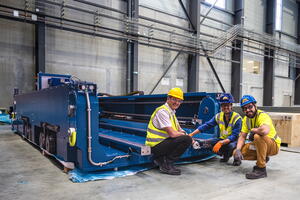
Longer than a small bus and powerful enough to maneuver 48-tonne components with millimetre precision, port plug assembly tools will play a central role in installing the port plugs that house critical heating and diagnostic systems. The arrival of the first assembly tool on site opens the way to a testing and training phase that will help prepare teams for the next stages of tokamak assembly. The vacuum vessel’s 44 openings, or “ports,” distributed around the machine at three levels, provide access for component installation and maintenance while also providing passage for the heating, fueling, vacuum, and diagnostic systems that are essential for plasma operations.The ports will be sealed by large stainless-steel box structures called port plugs that provide nuclear shielding while also hosting the systems that need access to the plasma. Weighing up to 48 tonnes when fully assembled and measuring as much as 2.5 × 3 × 2 metres, these plugs will be installed with very little clearance and—whenever access to the vacuum vessel is required—removed and reinstalled, much like giant corks being extracted and inserted into a bottle.The system charged with these activities—the cask and plug remote handling system—is being designed by the European Domestic Agency Fusion for Energy (F4E) in collaboration with the ITER Organization. Procurement will take place in two phases: an early set of handling tools integrating commercially available electronics and materials will serve to accelerate tokamak assembly and provide the experience that will help to optimize a second generation of equipment for tokamak operation, featuring nuclear-grade components, fully remote handling capabilities and a protective cask to provide the required contamination control function for activated components.“This was an opportunity to improve technological readiness because we will get experience using the tool for installation and this will improve specifications and the development of the cask,” says Massimo Battaglia, the ITER remote handling engineer who oversaw the design, manufacturing and testing of the port plugs handling tools. The first version of the cask and plug remote handling system is for the assembly phase and will feature commercially available materials. A more robust version using nuclear-grade components and featuring a protective cask for the plugs is being developed for the operational phase. The tool set for port plug assembly consists of a semi-automated transport system and equatorial and upper port plug handling machines. The transport system will carry the plug handling machine with the port plug through the narrow galleries of the Tokamak Complex to the port cell. Depending on what level the port cell is on, either the equatorial or the upper port plug handling machines will be used to precisely position and insert the port plugs into the opening.The system’s first deliverable, the assembly machine to handle equatorial port plugs, arrived at ITER on Wednesday 1 July. The major remaining equipment—the upper port plug handling machine assembly tool and the cask transport system—are expected to be delivered later this year.The equipment will be tested onsite in a facility equipped with a port cell testing environment, where operators will practice inserting and maneuvering dummy plugs.“The delivery of the tool is the beginning of an important testing and training process,” says Gonzalo Hinojosa Martinez, the ITER remote handling engineer who will be overseeing the tools. “We can now start to prepare for the smooth installation of the port plugs when we reach that phase of tokamak assembly.”See a report by the European Domestic Agency here. The cask and plug remote handling system is being developed and manufactured with industrial partners including the Italian nuclear engineering firm Ansaldo Nucleare in partnership with Officine L.C.M. and the Finnish heavy-load handling specialist Solving. Here, the equatorial port plug assembly tool (blue) can be seen on top of the motorized transport trolley (yellow) during factory acceptance testing with a dummy load.

ITER Council notes continued progress across construction, commissioning, and licensing

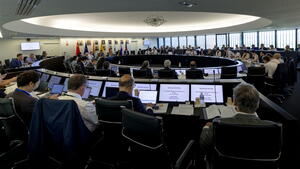
The ITER Council welcomes continued progress across the ITER project, citing advances in construction, assembly, commissioning preparation, and regulatory engagement during its 38th meeting, held on 25–26 June in Saint-Paul-lez-Durance, France. Reporting to Council members, ITER Director-General Pietro Barabaschi outlined developments achieved since the previous Council meeting. Members noted the latest Project Progress Report and expressed appreciation for the overall execution of the project under Baseline 2024, recognizing the sustained efforts of both the ITER Organization and the seven Domestic Agencies.Among the key areas highlighted were ongoing assembly and installation activities on the ITER site. Work continues on sector module assembly and installation, central solenoid assembly, plant installation, and related site operations. The Council also welcomed the project's continued emphasis on integrated planning, execution discipline, and close coordination among all ITER partners to support delivery along the project's critical path.Progress was also reported in commissioning-related activities. Council members noted the start of operation of the Magnet Cold Test Facility and advances in global commissioning efforts, which are intended to reduce technical risk and strengthen readiness for future stages of assembly and operation.Beyond construction, the Council acknowledged ITER's ongoing engagement with the wider fusion community. Activities carried out in collaboration with the Domestic Agencies under the Private Sector Fusion Engagement (PSFE) project include knowledge-sharing initiatives that support the growing fusion sector and contribute to the transfer of expertise to emerging private fusion enterprises.Regulatory matters also featured prominently in discussions. The Council welcomed continued constructive engagement between the ITER Organization and France's Authority for Nuclear Safety and Radiation Protection (ASNR). Members noted ASNR's agreement to exclude the ITER vacuum vessel from the scope of French legislation implementing the European Pressure Equipment Directive, a decision expected to support schedule and cost efficiencies while maintaining quality objectives.Reaffirming their commitment to the project, ITER Members emphasized the importance of ITER's mission to demonstrate the feasibility of fusion energy and pledged their continued support for the successful delivery of this unique international collaboration.Read the press release in English or French.

ITER Director @ the Aix Economic Forum

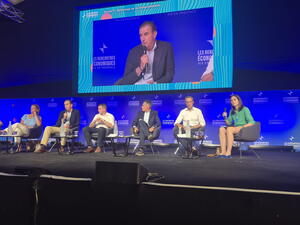
ITER Director-General Pietro Barabaschi introduced the audience to the ITER project in the context of a panel discussion titled "Planetary Boundaries: Earth on Red Alert." The Aix Economic Forum "Les Rencontres Économiques d'Aix" is an annual gathering of policy makers, business leaders, academics, heads of state and government, representatives of non-profit organizations, and community leaders. Free and open to the public, the forum aims to bring together leading thinkers to discuss issues with significant economic, political and social implications.From 2 to 4 July 2026, the forum's theme "Navigating a World of Uncertainty" explored how societies, economies and democracies can respond to an increasingly complex and rapidly changing world.As part of the program, ITER Director-General Pietro Barabaschi participated in the panel discussion “Planetary Boundaries: Earth on Red Alert,” where he introduced the ITER project and its role in addressing future energy challenges.You can watch the replay of the session with ITER Director-General Pietro Barabaschi here. Or read "Managing Complexity in Highly Coupled First-of-a-Kind Megaprojects: the case of ITER."
Press

FM Sitharaman visits ITER facility in France, praises Indian scientists and companies contribution to global nuclear fusion project

https://www.aninews.in/news/business/fm-sitharaman-visits-iter-facility-in-france-praises-indian-scientists-and-companies-contribution-to-global-nuclear-fusion-project20260704203720/

Fusion nucléaire : 538 millions de dollars injectés dans la chaîne d’approvisionnement

https://www.enerzine.com/fusion-nucleaire-538-millions-de-dollars-injectes-dans-la-chaine-dapprovisionnement/189469-2026-07

方代表团出席国际热核聚变实验堆(ITER)计划理事会第三十八届会议

https://www.iterchina.cn/picnews/info/2026/24367.html

超伝導トカマクのプラズマ立ち上げの物理機構を解明 ~ITERや原型炉でのプラズマ立ち上げの課題を解決~

https://www.qst.go.jp/site/press/20260703.html

Интервью с человеком, который строит Солнце! Знакомьтесь, Александр Алексеев — физик и руководитель проекта ITER

https://www.sobaka.ru/city/science/215891

プラズマの状態を多点同時に長時間計測できる 世界最高水準の計測システムを構築

https://www.nifs.ac.jp/news/research/260630.html

Advanced System for Simultaneous, Long-duration, Multi-point Plasma Measurement Developed in Japan

https://www.nifs.ac.jp/en/news/researches/260630e.html

Central solenoid final module in place

https://usiter.ornl.gov/news/central-solenoid-final-module-in-place/