Solidifying the lines of defence
International experts gathered at ITER for the Fourth IAEA Technical Meeting on Plasma Disruptions and their Mitigation to discuss advances in a field with implications for ITER and future fusion machines.
Disruptions—the sudden and uncontrolled termination of a plasma pulse—are among the major challenges facing the operation of large tokamaks. Growing instabilities or a loss of plasma control can cause the plasma to lose its magnetic confinement and release stored thermal and magnetic energy on millisecond timescales. This usually leads to transient heat loads on plasma-facing components that are orders of magnitude higher than the stationary loads they normally handle, large electromagnetic forces on surrounding structures and, in some cases, beams of high-energy “runaway†electrons that may, in single events, severely damage plasma-facing components and can thus potentially lead to the interruption of operations. Such interruptions in a reactor-class device like ITER would be very costly.The lines of defence against disruptions are built around three key questions: How severe are the consequences of a disruption and can the machine withstand them? How accurately can a plasma disruption be predicted and what would be the proper response to avoid it? And when a disruption cannot be prevented, how can its consequences be mitigated?These are the central questions that brought together more than 60 specialists for the fourth edition of the International Atomic Energy Agency’s Technical Meeting on Plasma Disruptions and their Mitigation that was held at ITER last week. The topic has implications well beyond ITER and the ability to reliably avoid or mitigate disruptions will be increasingly important for future fusion machines, where high plasma energies and the need for sustained, reliable operation will place demanding requirements on plasma control and machine protection.
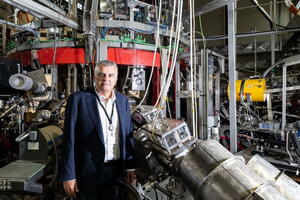
ITER’s Stefan Jachmich is also concerned about disruption budget consumption: how plasma disruptions will affect component lifetime in the tokamak.
For Stefan Jachmich, the ITER Science Division coordinating scientist for disruptions and the meeting host, one of the most encouraging developments since the previous edition in 2024 is the inclusion of machine-learning techniques in many aspects of disruption-related research. “For instance, projections of what to expect are improving, including estimates of electromagnetic loads using synthetic diagnostics,†says Jachmich. “Reliable prediction is essential for both disruption avoidance and mitigation. A missed or late warning may leave too little time for an effective response while a false alarm can trigger an unnecessary shutdown and consume part of the machine’s disruption and component-lifetime budgets.â€When a plasma disruption is predicted, avoidance measures can be taken through the plasma control system. Depending on the cause, the system can adjust the plasma’s magnetic configuration or use heating and current drive systems to suppress potentially disruptive instabilities.If a disruption is unavoidable, mitigation is required. ITER's mitigation system is based on shattered pellet injection. Pellets of cryogenic material (in the case of ITER protium and neon) will be accelerated towards the plasma and shattered before entering it. As the fragments evaporate in the plasma, they rapidly increase its density and help to dissipate a large fraction of its energy as radiation, reducing concentrated heat loads and the risk of runaway electron generation.While the overall design of ITER’s disruption mitigation system has already been established, important questions remain, including the optimal size and composition of the pellets to maximize the material assimilation and how best to deploy them under different plasma conditions. This gives the plasma disruption research presented at the IAEA technical meeting immediate relevance for ITER.
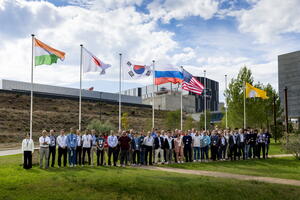
Plasma disruption experts meet in the ITER Council Room. The technical meeting was organized around the themes of mitigation, prediction and avoidance, and consequences.
Other concepts currently being investigated include dedicated runaway-electron mitigation coils and wave-driven pitch-angle scattering of runaway electrons. These approaches are not included in the present ITER design and would be applied to future fusion machines. Another important area of research is narrowing down the range of mitigation scenarios that ITER will need to test when Start of Research Operation begins. During this experimental phase, which is currently scheduled to start in late 2034, a temporary first wall will be in place. The plasma disruption team will be able to evaluate different prediction, avoidance, and mitigation techniques without fear of damaging the much more sophisticated, actively cooled wall that will be in place for deuterium-tritium operation. However, because each disruption provides only a single data point, modelling and multi-machine studies that combine results from other tokamak facilities at ITER Members’ fusion research institutes, along with other tokamaks that will commence operation in the coming years, are essential for precisely determining what ITER needs to test during the first phase.“For example, learning how to mitigate runaway-electron beams during the first phase of ITER operation with the temporary first wall is crucial,†says Jachmich. “This is where we need broad collaboration to build up a picture across different machines ahead of ITER switching on for the first time.â€