Logo
You're currently reading the news digest published from 5 October 2026 to 12 October 2026.
Featured (4)
Press (18)
Featured

4th ITER Public-Private Workshop announced

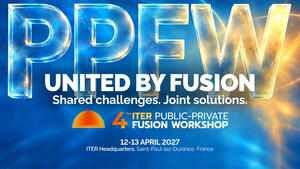
Save the date! The ITER Organization will host the 4th ITER Public-Private Fusion Workshop at ITER Headquarters on 12 and 13 April 2027. ITER Public-Private Fusion Workshops bring together actors from across the public and private fusion communities to strengthen collaboration across the global fusion ecosystem. For the fourth edition in 2027, the workshop will mark a further step in this dialogue, moving beyond information exchange towards practical collaboration on shared technical, engineering and industrial challenges.Under the theme "United by Fusion: Shared Challenges, Joint Solutions," the workshop will explore the engineering and industrial capabilities needed to build and operate fusion facilities, as well as the partnerships, infrastructure and skilled workforce required to accelerate progress.The workshop builds on three previous editions, held in 2024, 2025, and 2026, and forms part of ITER's broader Private Sector Fusion Engagement initiative. Through the sharing of technical documentation and software, cooperation agreements and direct technical exchanges, ITER is making decades of accumulated knowledge and experience available to the wider fusion community, while creating new opportunities for expertise, experience and innovative solutions to flow in both directions. More information on the Private Sector Fusion Engagement (PSFE) Project is available here. A particular emphasis in 2027 will be placed on smaller, focused exchanges between participants and ITER technical teams, designed to identify shared challenges, explore potential solutions, and open opportunities for longer-term cooperation. â€œWe want to move beyond the exchange of information towards concrete cooperation,” explains Deputy Director-General and Chief Scientist of the ITER Organization Alain Bécoulet, who is in charge of the two-day program. “The idea is to bring people together around specific technical challenges and explore opportunities for joint work that benefit both ITER and the wider fusion community. We want to move further from the initial customer mindset to a partnership mindset, where knowledge and expertise flow in both directions, and where public institutions and private actors work together to accelerate fusion.”The 2027 workshop will also place greater emphasis on the contribution of research institutes and universities, recognizing their essential role in connecting fundamental research, technology development, skills and the emerging fusion industry. â€œFusion is a collective endeavour. Public programs, private companies, research institutes and universities bring different strengths and experience, but they face many common challenges. By working together, we can advance faster, reduce unnecessary duplication, and build a stronger global fusion ecosystem,” says Bécoulet.As in 2025, the 2027 ITER Public-Private Fusion Workshop will take place just a few days ahead of the 2027 ITER Business Forum, which will be held in Mandelieu on the French Riviera. Taken together, the two events will provide the opportunity for the fusion community to exchange knowledge, build connections, and explore new partnerships—bringing scientific, technological, industrial, and business perspectives together within a single week.Registration will open in late November on the ITER website. Participation is free and open to private-sector fusion organizations, universities, and research institutions from the ITER Member countries, and well as to entities with collaboration agreements with the ITER Organization.

Why the removal of the first radial beam is a good sign of progress

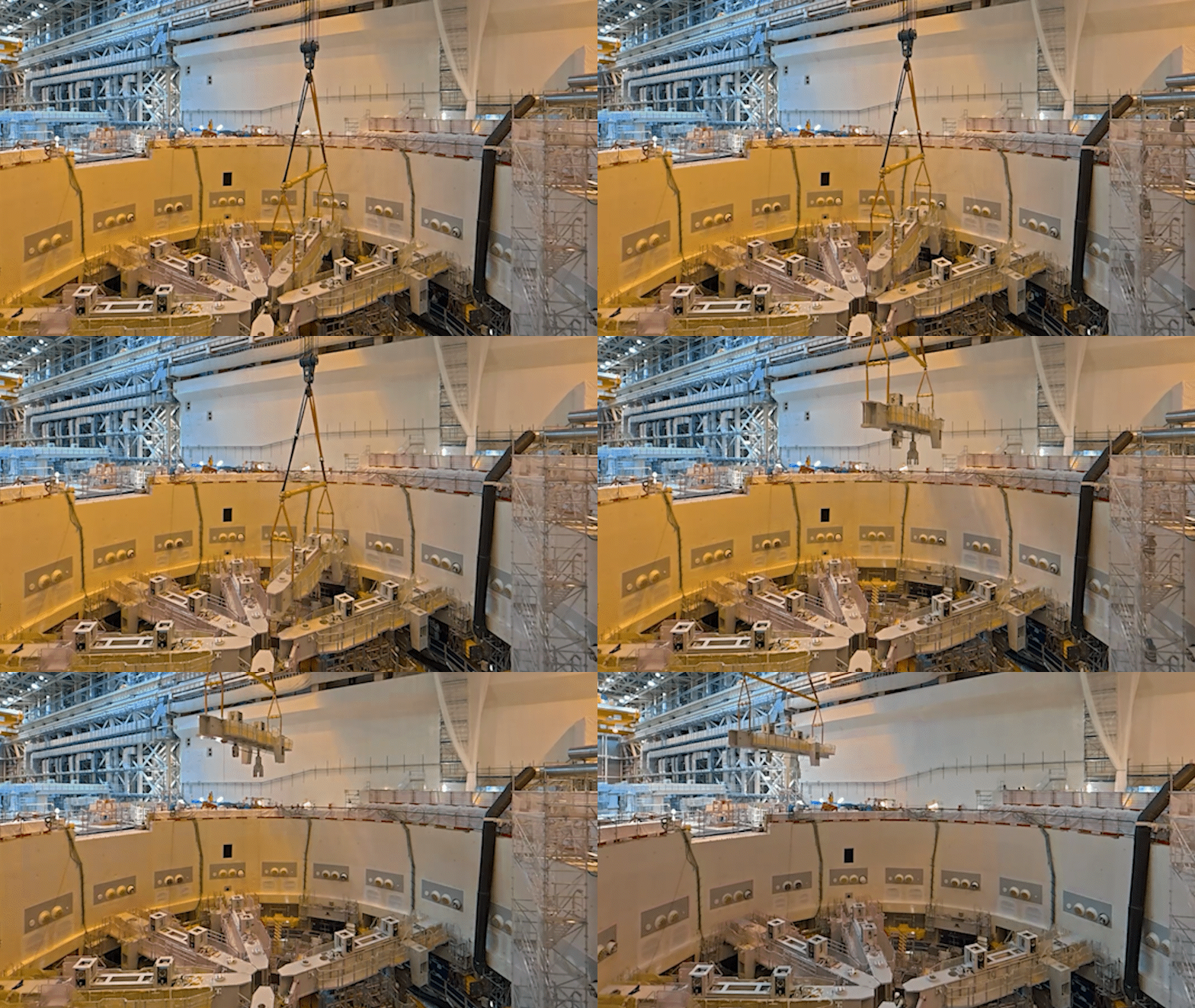
Vacuum vessel sector #5 and its radial beam—a critical element of support during Assembly Hall activities and the first few months in the tokamak pit—have parted ways. Radial beams are temporary lifting tools that support and stabilize sector modules weighing more than 1,000 tonnes as they are lifted from Assembly Hall tooling and lowered into the tokamak pit. After the modules are in position, these 80-tonne beams rest between the central column and the bioshield wall, holding vacuum vessel sectors securely in place for months while they are precisely aligned, stability clamps are attached, and their load is transferred to gravity supports and the tokamak’s underlying support system, the crown.Only once these engineering tasks are completed and metrology confirms that a sector is stable can its radial beam be removed. This operation was carried out for the first time at ITER on Wednesday 7 October as the beam for sector module #5 was successfully extracted from the pit.“The removal is an important milestone because it is the last step to demonstrate that the structure is now sufficiently stable,” says Sébastien Koczorowski, ITER’s Deputy Program Manager for the machine assembly. “This marks a major transition in the assembly process as it opens the way for welding and ex-vessel assembly activities in the tokamak pit that cannot proceed while the radial beams remain in place.” Lifting engineer Gael Hardy checks the hooks and slings on the crane before it moves to the tokamak pit to extract the first radial beam. The operation to remove the radial beam involved a team of more than 20 people and took a little less than two hours.“This operation has real importance because it shows the progress we are making in assembly,” says Colin Smith, the tokamak assembly engineer who oversaw the radial beam extraction. “Now that the first one has been successfully removed, three others will follow in rapid succession.”The extraction of the radial beams is the first step in a longer sequence that will transform the tokamak pit. The final sector module is scheduled to be lowered into the pit in spring 2027, with the last radial beam expected to be removed in September 2027.Once all nine beams have been removed, the central column that has served as a temporary support and alignment structure during sector installation can also be dismantled and extracted from the pit—an operation that is expected to take place over approximately six weeks at the end of 2027. Team members monitor the 80-tonne radial beam as it emerges from the tokamak pit.

Guiding the journal "Nuclear Fusion" into a new era

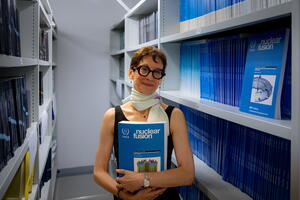
With the fusion landscape evolving at an unprecedented pace, questions of plasma physics are increasingly being joined by those related to engineering and materials science. Having recently been named editor-in-chief of Nuclear Fusion, ITER’s Francesca Poli is helping the journal follow these crucial developments. Peer-reviewed academic journals play an essential role in advancing science by providing a rigorous, independent process for evaluating and disseminating research. Published by the International Atomic Energy Agency (IAEA) since 1960, Nuclear Fusion has served the fusion community in this capacity for more than six decades—and now an ITER scientist, Francesca Poli, is at its helm.“Nuclear Fusion is the reference journal in our field and as a young scientist I always thought it would be an achievement to join the board of editors,” says Poli. “To take on the position of editor-in-chief is a truly great honour. I look forward to helping the journal shape the future of fusion research with the support of our authors, readers, and editorial team.”At ITER, Francesca Poli is working on the development of a plasma simulator that will allow scientists to model plasma behaviour and test operational scenarios before carrying out experiments in the tokamak. She holds a PhD in plasma physics from the École Polytechnique Fédérale de Lausanne and spent 13 years at the Princeton Plasma Physics Laboratory before joining ITER in 2023. Following six years on the board of editors for Nuclear Fusion, Poli was appointed editor-in-chief in June 2026. She is succeeding the late Professor Francesco Romanelli, who led the journal from 2021 to 2026.Poli is taking on this key position at a critical time for fusion research, as the development of commercial-scale fusion machines brings increasingly complex challenges in materials science, engineering and technology to the forefront. â€œAs we go into building many more fusion devices than in the last decades, much more research is being done on materials, on technology, and on operation,” explains Poli. “Nuclear Fusion needs to follow these developments and ensure the applicable research is being published, while also providing some leadership and guidance. This is a direction that the journal had already started and I'm really pushing for us to continue in this direction.”  Francesca Poli (second from left) participates in a meeting in the ITER Council Room during a visit by the IAEA team responsible for documentation. The IAEA has published the journal Nuclear Fusion since 1960. Released monthly, Nuclear Fusion now receives approximately 1,000 submissions a year, a number that has grown by 50% since the early 2020s as the fusion sector expands. The journal has played an important role in documenting ITER’s scientific basis. It published the landmark 1999 ITER Physics Basis that established the physics foundations for the ITER tokamak, followed in 2007 by Progress in the ITER Physics Basis. In 2025, the journal published the special issue On the Path to Tokamak Burning Plasma Operation summarizing the work done since 2007 by the International Tokamak Physics and Engineering Activity (ITPEA) on the physics of burning tokamak plasmas and operation. Most recently, in 2026, Director-General Pietro Barabaschi and 26 ITER colleagues published Progress of ITER and its importance for fusion development.“Nuclear Fusion is a major scientific and technical resource for fusion research and it has a long association with ITER that dates back to the project’s inception in 1988. The first energy confinement scaling law to guide the ITER design was actually published in Nuclear Fusion,” says ITER Science Division Head Alberto Loarte, whose first published academic paper appeared in Nuclear Fusion in 1992. “At the ITER Organization, we place a great emphasis on sharing knowledge with our Members, so having a deeper connection with such a respected journal will only benefit ITER and the worldwide fusion research community.”As editor-in-chief, Poli will also lead the board of editors in selecting the winner of the Nuclear Fusion Award, which recognizes outstanding research published in the journal. In 2025, the award was presented to Stefan Jachmich, ITER's coordinating scientist for disruptions, for a paper on shattered pellet injection.You can read Francesca Poli’s introductory message as editor-in-chief in the July 2026 issue of the journal (issue 7, volume 66).

A little science, a lot of curiosity

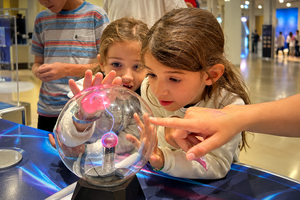
From marshmallows in a vacuum chamber to virtual visits to the construction site of the world's largest tokamak, ITER volunteers had plenty to share with visitors at local Fête de la science events this month. Every October in France, science leaves the laboratory and heads out to meet the public. Across the country, the annual celebration of science (Fête de la science), transforms municipal halls, cultural centres and other public spaces into places of discovery, where experiments are encouraged and no question is too simple.For ITER, a regular participant since 2011, it is an opportunity to bring fusion science into the public sphere. Engineer Raphael Tieulent has captured the attention of the next generation of scientists, and their parents, at the ITER stand in Villeneuve-Loubet. This year, volunteer teams travelled to Villeneuve-Loubet (3-4 October), Manosque (8-10 October) and Marseille (10-11 October), joining events that attracted an estimated 15,000 visitors in total.At the ITER stands, there was something for every age and level of curiosity. Virtual reality headsets transported visitors to the ITER worksite and inside the machine in construction, while a 3D-printed tokamak helped volunteers explain how fusion will work. Relatable demonstrations of electromagnetic fields and plasma drew curious crowds. And the ever-popular vacuum chamber experiment showed what happens to an ordinary marshmallow when the surrounding air is pumped out. (Spoiler: it doesn't stay “ordinary” for long.) At the stand in Marseille, volunteers Ingrid Blain (ITER nuclear pressure engineer) and Sylvain Catouillard (DAHER) help visitors understand the purpose and ambition of the ITER project. Between demonstrations, visitors had plenty of questions about ITER, fusion energy and the progress of machine assembly. Some were discovering the project for the first time; others were returning to hear the latest news from the construction site.Postcards, flipbooks and ITER pens provided a little something to take home—along with, hopefully, a new understanding of fusion and an appetite for more science.For the volunteers, the reward was in the exchanges: the questions, the surprises, and the enthusiasm of visitors young and old. After all, sometimes the best way to explain the science behind the world's largest fusion experiment is to start with something as simple as a marshmallow. Heading into the Fête de la Science exposition in Marseille on 11 October.
Press

PPPL data, simulation codes and compute power will be used in Phase II Genesis Mission project to build digital twin of fusion energy system

https://www.pppl.gov/news/2026/pppl-data-simulation-codes-and-compute-power-will-be-used-phase-ii-genesis-mission

Il più grande reattore a fusione nucleare del mondo riceve l’ultimo componente della sua gigantesca camera al plasma (che è stato costruito in Italia)

https://www.msn.com/it-it/notizie/other/il-pi%C3%B9-grande-reattore-a-fusione-nucleare-del-mondo-riceve-l-ultimo-componente-della-sua-gigantesca-camera-al-plasma-che-%C3%A8-stato-costruito-in-italia/ar-AA2dQj57?cvid=5da86a3ebaf543ffb5bee3a0ad4fa5fe

L’Allemagne soutient la fusion nucléaire à hauteur de 500 millions d’euros

https://www.deutschland.de/fr/news/lallemagne-soutient-la-fusion-nucleaire-a-hauteur-de-500-millions-deuros

ITER receives final vacuum vessel sector for core assembly

https://www.nuclearnewsnetwork.com/news/iter-final-vacuum-vessel-sector-delivered

The first Inner Vertical Target is ready for ITER

https://fusionforenergy.europa.eu/news/the-first-inner-vertical-target-is-ready-for-iter/

ITER welcomes last major component needed for core machine assembly

https://www.ans.org/news/2026-10-07/article-8469/iter-welcomes-last-major-component-needed-for-core-machine-assembly/

Ep277: Nuclear Fusion’s Theranos Moment (video 59:45)

https://cleaninguppod.substack.com/p/ep277-nuclear-fusions-theranos-moment

Europe delivers final ITER vacuum vessel sector

https://www.innovationnewsnetwork.com/europe-delivers-final-iter-vacuum-vessel-sector/74497/

Europe delivers the fifth and final sector of the ITER vacuum vessel

https://energynews.pro/en/europe-delivers-the-fifth-and-final-sector-of-the-iter-vacuum-vessel

World’s largest nuclear fusion reactor receives final piece of its giant plasma chamber

https://interestingengineering.com/energy/iter-fusion-reactor-vacuum-vessel-delivery

Europa levererar sista vakuumsektorn till ITER

https://www.energinyheter.se/20261006/35420/europa-levererar-sista-vakuumsektorn-till-iter

China commissions BEST fusion facility

https://www.neimagazine.com/news/china-commissions-best-fusion-facility/

Laatste megacomponent bereikt ITER: bouw van ’s werelds grootste fusiereactor gaat beslissende fase in

https://tw.nl/laatste-megacomponent-bereikt-iter-bouw-van-s-werelds-grootste-fusiereactor-gaat-beslissende-fase-in/

Термоядерный реактор ITER получил последний сектор вакуумной камеры

https://dzen.ru/a/asVm74wtABJAza4C

Fusione nucleare: consegnati tutti i componenti principali del reattore ITER

https://www.dday.it/redazione/58993/fusione-nucleare-consegnati-tutti-i-componenti-principali-del-reattore-iter

Последняя часть 8500-тонного пазла: термоядерный реактор ITER получил девятый сектор плазменной камеры

https://3dnews.ru/1149546/poslednyaya-chast-8500tonnogo-pazla-termoyaderniy-reaktor-iter-poluchil-devyatiy-sektor-plazmennoy-kameri

A novel path to fusion ignition: heat first, then add fuel

https://www.pppl.gov/news/2026/novel-path-fusion-ignition-heat-first-then-add-fuel

Europe delivers final ITER vacuum vessel sector

https://www.world-nuclear-news.org/articles/europe-delivers-final-iter-vacuum-vessel-sector