Logo
You're currently reading the news digest published from 12 October 2026 to 19 October 2026.
Featured (3)
Of interest (1)
Press (9)
Featured

JOREK magneto-hydro-dynamic simulation code now available open source

The open licence will allow a broader group of scientists to contribute to and validate the JOREK code against experiments.  As recently announced by the European Consortium for the Development of Fusion Energy (EUROfusion), the JOREK code is now openly accessible to the worldwide fusion scientific community at the ITER IMAS repository. JOREK is a reference code for the simulation of magneto-hydrodynamic plasma instabilities, which members of the ITER Organization have contributed to with developments.JOREK is extensively used for modelling of plasma disruptions, which are the most intense plasma instabilities in tokamaks, and the associated thermal and electromagnetic loads on components installed inside ITER’s vacuum vessel to protect it from plasma and neutron impact (see Fig. 2). However, its most important application for ITER is the study and improvement of the efficiency of disruption mitigation. JOREK can accurately simulate the physics of the injection of shattered pellets and the resulting 3-dimensional evolution of the magnetic field, which determines the deposition of energy and particles (including runaway electrons) in the large-scale plasma disturbances that take place during disruptions.   For more details on JOREK please consult the EUROfusion announcement. --Figure 1 (right). JOREK simulation of the temperature profile evolution following the injection of a shattered pellet for disruption mitigation [D. Hu et al 2024 Nucl. Fusion 64 086005]  Figure 2. (Left) Maximum surface temperature of the tungsten first wall in ITER (black spots correspond to locations where melting temperature is reached) and duration of the phase during which tungsten remains liquid (right) during a 15 MA unmitigated Vertical Displacement Event. The first wall surface is represented in toroidal (Φ) and poloidal (θ) coordinates, with the index referring to the numbering of the various first wall panel toroidal rows in ITER [F.J. Artola et al 2026 Nucl. Fusion 66 086036].

Through a photographer's lens

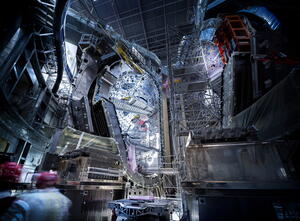
Photographer Jan Hosan explores the nexus between visionary science and technological complexity. The German photographer Jan Hosan has documented science and industrial projects in more than 70 countries. He recently returned to ITER for the third time to capture new images of the progress being made on tokamak assembly.“Having had the opportunity to photograph several fusion reactors on behalf of the Max Planck Institute for Plasma Physics and various magazines, my interest in fusion research has continued to grow,” says Hosan. “I am particularly fascinated by the interplay between visionary science, technological complexity, and the quest for a sustainable energy source. To me, ITER is a unique project that brings these dimensions together—a development I would very much like to document through my photography.”See images from Hosan’s previous visits to ITER here.(And you can see a bonus photo from Hosan in this week's news on Wendelstein 7-X!)

First production unit completed in Europe

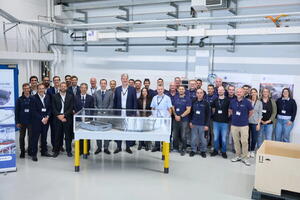
Three years after the launch of series manufacturing, the first inner vertical target for the ITER divertor has been completed by German supplier Research Instruments. The milestone marks an important step in the procurement of one of the most technically demanding components of the ITER machine. Positioned at the bottom of the vacuum vessel, the divertor is designed to exhaust heat, helium ash and other impurities from the plasma. Its plasma-facing components—the inner vertical target (Europe), outer vertical target (Japan) and dome (Russia)—must withstand exceptionally intense heat loads of up to 20 MW/m², approximately ten times those experienced by a spacecraft re-entering Earth's atmosphere.Each inner vertical target is armoured with 2,208 precisely machined tungsten blocks, which are joined to water-cooled tubes through a process called brazing, and mounted on a curved steel support structure. Manufacturing requires exacting dimensional tolerances, sophisticated joining techniques and rigorous quality controls. The first series unit, completed by Research Instruments in Germany, is the culmination of more than a decade of development, prototyping and qualification activities coordinated by the European Domestic Agency, Fusion for Energy (F4E). Its fabrication involved an international supply chain of more than 60 companies.Europe is responsible for supplying 58 inner vertical targets, including four spares. Research Instruments has contracts for 28 units, while French supplier ALSYMEX is manufacturing another 13.With the first series component completed, the challenge now shifts to accelerating production while maintaining the stringent quality standards required for ITER.Read the full story on the Fusion for Energy website.

Of interest

Wendelstein 7-X: new experimental campaign underway

https://www.iter.org/of-interest?id=35771
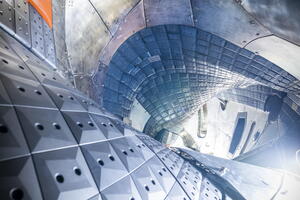
Germany’s Wendelstein 7-X stellarator began a new experimental campaign in September, bringing together scientists from around the world to advance research into high-performance plasmas and long-pulse operation in stellarators.The OP2.4 campaign, scheduled to run through mid-December, builds on previous achievements in plasma confinement and sustained operation. Among the participants are EUROfusion researchers from approximately 20 European laboratories, whose contributions focus on three priorities: achieving hotter, denser and better-confined plasmas; improving understanding of fast-ion behaviour and turbulence; and extending high-power plasma discharges.One ambitious objective is to sustain discharges lasting more than 500 seconds, with an energy throughput of 6 gigajoules.Unlike tokamaks, stellarators use a complex, three-dimensional magnetic field to confine plasma without requiring a strong plasma current. The results of the campaign will help improve physics models and inform the development of future stellarator-based fusion power plants.Read the full article on the EUROfusion website.--Photo: MPI for Plasma Physics, Jan Michael Hosan
Press

Swiss expertise to power up ITER

https://fusionforenergy.europa.eu/news/swiss-expertise-to-power-up-iter/

New experimental campaign at Wendelstein 7-X to push boundaries of the excellent physics results

https://euro-fusion.org/eurofusion-news/wendelstein-7-x-op2-4-experimental-campaign/

Spektrum Podcast: Ist das Fusionskraftwerk die Zukunft?

https://www.spektrum.de/podcast/spektrum-podcast-ist-das-fusionskraftwerk-die-zukunft/2350095

Росатом успешно завершил этап квалификационных испытаний вольфрама для ИТЭР

http://www.atominfo.ru/newsz10/a0052.htm

PPPL celebrates its 75th anniversary

https://www.pppl.gov/news/2026/pppl-celebrates-its-75th-anniversary

Public-private partnership to bring new exhaust system to DIII-D

https://www.ans.org/news/2026-10-15/article-8489/publicprivate-partnership-to-bring-new-exhaust-system-to-diiid/

JOREK, a plasma simulation code, is now open source

https://euro-fusion.org/eurofusion-news/jorek-a-plasma-simulation-code-is-now-open-source/

Physics and fusion research advances through Fermilab’s MAGNES

https://news.fnal.gov/2026/10/physics-and-fusion-research-advances-through-fermilabs-magnes/

WEST’s ECRH system is operational with its first gyrotron

https://irfm.cea.fr/en/2026/10/west-s-ecrh-system-is-operational-with-its-first-gyrotron/