Paul-Henri Rebut, a fusion visionary
It is with deep sadness that the ITER Organization has learned of the passing of Paul-Henri Rebut at the age of 91. A pioneering plasma physicist, visionary engineer, and one of the great figures of European fusion research, Rebut helped shape some of the most important machines in the history of magnetic confinement fusion—including the Joint European Torus (JET) and the early design of ITER.
When Paul-Henri Rebut joined the newly established Fusion Department of the French Atomic Energy Commission (CEA) in September 1958, fusion research was still in its infancy. Experimental plasma discharges lasted barely a millisecond and temperatures were a fraction of those required for fusion. Yet the young graduate in physics from France's prestigious École Polytechnique was already convinced that fusion would one day play an essential role in meeting humanity's energy needs.
They rememberPaul-Henri was the one who interviewed me when I joined JET, and again when I joined ITER in 1993 during early Engineering Design Activities. I worked closely with him for about five years at JET and later at ITER. He was a person of exceptional imagination and of total commitment to fusion and to ITER. His manner could at times be a little rough, but those who came to know him well discovered a man of deep humanity. I owe him a great deal, and I know that many in our community, at ITER and in the fusion laboratories around the world, feel the same. Pietro Barabaschi, ITER Director-General
Over the following four decades, Rebut would help transform that conviction into scientific and technological reality. He played a leading role in the design and construction of the French TFR tokamak (Tokamak de Fontenay-aux-Roses), which became one of the world's leading fusion devices in the 1970s. He went on to help design and build the Joint European Torus (JET), serving as its director from 1985 to 1992.Under his leadership, JET achieved a series of remarkable milestones, including plasma currents of 7 mega-Amperes far exceeding its original design specifications and near-breakeven-equivalent conditions in deuterium-deuterium plasmas. On 9 November 1991, JET became the first magnetic confinement device to produce significant fusion power from a mixture of deuterium and tritium.
This work is licensed under a Creative Commons Attribution-NonCommercial-NoDerivatives 3.0 Unported License (CC BY-NC-ND 3.0).
Download
Paul-Henri Rebut, foreground (left), together with JET director Hans-Otto Wüster, witnessing JET’s first plasma on 25 June 1983.
For Rebut, however, even this historic breakthrough was only a step toward a larger goal. In an interview in the ITER Newsline 20 years later, he explained, "JET in itself was of no use if it didn't open the path for a new machine."That next machine was ITER. As the project's first director during the Engineering Design Activities phase (1992–1994), Rebut helped establish the foundations of its engineering design and the scientific framework that would guide its development.
They rememberRebut was director when I was doing my PhD at JET (for which he gave me a JET grant). He selected me to join the ITER divertor modelling physics expert group when these groups were formed in 1994. I was only 29. I will always be grateful to Paul-Henri Rebut and the JET director at that time, Martin Keilhacker, for their trust in my capabilities. I worked a lot to deserve this, but also learned a lot by interacting with the other experts who were more senior than me and were the best in the world in my field of expertise. Alberto Loarte, Head of the ITER Science Division
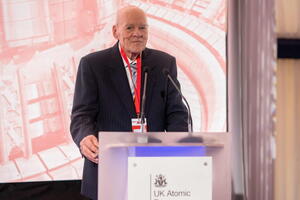
He also established the ITER Physics Expert Groups, an expansion of the physics activities on plasma confinement started during ITER’s Conceptual Design Activities (1988-1990). Their work culminated in the publication of the first ITER Physics Basis in 1999 and evolved into the continuing International Tokamak Physics Activity, now the International Tokamak Physics and Engineering Activity (ITPEA).Rebut's contributions extended well beyond the design and construction of machines. An exceptionally creative physicist, he made important advances in the understanding of magneto-hydrodynamics instabilities (tearing modes and disruptions), tokamak energy confinement and the control of power fluxes to the walls of fusion reactors (plasma detachment). In 2006, the European Physical Society honoured him with the prestigious Hannes Alfvén Prize, describing him as "one of the most successful physicists, engineers, machine-builders and managers in the history of magnetic confinement fusion." In 2024, he was at JET for one last time for a celebration of JET’s successful history and the role he played in it.
Paul-Henri Rebut, "... one of the most successful physicists, engineers, machine-builders and managers in the history of magnetic conï¬nement fusion."
Those who knew Rebut also knew a man of strong convictions, intellectual independence and an enduring willingness to challenge established thinking. He continued to contribute to ITER as a consultant long after leaving its leadership, offering new ideas and drawing on an experience that few in the fusion community could match.With the passing of Paul-Henri Rebut, the international fusion community loses one of its great pioneers—a scientist and builder whose imagination, determination and achievements helped carry fusion from its earliest experiments toward the ambitious international undertaking that ITER represents today. His legacy lives on in the machines he helped create, the scientific advances he inspired, and the generations of researchers and engineers who continue the work to which he devoted his life.