Into thin air
A successful helium testing campaign for ITER’s first production cryopump has demonstrated strong pumping performance and provided valuable experience with the equipment, instrumentation and procedures that will be used during commissioning.
A vacuum is a space where the air pressure is lower than the surrounding atmospheric pressure. This pressure is measured in pascal, with lower values indicating fewer gas molecules per unit volume and thus a higher vacuum.At ITER, an ultra-high vacuum measuring 10â»â¶ pascal—an air pressure level approximately 100 billion times lower than the air we breathe—must be created inside the vacuum vessel before a plasma can be generated. To do this, a constellation of components (the vacuum vessel chamber, pumps, cryogenic systems, vacuum lines, valves…) must operate in perfect harmony. One of the stars of this process, a customized cryopump developed through two decades of research and engineering, has now shown it can efficiently evacuate helium from a test tank and achieve the target vacuum levels.“The results are a win for all of us,†says Alessandra Iannetti, ITER’s vacuum delivery coordinator. “It’s also an important step towards operating the tokamak vacuum systems because we’re not just testing equipment and instrumentation, we’re learning how to work together and refining procedures that, until now, have largely existed on paper.â€The vacuum required in the ITER plasma chamber will be created in two steps. First, mechanical pumps, known as “roughing pumps,†suck air molecules out of the chamber and take the pressure down from the standard atmospheric pressure of 105 pascals down to 10 pascal. Then, the specialized cryopumps reduce the pressure to the required base operating level of 10â»â¶ pascal through the process of “cryosorptionâ€: the pumps are cooled to 4.5 K (about −269 °C) and at these extremely low temperatures, residual gas particles in the air lose energy and are trapped as they come into contact with the activated charcoal in the cryopanels.The cryopumps will also perform a critical function during plasma operations by removing exhaust gases, including unburned fuel (deuterium and tritium) and most importantly the helium “ash†produced by fusion reactions.In total, there will be eight main cryopumps serving the ITER tokamak: six to create and maintain vacuum conditions in the vacuum vessel and two installed on the cryostat to provide the vacuum that thermally insulates the magnet system.
This work is licensed under a Creative Commons Attribution-NonCommercial-NoDerivatives 3.0 Unported License (CC BY-NC-ND 3.0).
Download
To confirm the cryopumps can perform at the necessary levels for plasma operations, ITER built a cryopump test facility and ran cold tests on a pre-production cryopump in 2025.Testing of the first production pump was conducted from 21 to 27 October 2026 using a 15-cubic-metre test tank. Pumping tests were performed with helium and a mixture of helium, hydrogen and neon simulating the gas throughputs expected under certain ITER operating scenarios. After successful cooldown to 4.5 K, the pump underwent several pumping tests and reached the target of 10â»â¶ pascal while demonstrating a helium pumping capacity nearly 50% higher than achieved on the pre-production unit tested last year.The campaign also provided an opportunity to test several auxiliary systems alongside the cryopump, including control software, inlet valve modulation and the procedures used to isolate the pump for regeneration—a process in which the pump is warmed to release the gases it has trapped. The team also gained experience with the residual gas analyzer, which identifies the gases present in the system, and specialized vacuum instrumentation, including optical sensors.In 2027, a second production cryopump will be tested for its ability to evacuate hydrogen, a process that is crucial for plasma operations. All eight pumps will then be kept in protected storage at ITER until their installation in the tokamak, which is scheduled to begin in 2029.“The experience we have gained from this round of testing on the production cryopump is a positive step towards commissioning,†says Liam Worth, ITER Vacuum Systems Project Leader. “The helium results are encouraging, and the campaign has provided valuable information that will help us prepare for the next phase of testing with hydrogen in 2027.â€
This work is licensed under a Creative Commons Attribution-NonCommercial-NoDerivatives 3.0 Unported License (CC BY-NC-ND 3.0).
Download
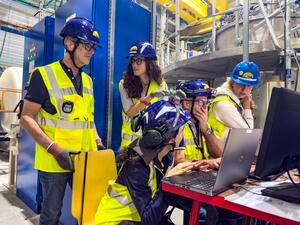
The vacuum test team is all smiles after the first production cryopump was cooled down to 4.5 K and created a high vacuum. The cryopump and test tank stand behind them on the right while thick cryojumper connections snake their way to the cold valve box on the left.