ITER sustains strong project execution
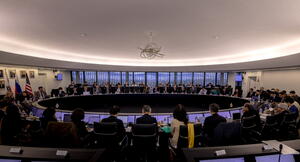
Progress on the ground, strong performance against the project schedule, and renewed commitment from the seven ITER Members: these were the key messages emerging from the 39th meeting of the ITER Council, held on 18–19 November 2026. Against the backdrop of continued advances in tokamak assembly, commissioning preparations and licensing, the Council acknowledged the achievements of the ITER Organization and Domestic Agencies and reaffirmed its determination to support the success of this unprecedented international undertaking.
Delegations from all seven ITER Members gathered at ITER Headquarters for the second time this year to review project performance against Baseline 2024.Six of the nine vacuum vessel sector modules are now in place in the tokamak pit and a seventh is scheduled for installation in the last week of November. Project execution remains strong, with 212 Level-1 milestones achieved against a target of 202.Council members also noted advances in commissioning and testing—including the first successful gyrotron pulses, continued coil testing at the magnet cold test facility, and the accreditation of the ITER static magnetic field laboratory under the ISO/IEC 17025 standard—and welcomed the progress reported in quality management and in the discussions with the French Authority for Nuclear Safety and Radiation Protection (ASNR) on ITER’s licensing requirements.At the end of the two-day Council meeting, a ceremony was held on site to mark the completion and delivery of all vacuum vessel sectors, as the final sector had been delivered by the European Domestic Agency, Fusion for Energy, in October.
Representatives from the ITER Members attending the 39th ITER Council on 18 and 19 November join staff and contractors on site for a celebration of vacuum vessel completion. The nine sectors of the ITER vacuum vessel were procured in a multidecade effort by Europe (five sectors, including sector #2 in the background) and Korea (four sectors).
“The vacuum vessel is a demonstration of the true nature of ITER as an enterprise that no single country can achieve on its own, but where together we can do miracles,†said Jan Panek, Europe’s Head of Delegation to the ITER Council and Director for Nuclear Energy, Safety and ITER at the European Commission (DG ENER). “The achievement shows the strength and maturity of a partnership built on mutual trust and borne out in practice.â€Echoing this message, Lee Chan-Young, Head of the Korean delegation to the ITER Council and Director of the Nuclear Fusion Energy and Environmental Technology Division at Korea’s Ministry of Science and ICT (MSIT), emphasized ITER’s role in international cooperation: “Beyond national boundaries, [ITER] unites our knowledge, expertise and resources. It stands as a powerful example of international cooperation and a symbol of science diplomacy.â€With all vacuum vessel sectors, superconducting magnets, cryostat sections, and the thermal shields now delivered, a procurement effort spanning almost two decades for core components of the ITER tokamak has come to a close. In addition, the completion this autumn of the repair campaign for key components removes a major risk factor for the continuation of assembly.Read the full ITER Council (IC-39) press release in English or French.