
Third CLI Meeting: "Making ITER a success—with you!"
1 Oct 2010
-
Robert Arnoux
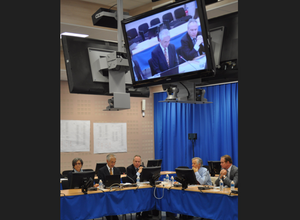

Every time a nuclear installation is created, French law requires that a Local Commission for Information (CLI) be established.
When the ITER CLI, the Local Commission for Information for ITER, was established in December 2009, Kaname Ikeda, then ITER Director-General, defined it as "an opportunity for mutual understanding, a place where any question can be asked and all answers will be provided."
The CLI's third meeting, on Monday 27 September, in the Council Room at the Château fell perfectly into this definition.
"I have come here to make ITER a success—with you," DG Osamu Motojima told the assembled CLI members.
As the Preliminary Safety Report was being presented to the CLI members, there were indeed several questions asked, some harsh, most of them pertinent, and all were answered in detail by Director-General Osamu Motojima, Deputy Director-General Carlos Alejaldre, and Section Leader (Safety Design and Integration) Joëlle Elbez-Uzan.
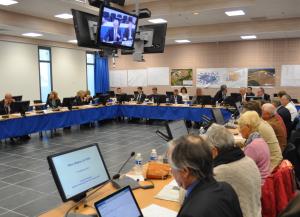

The CLI is composed of members of Parliament, representatives from local communities, environmental groups, trade unions, businesses and health professionals.
The CLI, which is composed of members of Parliament, international experts, representatives from local communities, environmental groups, trade unions, businesses and health professionals "reflects the image of ITER in the local population," says Section Leader Bertrand Beaumont (Ion Cyclotron & Lower Hybrid) and the ITER staff representative at the CLI. "I see my role as an interface: I try to convey to my colleagues what the CLI expresses and worries about."
Jean Gonella, a math and physics professor at the Université de Provence in Marseille, explains that he is "neither pro- nor anti-ITER," but "fascinated by the project." A veteran activist, his purpose in joining the CLI was "democracy." "The debates we have here are good for the project and can contribute to make it better. During today's meeting, for example, we were provided with a lot of very useful information."
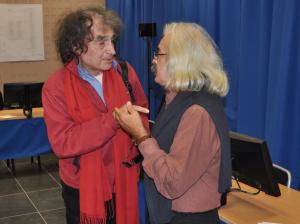

"The debates we have here are good for the project and can contribute to make it better," says Jean Gonella (left) a math and physics professor at the Université de Provence and veteran activist.
Does Gonella "trust" the information he is given? "I'm a scientist," he says, "and science is not founded on trust. Experts know, scientists doubt ..."
Whatever their background or their attitude toward the project—Maryse Joissains, the mayor of Aix-en-Provence and President of the Greater Aix Council renewed her commitment to ITER—most CLI members agree: information is a central issue. "I'm amazed at the abyss that lies between the reality of ITER and the perception, sometimes, of the general public," says Beaumont.
"It is difficult for an 'ordinary citizen' to have a clear idea about ITER. A lot of explanation, using simple words, is required," adds Gonella.
Some CLI members may appear to be and behave as "adversaries" of ITER. As Gonella says, however: "Nothing is better than an adversary to make progress toward the truth."