
Conductor tests under scrutiny
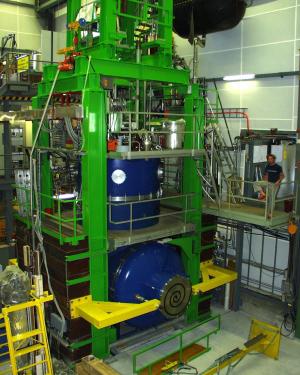

The testing of the ITER central solenoid conductors last November in the SULTAN facility produced some puzzling results. In an article that appeared in March, 2011, Nature viewed these results as proof of a "potentially serious problem" that could "further delay" the project.
For Neil Mitchell, Head of the ITER Magnet Division, some of the SULTAN data simply "does not fit with our existing database of conductor behaviour." The issue, he says, may not be about "real quality" but rather the consequence "of an artefact of the samples and of the test arrangement."
Conductor samples tested in SULTAN are exposed to magnetic field, current intensity and temperature conditions that are very close to those of the actual ITER environment—with one important difference. "SULTAN's configuration prevents us from mimicking the strain that magnetic forces exert on the conductor in a coil," explains Neil.
For the niobium-tin (Nb3Sn) superconducting compound used in central solenoid conductors, strain simulation is a crucial parameter in the qualification process. In the SULTAN tests, however, ITER-like magnetic forces can only be applied to a 45-centimetre section of the three-metre-long straight sample. In Neil's opinion, this is what causes "a local unrepresentative strain pattern" and is the artefact that distorts the results of the tests. This supposition has been confirmed by strain gauges placed on the sample.
The SULTAN tests consist of submitting the central solenoid conductor samples to several thousand cycles in order to verify that they will withstand the 60,000 or so current pulses that are anticipated during ITER's lifetime. Neil explains: "We cycled two conductor samples 7,000 times. Results were getting better through the first 100 cycles, then went down to the original level over the following 900 and then continued down. It doesn't make sense to ignore the increase and focus on the decrease. The combination shows that this is not just an irreversible degrading of the conductor under the magnetic forces."
While a program is being implemented to definitively confirm the cause of the SULTAN sample behaviour and also to improve the sample design and data interpretation, another solution exists for discriminating between the probable deficiency in testing methodology and a possible quality issue: the central solenoid insert. This solution consists in inserting a new conductor sample into the central solenoid model coil that was built during the ITER Engineering Design Activities (EDA) in the mid-1990s.
"As we know from the first successful model coil test, the central solenoid insert option would provide conditions that are much closer to reality," says Neil. "The central solenoid insert should be manufactured and tested as soon as possible to confirm the actual conductor performance, benchmarking the SULTAN samples."
It has been agreed that the US Domestic Agency will manufacture the central solenoid insert for testing in Naka, Japan, beginning 2013.
The ITER Organization now faces a difficult decision: since toroidal field conductors face some of the same testing issues as central solenoid conductors, should toroidal field manufacturing be delayed until a reliable quality test is available? And should ITER also wait to initiate central solenoid conductor manufacturing?
"In view of the data already available," says Neil, "which show that the toroidal field conductors have sufficient margin to meet the requirements despite the uncertainty of the test results, ITER believes that it is an acceptable risk to continue with toroidal field production and initiate central solenoid production as soon as we have a sample test where we can separate artefacts from real degradation."