
Sensitive detector to measure fusion power
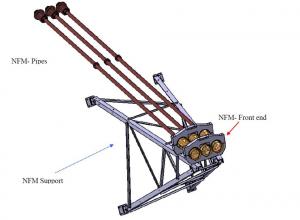

In and around the ITER Tokamak, 40 diagnostic systems will capture and relay key information during ITER's plasma pulses. Providing information on operational parameters as varied as density, temperature, impurity level, plasma current, and fusion power, these systems will provide the data necessary to control and protect the machine, and to understand and optimize the physics of the plasma.
A specific subset of neutron diagnostic systems in ITER will measure the emission of neutrons during the fusion reaction and provide real-time information about the level of fusion power. As one neutron is produced by every fusion reaction, measuring neutron output during experimental plasmas can convey important information on the amount and location of fusion reactions.

This month, the Procurement Arrangement for a neutron flux monitor planned for equatorial port 07 was finalized after signature by ITER Director-General Osamu Motojima (5 August) and Head of the Chinese Domestic Agency Luo Delong (2 September). This is the second completed Procurement Arrangement for the ITER Diagnostic Division ... and also the second neutron diagnostic signed (see report on the neutron activation system in Newsline 182). "This milestone is the result of a lot of hard work by both sides and an important step in realizing our joint responsibility in providing the key measurement systems in ITER," commented Diagnostic Division Head Michael Walsh, on the occasion of the signature.
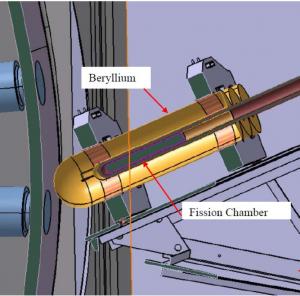
The neutron flux monitor (NFM) is composed of three cylindrical fission chambers containing argon gas and a tiny amount of uranium (235U). Each neutron arriving from the fusion reaction induces a fission event in the uranium layer of the chamber, triggering a pulsed signal that is transmitted to an electronic acquisition system. The pulses induced by individual neutrons can be calibrated and related to the total neutron yield rate in real time, and to total fusion power in megawatts (MW). Each fission chamber contains a different amount of fissionable material and therefore varies in sensitivity, which permits the measurement of a range of neutron yield, from low to high.
In order to increase the probability of fission events, each fission chamber is inserted into a moderator. As the neutrons pass through the moderator, they lose part of their energy and induce a fission event more easily (the lower the energy of the neutron, the higher the probability of a fission event).
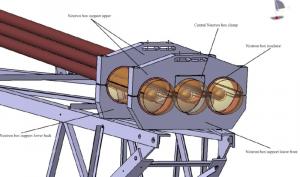

The neutron flux monitor for equatorial port 07 is the first of four NFMs planned for the ITER machine. Highly sensitive, it will be used during the early deuterium phase of operation and for initial tritium operation to measure low/medium fusion power levels. Three similar systems are planned at equatorial port 01 for low fusion power measure during the deuterium phase and equatorial ports 08 and 17 for high-power measurement during full tritium operation.
"This diagnostic, which will be located in the cryostat region of the Tokamak between the vacuum vessel and the bioshield, has been a challenge to integrate into the machine," explains Luciano Bertalot, Technical Responsible Officer for this Procurement Arrangement. "This month's signature is the outcome of very efficient collaboration between the diagnostic teams at the ITER Organization and the Chinese Domestic Agency."
Dr. Fang, Diagnostic Division Head for ITER CHINA, added: "China has accumulated experience with diagnostics in related fields and has made specific R&D work related to ITER requirements. It has been a pleasurable collaboration between ITER China and the diagnostics team at ITER. ITER China will soon begin the procurement description preparation and the tendering process for this diagnostic as scheduled."