
ITER engages in energy security debate
13 Apr 2012
-
Sabina Griffith
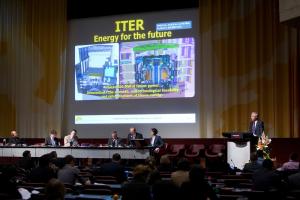

"The advantages of fusion energy are considerable." Director-General Osamu Motojima takes the ITER Project back to Geneva—the place where it all began.
Twenty-seven years after the leaders of the United States and the Soviet Union, Ronald Reagan and Mikhail Gorbachev, met on the Swiss shore of Lake Geneva to agree on an international effort to develop fusion energy "as an inexhaustible source of energy for the benefit of mankind," the ITER Project—born that day—entered the stage again.
The International Congress on Energy Security in Geneva last week attracted the representatives of many organizations and institutions that either analyze energy demand or are very directly involved in its supply. The stakes are high—a point stressed by every speaker during this two-day event.
"The era of cheap and abundant energy is soon ending," said ITER Director-General Osamu Motojima, who had been invited to deliver the keynote speech. "The advantages of fusion energy, although not easy to achieve, are considerable. The universal availability of the fusion fuels will contribute to easing the international tensions that energy supply and demand currently generate."
"Energy security, is, in all its aspects, a key issue for the international community," UN under-secretary-general Kassym-Jomart Tokayev added in his opening remarks. "International organizations, industry, civil society, and governments must partner to meet this challenge, so that the vast opportunities of the modern world are available to everybody. And, of course, for these opportunities to be truly available to everybody they must be approached in a sustainable fashion."
One of the major questions addressed at this energy summit was the future of nuclear energy. Where and how will nuclear energy position itself in the new world order that was shaped on 11 March 2011? "Fukushima changed it all," said Hans Püttgen, director of the Energy Center in Lausanne. "The race to get out of nuclear first is on."
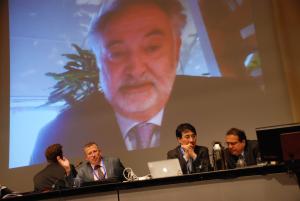

The head of ITER Communication Michel Claessens (2nd from left), chairs a session with Jacques Attali, who came in via video.
Taking a look at the nuclear issue from a very French angle was Jacques Attali, President of PlaNet and special advisor to the former French President Francois Mitterand. "Nuclear here in France represents an important portion of the energy mix and a rapid pull-out would consequently mean a steep increase in the price of electricity." However, Attali added, the Fukushima disaster had shown that there was still a "certain lack of transparency" when discussing nuclear issues.
In such a context Oliver Steinmetz, one of the founding fathers of Desertec, presented one of the world's most ambitious solar initiatives, whose aim it is to generate and transmit solar power from the world's deserts. Driven by the maxim that within six hours the deserts receive more energy from the sun than humankind consumes in a year, industrial partners in Europe, the Middle East, and North African are collaborating to build solar power stations.
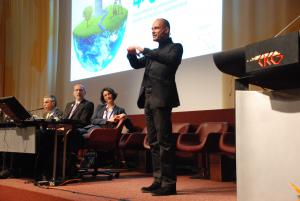

"Our best allies are those who tell us that our undertaking is impossible," said Bertrand Piccard, psychiatrist, explorer and founder of the Solar Impulse project.
Another highlight of this Energy Security Conference was the presentation of Bertrand Piccard, son of the famous deep-sea explorer Jacques Piccard and the first man ever to circumnavigate the world in a hot-air balloon. With his Solar Impulse project, Bertrand Piccard proved that it was possible to fly night and day for more than 26 hours without fuel, powered only by solar energy. When asked about his motivation for seeing the project through against all odds, Bertrand Piccard replied: "Our best allies are those who tell us that our undertaking is impossible."