Logo
You're currently reading the news digest published from 7 April 2026 to 13 April 2026.
Featured (3)
Of interest (1)
Press (6)
Featured

On KSTAR, ITER’s plasma control system successfully takes charge

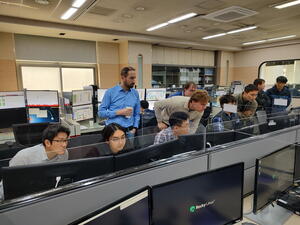
In March, ITER’s plasma control system (iPCS) was successfully deployed and operated on the KSTAR tokamak in Daejeon, Korea. The primary objective was to validate the behaviour of the ITER plasma control system under realistic operating conditions and to expose system‑level issues at an early stage. The experimental campaign was carried out between 9 and 20 March 2026 and comprised a total of 38 pulses, including four preliminary commissioning pulses. The campaign marked a major milestone for the development of the ITER plasma control system, as this was the first time the system achieved first plasma on an operating tokamak—a concrete result that reduces technical risk ahead of ITER plasma operations.The activities were led by the ITER CODAC team (Control, Data Access and Communication) and jointly executed with the ITER plasma control system design team, establishing a direct feedback loop between design intent, implementation, and operational validation.The iPCS—which is the name given to the plasma control system deployed at KSTAR â€”isolates the core structural framework of the ITER plasma control system, while maintaining complete structural equivalence without component-level modifications and supporting direct and transparent integration with KSTAR plant systems.The role of Korea’s KSTAR tokamak in the development of ITER’s plasma control system is strategic, enabling the system to be validated on a fully operational superconducting tokamak. “Operating the system on a live machine allows controller behaviour, timing performance, and plant‑system integration to be assessed under real constraints that cannot be fully captured by simulation alone,” says Control System Coordinating Engineer Woong-Ryol Lee. “This setting provides an effective framework for close coordination between CODAC and the design team, enabling rapid iteration and informed design refinement.” This figure shows representative plasma current evolutions obtained using different start-up scenarios, namely trapped particle configuration (TPC) (#41773), ohmic (#41774), and electron-cyclotron heating (ECH)-assisted startup (#41775). Two performance targets were defined for the 2026 campaign: a plasma current exceeding 0.1 mega‑ampere and a plasma flat‑top duration longer than 100 milliseconds. Both targets were exceeded with significant margin. Peak plasma current surpassed 0.2 mega-ampere, and plasma duration reached approximately 0.8 seconds, exceeding one second in later experiments.Plasma initiation was successfully demonstrated using three complementary start‑up scenarios: ohmic, electron cyclotron heating (ECH)‑assisted, and trapped particle configuration. The first plasma achieved by the ITER plasma control system was obtained on 10 March 2026 using an ECH‑assisted scenario. The results provided practical confirmation of the control strategies defined during the design phase. The ITER delegation at KSTAR for the iPCS campaign (from left to right): Taehyun Tak, Piotr Perek (DMCS), Luca Zabeo, Woong-Ryol Lee, Timo Ravensbergen, and Myounghun Kim. In parallel, integrated real‑time operation of the edge Thomson scattering and two-colour interferometer diagnostics was successfully demonstrated, confirming that real-time framework (RTF)‑based diagnostic applications can operate synchronously with the plasma control system during tokamak operation. This integration further validated the end‑to‑end control and diagnostics architecture under CODAC coordination.“The successful collaboration with KSTAR demonstrates the effectiveness of ITER’s development model, in which CODAC implementation and close collaboration with the plasma control system design team are used to mature critical systems through operation on existing facilities,” says Project Leader Mikyung Park. Experience gained from real‑machine commissioning and joint evaluation directly strengthens confidence in ITER’s plasma control system architecture and its readiness for upcoming program milestones. Future campaigns will progressively introduce additional control functions, advancing the system towards full plasma control capability for ITER.Below, a video recorded by a diagnostic CCD camera capturing the first plasma (#41608) generated under the control of the ITER plasma control system (iPCS).

New program published

The updated agenda for ITER’s 3rd Public-Private Fusion Workshop, newly published today, marks a clear evolution from the broad thematic framing first described in Newsline in February as “Fusion: a Joint Quest” to a fully articulated program. It offers a sharper picture of how collaboration across the fusion ecosystem is taking shape in practice. Workshop participants will experience a stimulating sequence of sessions ranging from how to incorporate advanced technology domains (robotics and AI) to familiar fusion challenges (high-temperature superconductor magnet scale-up; first wall materials; tritium breeding), as well as lessons learned from ITER and best practices driving public-private partnerships. The opening “Fusion Innovation” session on robotics highlights the complexity of remote handling inside the demanding environment of a tokamak, with multinational contributions ranging from ITER’s use of large-scale robots to specialized tooling, sensing technologies, and telemanipulation. This is complemented by a dedicated session on AI and machine learning, where major technology players such as Nvidia and NTT join emerging innovators to explore digital twins, predictive maintenance, and new computational paradigms for plasma modelling. Together, these sessions illustrate the practical value of the shift toward data-rich, autonomous, and highly integrated approaches to fusion R&D.The program also expands in its international and institutional scope. The inclusion of the China Fusion Energy Company roadmap and additional contributions from Chinese institutes introduces a more explicit view of how public and private fusion efforts are being coordinated in China, adding an important dimension to the global discussion. This is reinforced on the second day through sessions on high-temperature superconducting magnets and technology development at major research institutes, offering insight into parallel advances across different fusion ecosystems.The workshop places significant emphasis on technology barriers and breakthroughs: how different actors are trying to create the enabling conditions for fusion deployment. A featured evening session introduces the prospect of a fusion-focused competition modelled on the XPRIZE, conceived as both an incentive structure and a recognition mechanism that could accelerate progress. This forward-looking perspective is paired with a panel on supply chain challenges and advancements—as well as an exhibition—where companies will address manufacturing constraints, materials production, and scaling strategies essential for moving from prototype devices to industrialized systems.The second day deepens the discussion through a dedicated session on best practices in public-private partnerships, bringing together perspectives from government agencies, established fusion companies, and emerging initiatives. These exchanges reflect a growing recognition that realizing fusion depends not only on technical breakthroughs, but also on effective, sustained models of collaboration, funding, and risk-sharing.Taken together, the program reflects a maturing fusion landscape in which innovation, both public and private, is increasingly shaped by industrial capability and cross-sector collaboration. By bringing these elements into direct conversation, the workshop reinforces ITER’s role not only as a scientific project, but as a platform for structured engagement across the global fusion community. The emphasis throughout is practical: aligning capabilities, identifying gaps, and accelerating the transition from experimental success to deployable systems.The workshop is free but filling up, and registration will close as of this Friday 17 April. Follow this link to register. 

Holding steady

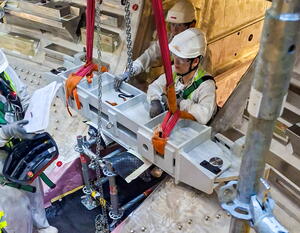
Before lifting a 1,300-tonne sector module from the assembly tool into the tokamak pit, all the components must first be perfectly secured to prevent movements or damaging clashes. This is where the bracing tool system comes into play. In a process resembling a giant game of Jenga, the bracing tools that kept sector module #7 steady and safe during its lifting operation have been successfully disconnected and removed from the tokamak pit.ITER’s plasma chamber consists of nine sector modules that are each composed of three main elements: a vacuum vessel sector, two toroidal field coils, and vacuum vessel thermal shield panels. However, while the coils and vacuum vessel sector are associated in tooling, there is no permanent connection between them as they will operate independently in the tokamak pit. Instead, a series of temporary braces are attached to maintain strict separation and alignment so that no damage is caused to components by the swaying movements that occur during the lift.“The components have different centres of gravity, and these bracing tools keep them in good balance during the lift while maintaining the proper displacement between them,” says ITER Assembly & Installation Engineer Pablo Garcia Sanchez, who helped develop the bracing tool system. “Once in the tokamak pit, the bracing tools also serve to prevent any damage to the components in the case of possible seismic activity before they are properly ‘landed’ and attached to stability clamps.” The bracing tools stop the individual components from moving in both the radial and toroidal directions as the sector module is transported by the crane. Bracing tools are installed at the top, mid-plane, and bottom of each sector module, in a sequence of operations that lasts several weeks due to the size and weight of the bracing tools.However, the true challenge—requiring scaffolding, rails, hoists, and counterweight lifting tools—comes when the bracing tools need to be disconnected from the installed modules and removed from by crane from the tight confines of the tokamak pit. The most difficult bracing tool to access is inner jaw beam, which is attached on the inside of the vacuum vessel sector as part of divertor-level stabilization and needs to be lifted and guided out of the module while navigating incredibly tight turns. Grégoire Daumy examines the divertor-level stabilizer bracing tool before it is removed in a Jenga-like operation from sector module #7. “This last phase is particularly complex because everything depends on precise positioning,” says ITER Assembly Coordinator Grégoire Daumy. “If scaffolding placed to access the bracing tool for removal is off by just a few millimetres, the inner jaw beam won’t pass.”The removal of the bracing tools is an essential step, because the vacuum vessel load can’t be transferred to dedicated gravity supports while the sectors are still connected to the toroidal field coils.Sector module #6 was the first to have its bracing tools detached and removed from the pit in a process that was completed in January 2026. For sector module #7, the last brace was removed on Monday 13 April. The team will now turn its attention to the removal of the bracing tools from sector module #5. A mid-plane brace is attached while the sector module is in the assembly tool (left) and then removed after the module is successfully transferred into the tokamak pit (right).
Of interest

New aerial photos

https://www.iter.org/of-interest?id=34383
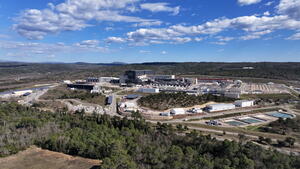
Over a week of fine weather in April 2026, a drone captured a series of striking views of the ITER project site in southern France. Of the 180 hectares (450 acres) allocated by France to the ITER Organization in 2010, approximately half was cleared for construction; from the air, the installation appears as an island set within a sea of green. Most buildings are concentrated on the 42-hectare (100-acre) scientific platform, where the tallest structure—the Tokamak Building—is surrounded by a dense network of facilities supporting machine operation.View or download the latest aerial photos on the Image Galleries page of the ITER website.
Press

ITER托卡马克大楼波纹管安装筹备工作全面启动

https://www.iterchina.cn/picnews/info/2026/24293.html

Fusionsenergie: ASG stellt magnetischen Kern des DTT der Forschungsagentur ENEA her

https://www.prnewswire.com/il/news-releases/fusionsenergie-asg-stellt-magnetischen-kern-des-dtt-der-forschungsagentur-enea-her-849012873.html

Gigantiskt fusionsprojekt ITER går vidare – ny fas inledd

https://www.energinyheter.se/20260409/34563/gigantiskt-fusionsprojekt-iter-gar-vidare-ny-fas-inledd

Europe’s joint nuclear-fusion project needs Russian expertise

https://www.economist.com/europe/2026/04/09/europes-joint-nuclear-fusion-project-needs-russian-expertise

New X-ray imaging for ITER-supporting tokamaks

https://www.ans.org/news/2026-04-08/article-7919/new-xray-imaging-for-itersupporting-tokamaks/

Der Fahrplan für das erste deutsche Funktionskraftwerk steht

https://www.faz.net/aktuell/wissen/physik-mehr/der-fahrplan-fuer-das-deutsche-fusionskraftwerk-200698815.html