Logo
You're currently reading the news digest published from 1 June 2026 to 8 June 2026.
Featured (4)
Press (12)
Featured

Why the world comes to ITER

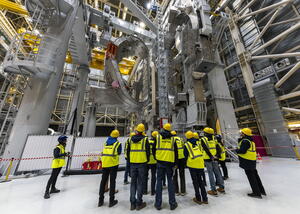
Since 2013, the ITER Organization has welcomed more than 250,000 visitors to the ITER site in southern France. Today, approximately 20,000 people visit the project each year, reflecting sustained international interest in ITER and its mission. For more than a decade, visitors have come from across the globe to learn more about fusion energy and to witness the scale and complexity of one of the world's most ambitious scientific collaborations firsthand.The audience is remarkably diverse. Government officials, industry leaders, researchers, expert groups, media representatives, students, and members of the general public all seek to better understand the project and the potential contribution of fusion to the energy mix of the future. Accommodating this sustained level of interest is a dedicated team within ITER Communication that works throughout the year to organize access for visitors while ensuring that construction, assembly, and operational activities can continue uninterrupted.  Kirsten Haupt manages the visits program at ITER. Programs are tailored to the interests and expertise of different audiences and no two visits are exactly alike. A group of university students specializing in plasma physics, for example, may meet directly with ITER scientists and engineers, while the program for government delegations will focus more on project governance, international cooperation, and progress toward key milestones."The needs of each group are different," explains Kirsten Haupt, who manages the ITER visit program. "Our objective is to provide meaningful access to the project while ensuring that visitors gain a deeper understanding of fusion energy and ITER's mission."Delivering that experience requires close collaboration across the organization. Site access conditions evolve continually as construction and assembly activities progress, and visit schedules must be coordinated with numerous technical and operational teams.It’s all about teamworkWhile some visits are organized directly by the Office of the Director-General, Agence Iter France, or individual ITER departments, the public visit program remains a significant undertaking. In 2025 alone, approximately 12,000 public visitors came to the site, and more than 500 separate visits were organized.The program relies on a small core team supported by a large network of volunteer guides drawn from across the organization. The team that makes visits to ITER possible (left to right): Hélène Delmotte (bookings, access and site transport, coordinator, guide); Julie Marcillat (Open Doors Days and local outreach, public visits support); Anthony Sanna (bookings, access and site transport, coordinator, guide); Axelle Lohez (VIP visits in coordination with the Office of the Director-General); and Kirsten Haupt, program manager and guide. Since taking over the management of the public visit program in 2019, Haupt has substantially extended the roster of guides within the organization that her team can call on for assistance and, today, more than 200 volunteers contribute to the program. They include physicists, engineers, project managers, administrative professionals, and finance specialists who help deliver presentations, answer questions, and share insights into their areas of expertise. All volunteers receive training on organizational and safety requirements.Haupt calls the volunteers “an essential part of the program,” with benefits that cut both ways. Visitors gain direct access to experts working on the project, while volunteers have opportunities to engage with audiences from around the world and develop a broader perspective on ITER's many activities.Visits in 2025In 2025, ITER welcomed 19,444 visitors. Although total attendance was down slightly year-on-year, the number of visits increased by 8%, reflecting growing demand for smaller, more specialized group visits. Requests for VIP, school, and media visits are all on the rise. ITER hosted delegations from every ITER Member, including a high-profile visit by French President Emmanuel Macron and Indian Prime Minister Narendra Modi. The program also supported several large-scale events that brought hundreds of people onto the worksite such as Open Doors Days, the second ITER Public-Private Fusion Workshop (a third took place this spring), and the ITER Business Forum.Since the start of 2026, the number of visits is already outpacing 2025 numbers by 10%.A visit to ITER offers a rare opportunity to witness the development of fusion energy at industrial scale and to engage directly with the people working to make it a reality. If you are interested in visiting the ITER project, see this ITER webpage.

Final correction coils received on site

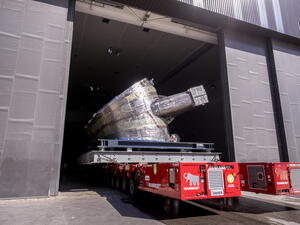
With the arrival in May of two coils from China, all 18 correction coils are now on site at ITER. ITER correction coils, though less prominent than the massive toroidal, poloidal, and central solenoid magnets, play a critical role in ensuring the stability and precision of the fusion machine’s magnetic environment. Distributed below, around and above the vacuum vessel, the coils are designed to correct magnetic asymmetries and compensate for small field errors that can arise from the manufacturing and assembly of ITER’s principal magnet systems.While comparatively lighter and slimmer than ITER’s larger magnets—and with a lower operating current (10 kA)—the correction coils stand out for their scale and unusual geometry. The side coils are square but non-planar, while the top and bottom coils feature a distinctive curved, banana-like planar design.Six bottom correction coils have already been installed in the machine; the side and top coils will be installed later in the installation sequence after the load of all 18 toroidal field coils has been transferred to their gravity supports. Correction coils are arranged in groups of six—at, below, and above the mid-plane of the vacuum vessel. Although much lighter and thinner than the toroidal and poloidal field coils—and running a smaller current (10 kA)—the correction coils measure up to 8 metres in width and present particular challenges for assembly and installation. ITER’s correction coils are built from long lengths of superconducting cable wound into layered structures known as “pancakes.” These layers are insulated, vacuum pressure impregnated for structural integrity, and enclosed within stainless steel casings designed to withstand the demanding operational conditions of the ITER machine.Designed and manufactured by Chinese Domestic Agency supplier ASIPP (Institute of Plasma Physics, Chinese Academy of Sciences), the coils had to be produced to extremely tight precision requirements. Before production could begin, engineers completed an extensive qualification program covering winding techniques, the impregnation processes, case manufacturing, and final assembly procedures. ITER Assembly Coordinator Fabrice Simon inspects a newly arrived correction coil while ITER Project Associate Lee Cheol Woo looks on. “This is the end of an industrial journey that started in 2010,” says Fabrice Simon, who has been involved since the earliest days. “Key to our success has been the excellent collaboration that we have with the Chinese Domestic Agency and supplier ASIPP.” The six side and six top correction coils will now be stored at ITER until early 2028, when they will be tested, surveyed and prepared for installation in the machine.The delivery of the completed correction coil set marks another milestone in ITER’s procurement-sharing program, under which Members contribute to the project primarily through in-kind delivery of components and systems, while gaining valuable industrial experience in key fusion technologies.

First Russian gyrotrons installed

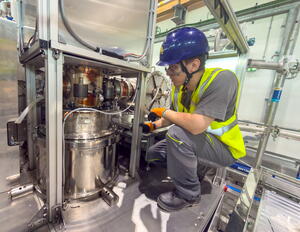
With equipment being procured by Europe, India, Japan, Russia, and the United States, ITER’s electron cyclotron resonance heating system—one of three external heating systems needed to bring the plasma to 150,000,000 °C—reflects the international cooperation driving the ITER project. On the top floor of the Radiofrequency Building, the first three Russian-made gyrotrons have been successfully installed, marking another step forward for the system that will heat the electrons in the plasma with a high-intensity beam of electromagnetic radiation.“Having the first Russian units in their operational locations is a major step forward because gyrotrons are the principal components of the electron cyclotron heating system and these units are needed for the first phase of ITER operation,” says Caroline Darbos, Technical Responsible Officer for the gyrotrons at ITER. “Auxiliary work such as cabling and associated systems can now be done and then testing will begin once all connections are completed.” The installation was carried out during a six-week mission to ITER by a three-person team representing the Russian Domestic Agency, the Institute of Applied Physics of the Russian Academy of Sciences, and the Russian gyrotron manufacturer GYCOM.“We were able to progress very quickly and complete 100% of the planned work,” says Andrei Fokin, the ITER Project Associate who led the team. “This is important for ITER and for the Russian Federation because it shows we are moving forward.”  A Russian gyrotron can be seen on the left and a Japanese gyrotron on the right. While their design is different, they both meet ITER's high-power, high-frequency, and long-pulse requirements. Gyrotrons generate the high-intensity electromagnetic radiation used for electron cyclotron resonance heating. Fokin says it is helpful to compare gyrotrons to microwave ovens: “Imagine a microwave that is 1,000 times more powerful than the one in your kitchen and focused on a volume 1,000 times smaller. Then imagine how hot that small volume becomes.” Gyrotrons were developed over decades of research and prototyping to meet ITER’s high-power, high-frequency, and long-pulse requirements.The first three Russian gyrotrons are now ready to be connected to the matching optics units, which are two-mirror systems that connect the outputs from the gyrotrons to the transmission lines that lead to the tokamak. Another team will arrive from Russia in September to complete the connections and start commissioning.Five ITER Members are participating in the procurement of the electron cyclotron resonance heating system at ITER: Europe (6 gyrotrons, 12 high-voltage power supplies, upper launchers), India (2 gyrotrons, 4 high-voltage power supplies), Japan (8* gyrotrons, equatorial launcher), Russia (8* gyrotrons), and the United States (transmission lines).*Under the new ITER baseline, which demands more powerful radiowave plasma heating, 48 gyrotrons will be required at the start of ITER operations and another 24 for the first phase of deuterium-tritium plasma operations. Japan and Russia will both be providing an additional 20 gyrotrons with an option for four more units for a possible total of 24 each to be delivered by 2032.  The three Russian gyrotrons are installed on the “gyrotron floor” of the Radiofrequency Building. The installation team from left to right: Andrei Krasovkii, Andrei Ananichev, and Andrei Fokin.

Vacuum vessel sector #9: moving in

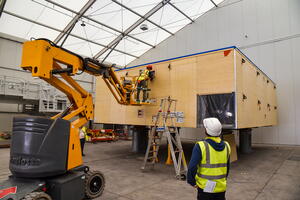
Despite a complex sensor configuration that required twice as much work activity as some previous sectors, vacuum vessel sector #9 went through pre-assembly preparation in record time. Sector #9 from Europe arrived at ITER on 6 March and was placed temporarily in a building near the Tokamak Complex so bosses, studs, clips, sensors, and cables could be welded and installed onto its inner and outer walls. This phase of preparation was completed in just over three months. For comparison, the pre-assembly preparation of vacuum vessel sector #5 (the first European sector to arrive on site) had required more than six months to complete even though there was only half as much sensor-related welding and installation to execute.Sector #9 was transferred today to the Assembly Hall. The next step is to place the 440-tonne sector in the upending tool before transferring it—in a vertical position—to a sector sub-assembly tool where will be transformed into a “sector module” through the addition of toroidal field coils, thermal shield panels, and other components. A team photo to celebrate the completion of sector #9 pre-assembly work (in record time) before the component is transported to the Assembly Hall across the way. In the background, preparations continue on another sector.
Press

Delivery of magnet bundle signals a new age of fusion research

https://www.pppl.gov/news/2026/delivery-magnet-bundle-signals-new-age-fusion-research

Гендиректор ИТЭР Пьетро Барабаски выступил на сессии ПМЭФ-2026 «Мегаустановки: Новая физика международного сотрудничества»

https://www.atomic-energy.ru/news/2026/06/05/166245

Giving Fusion Robots Eyes and Touch – Metrology Technologies Powering ITER’s In-Vessel Assembly

https://metrology.news/giving-fusion-robots-eyes-and-touch-metrology-technologies-powering-iters-in-vessel-assembly/

Глава ITER: Россия остается ключевым участником создания термоядерного реактора

https://www.ntv.ru/novosti/2986551

В ходе визита на ПМЭФ-2026 генеральный директор Международной организации ИТЭР Пьетро Барабаски посетил стенд Росатома и выступил на одной из сессий форума Ключевые

http://www.atominfo.ru/newsz09/a0625.htm

«Искусственное Солнце» уже на горизонте: крупнейший термоядерный реактор мира ITER строят быстрее срока

https://www.ixbt.com/news/2026/06/04/iskusstvennoe-solnce-uzhe-na-gorizonte-krupnejshij-termojadernyj-reaktor-mira-iter-strojat-bystree-sroka.html

Robotic Innovations Transforming Fusion Assembly and Maintenance Operations

https://news.ssbcrack.com/robotic-innovations-transforming-fusion-assembly-and-maintenance-operations/

Iter uses robots and machine vision to build the tokamak’s interior

https://www.mogazmasr.com/120857

Cold testing starts at ITER

https://www.neimagazine.com/news/cold-testing-starts-at-iter/

Europe’s first ITER Divertor Cassettes ready

https://fusionforenergy.europa.eu/news/iter-divertor-cassettes-ready-simic/

Nuclear’s moment: The ANS Annual Conference opens in the Mile-High City

https://www.ans.org/news/article-8084/nuclears-moment-the-ans-annual-conference-opens-in-the-milehigh-city/

ITER:s magnettestanläggning i Frankrike tar viktigt steg mot fusion

https://www.energinyheter.se/20260601/34849/iters-magnettestanlaggning-i-frankrike-tar-viktigt-steg-mot-fusion