Logo
You're currently reading the news digest published from 6 July 2026 to 20 July 2026.
Featured (3)
Of interest (1)
Press (19)
Featured

Monitoring the tokamak from within

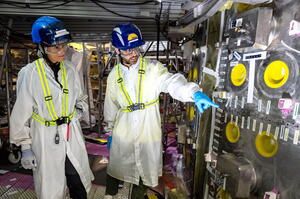
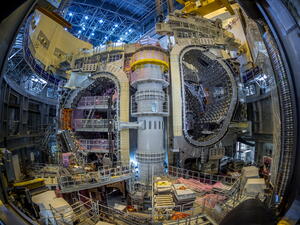
From 18 kilometres of wobbled cabling to thousands of specialized sensors, the inner walls of the ITER vacuum vessel will feature an elaborate mosaic of diagnostic and instrumentation systems. When the ITER tokamak begins operations, scientists will need to measure the performance of the plasma and monitor the condition of the plasma chamber. Two different systems will provide these capabilities: diagnostics that observe, measure, and characterize the plasma, and instrumentation that monitors the structural parameters of the vacuum vessel and its protective blanket.Teams attached diagnostic equipment and instrumentation to the outer shells of vacuum vessel sectors before they were installed in the tokamak pit, but this month marks the start of the complex installation of sensors and cables on the inside of the chamber as part of the in-vessel diagnostics, fuelling, and instrumentation project. The head of the ITER Construction Project, Sergio Orlandi, calls these activities “critical,” saying that, “This phase of installation is receiving the highest level of attention because any delay would directly affect the project schedule.” As part of the kick-off ceremony for the diagnostics and instrumentation installation, Head of ITER Construction Project Sergio Orlandi and Deputy Director-General of the Chinese Domestic Agency Yan Xiaohong tour the Trial, Test and Training Facility where technicians will practice installing cables and sensors. Work began in 2025 to attach the supports that will hold the instrumentation and diagnostics against the inner wall of the plasma chamber behind the blanket. This includes close to 20,000 bosses where sensors and other equipment will be mounted as well as more than 80,000 clips that will hold 18 kilometres of cabling in place. Preparations are now underway for the installation of the first cabling and sensors in the coming weeks.“This is a genuine milestone for the project because it marks the transition from installing the mounts and supports to installing the actual instrumentation and diagnostics,” says Davide Macioce, the ITER engineer who is overseeing the contract for the work. The installation will be carried out in two stages. The first stage—before the welding of the vacuum vessel sectors into a single chamber—involves about two-thirds of the sensors and cabling whose final positions will not interfere with the welding or be affected by minor movements in the vacuum vessel caused by welding shrinkage. Once welding is completed, the teams will install the remainder of the in-vessel instrumentation and diagnostics.“This two-stage approach improves overall efficiency because the installation work can proceed in parallel to other activities,” says Daria Nikolaeva, an Operational Instrumentation Officer at ITER. “By starting with what can be accomplished now, we’re making use of time that would otherwise be lost waiting for sector welding.” Daria Nikolaeva, an Operational Instrumentation Officer at ITER, opens a connector box that will be installed on the plasma chamber’s wall to link the main fibre optic cable (on the right) to the smaller cable leading to the sensor (left). One of the biggest challenges will be the routing of the many kilometres of cable required for the instrumentation and diagnostics. Multiple fibre optic cables for transmitting data and electrical cables will be combined into looms. Then, in a process known as “wobbling,” they will be meticulously bent and shaped so they follow the inner surfaces of the vacuum vessel and match the locations of the pre-installed clips that will secure them to the walls.“The surface is never flat and it’s full of pipes, blanket supports, penetrations and other equipment,” says Lukasz Tomkow, the Electromagnetic Services Engineer overseeing the cables and looms. “Some of the large curves can be bent by hand, but we will have an automated process for the complex local wobbles. We’ll laser-scan the vessel to determine the exact as-built positions of every boss and feed the positions into an algorithm that calculates the required cable routing so the data can be sent to a bending machine.”While some of the standard equipment can be attached immediately within the vacuum vessel, there are also first-of-a-kind devices and components that have to be installed in challenging positions with limited access. For these operations, technicians will train on a replica of the vacuum vessel wall—part of the ITER Trial, Test and Training Facility—to perfect the process before the work is done in the vacuum vessel. The first training exercises for instrumentation and diagnostics will begin in late July.

ITER Director-General: “The power of cooperation around a shared scientific objective”

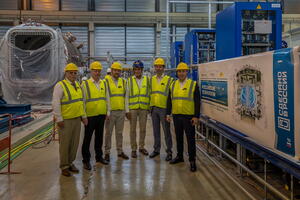
Russian Federation Minister of Science and Higher Education Valery Falkov led a delegation to ITER on Thursday 16 July. It was the second visit from Russia in the context of scientific and technological cooperation to take place during the week. The 20-person ministerial delegation met with the ITER Director-General, senior officials, and Russian members of staff before touring the ITER construction site. The visitors observed different phases of tokamak assembly and activities at the magnet cold test facility. They also toured the integration sites for two Russian-contributed components: gyrotrons and the port plug test facility.  Many advanced technological components for ITER have been procured with the help of Russian universities, research institutes and enterprises, including electrotechnical components, gyrotrons, blanket first wall panels, the divertor dome and poloidal field magnet #1. The delegation saw some of these contributions as it toured the ITER plant and facilities. Minister Falkov described ITER as “a unique space of trust, bringing together nations and leading researchers in pursuit of a common goal: the creation of a new source of energy.”Director-General Barabaschi highlighted the value of international cooperation around a shared scientific objective and the project's long-term contribution to future energy needs. The ITER Director-General greets Russia's Minister of Science and Higher Education, Valery Falkov, on 16 July 2026. The ministerial-level delegation was preceded on Wednesday 15 July by a delegation from the Kurchatov Institute led by Director Iuliia Diakova. Under discussion was the agreement signed last month in Russia with the ITER Organization on scientific and technical cooperation. Areas of possible collaboration include the study of the physics and engineering of plasma disruptions, the study of runaway electrons, and the preparation of joint training programs for the operation of tokamaks.  Iuliia Diakova, Director of the Kurchatov Institute (sixth from right), led the delegation from the Kurchatov Institute on 15 July 2026.

16th ITER International School announced in India: "Tokamaks as Fusion Reactors"

Two ITER International Schools in one year? That translates to double the opportunity for young fusion scientists and engineers to gain skills that are relevant to the ITER project's success. For the first time in the 20-year history of the ITER International School, two schools will take place in one year. Following the 15th ITER International School, organized this month in China, a second event—the 16th ITER International School (IIS)—will take place from 30 November to 4 December 2026 in Bangalore, India. Organized around the theme "Tokamaks as Fusion Reactors," the 16th ITER International School is jointly hosted by the Institute for Plasma Research (IPR), Gandhinagar, and the International Center for Theoretical Sciences (ICTS), Bangalore, and will take place at ICTS. The ITER International School aims to prepare young scientists and engineers for working in the field of nuclear fusion and in research applications associated with the ITER project. The "school" format reflects the necessity of training future professionals on a wide range of interdisciplinary subjects, equipping them with a broad understanding of the skills required to contribute effectively to ITER’s success.The scientific program is being coordinated by Drs. Indranil Bandyopadhyay and Mahendrajit Singh from IPR, head of the ITER Science Division Dr. Alberto Loarte, and Prof. Sadruddin Benkadda (Aix-Marseille University). As the first experimental fusion reactor, ITER will pave the way for the first commercial tokamak reactors with net production of electricity. To reach this goal several scientific and technological challenges need to be addressed and resolved, for which ITER is a crucial first step. The school will cover a broad range of topics related to tokamak fusion reactors’ physics and technologies, such as plasma confinement, heat and particle exhaust, integrated control and operation, plasma-materials interaction, superconducting magnets technology, neutron shielding and tritium breeding. Further information on the 16th ITER International School will be available shortly at https://iis2026.ipr.res.in. The registration for the school will be open from 25 July to 23 August 2026. 20 years of ITER International SchoolsThe first ITER School was organized in Aix-en-Provence, France, in July 2007 on the topic of turbulent transport in fusion plasmas. Fourteen successive schools have followed on a variety of subjects: magnetic confinement (Fukuoka, Japan, 2008); plasma-surface interactions (Aix-en-Provence, 2009); magneto-hydro-dynamics and plasma control (Austin, Texas, USA, 2010); energetic particles (Aix-en-Provence, 2011); radio-frequency heating (Ahmedabad, India, 2012); high-performance computing in fusion science (Aix-en-Provence, 2014); transport and pedestal physics in tokamaks (Hefei, China, 2016); physics of disruptions and control (Aix-en-Provence, 2017); the physics and technology of power flux handling (Daejeon, Korea, 2019); ITER plasma scenarios and control (San Diego, USA, 2022), the impact and consequences of energetic particles on fusion plasmas (Aix-en-Provence, 2023), magnetic fusion diagnostics and data science (Nagoya, Japan, 2024), integrated modelling of magnetic fusion plasmas (Aix-en-Provence, France, 2025), and physics and engineering of heating and current drive systems for magnetic fusion plasmas (Chengdu, China, July 2026).Find out more about past schools here.

Of interest

AI’s growing energy demand fuels interest in fusion

https://www.iter.org/of-interest?id=35023
The 2026 Global Fusion Industry Report from the Fusion Industry Association identifies an important new driver for fusion investment and development: the soaring energy demands of artificial intelligence.“This is a business problem as well as a political problem, as energy consumers around the world are feeling the cost of rising energy prices every day,” writes Andrew Holland, the CEO of the Fusion Industry Association. “Fusion will be the solution. Its approach of turning abundant, energy dense fuel into power, without carbon emissions, make it the only source of energy that will be able to scale up to meet constantly growing demand. Even though it cannot deliver today, the demand from the market is bringing fusion forward.”The report states that $4.5 billion was invested in private-sector fusion companies in 2026, bringing total industry funding to $14.25 billion. The fusion workforce now numbers more than 16,000 employees.The report also notes that governments are embracing new fusion strategies, while public-private partnerships are providing valuable opportunities for knowledge sharing.Download the full report here.
Press

五洲学者聚发源地 四海英才探聚变能——第15届ITER国际学校在四川乐山开幕

https://mp.weixin.qq.com/s/jw0USOv6a99pYetQ6IMJXQ

Фальков: ИТЭР - самый сложный мегасайенс-проект в мире

https://scientica.ru/news/falkov-iter-samyy-slozhnyy-megasayens-proekt-2026-07-17

Российские ученые разрабатывают высокотехнологичные системы для ИТЭР

https://rutube.ru/video/0a6c7baae61ef98bf34d0d0942390ea6/

Предприятия РФ спроектировали порядка 25 систем для Международного термоядерного экспериментального реактора ИТЭР

https://www.interfax-russia.ru/academia/news/predpriyatiya-rf-sproektirovali-poryadka-25-sistem-dlya-mezhdunarodnogo-termoyadernogo-eksperimentalnogo-reaktora-iter

第15届国际热核聚变实验堆(ITER)国际学校在四川乐山开幕

https://m.chinanews.com/wap/detail/chs/zw/10663172.shtml

F4E Supply Chain Excellence Awards launched

https://fusionforenergy.europa.eu/news/f4e-supply-chain-excellence-awards-launched/

Russian scientists developing about 25 systems for ITER installation — minister

https://tass.com/science/2161833

Neuer Forschungsverbund testet Materialien für Fusionskraftwerke

https://www.ipp.mpg.de/start-forschungsverbund-fuma

New research consortium tests materials for fusion power plants

https://www.ipp.mpg.de/start-research-consortium-fuma?c=5594164

Quantum computers model nine fusion fuel material configurations for first time

https://phys.org/news/2026-07-quantum-fusion-fuel-material-configurations.html

F4E publishes the first Global Fusion Energy Trends report

https://fusionforenergy.europa.eu/news/f4e-publishes-the-first-global-fusion-energy-trends-report/

Fusion Industry Attracts Record Annual Funding of $4.48bn, Raising Total to $14.24bn

https://www.fusionindustryassociation.org/fusion-industry-attracts-record-annual-funding-of-4-48bn-raising-total-to-14-24bn/

Commercial fusion race shifts from laboratories to supply chains (paywall)

https://www.ft.com/content/d71c06e5-413a-4468-9512-dbc5be5fe162

INTERVIEW: Don't fall for the fusion hype, says head of world's biggest experimental reactor (paywall)

https://www.euractiv.com/news/interview-dont-fall-for-the-fusion-hype-says-head-of-worlds-biggest-experimental-reactor/

IAEA Launches Project on Small and Medium Sized Magnetic Devices for Fusion Research

https://www.iaea.org/newscenter/news/iaea-launches-project-on-small-and-medium-sized-magnetic-devices-for-fusion-research

New facility in Denmark will let engineers test robots in handling key fusion components

https://euro-fusion.org/eurofusion-news/new-facility-in-denmark-will-let-engineers-test-robots-in-handling-key-fusion-components/

Europe delivers the last components for MITICA

https://fusionforenergy.europa.eu/news/mitica-beam-source-calorimeter-delivered/

UKAEA and Eni launch RH3OVA to advance fusion industry

https://www.ukaea.org/news/ukaea-and-eni-launch-rh3ova-to-advance-fusion-industry/

Nirmala Sitharaman hails Indian contribution to ITER nuclear project

https://newsable.asianetnews.com/business/nirmala-sitharaman-hails-indian-contribution-to-iter-nuclear-project-articleshow-ic9vweh