Logo
You're currently reading the news digest published from 21 September 2026 to 28 September 2026.
Featured (4)
Press (4)
Featured

ITER test facility earns international accreditation

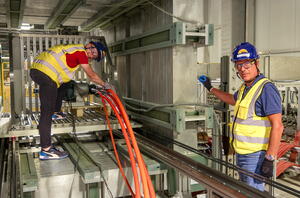
With unmatched testing capabilities, ITER’s static magnetic field laboratory is poised to support equipment qualification and the development of international standards across the fusion sector. ITER’s static magnetic field test facility has achieved ISO/IEC 17025 accreditation, meaning qualification tests on fusion equipment carried out at the facility are now officially recognized by regulators, suppliers, and partners across the global fusion ecosystem.The laboratory offers what is believed to be the world’s best combination of static magnetic field strength and testing space with a working volume of 1 cubic metre and a field strength of up to 275 milliTesla or mT. (For context, a typical refrigerator magnet produces a magnetic field of roughly 5 to 10 mT). The facility is already open for testing equipment for ITER, the Domestic Agencies, and partner research institutions. As part of the ITER Organization’s knowledge-sharing and engagement initiatives, protocols are also being developed for external entities from ITER Members that have an established contractual, cooperation or partnership relationship with the ITER project.Massimiliano Camuri, the ITER Magnetic Field Compatibility Project Leader, calls the facility a mosca bianca—a “white fly,” an Italian expression meaning something rare or exceptional—and says it will benefit a range of fusion stakeholders. “This laboratory is a highly specialized facility with capabilities that are difficult to find anywhere else,” says Camuri. “People working on fusion energy projects related to ITER can now use our laboratory and this will become increasingly important as fusion develops.” Analysis shows that ITER’s laboratory offers the world’s best combination of magnetic field strength and testing volume. The closest published comparisons are a system at CEA Cadarache in France that reaches 480 mT within a test zone of approximately 0.043 cubic metres, and a facility at ASIPP in China with a 2.1-metre test space and a field strength of 120 mT. In magnetic confinement fusion devices, magnetic fields can affect the performance of equipment and components. At ITER, equipment in the Tokamak Complex will be exposed to the fields generated by the central solenoid and poloidal field coils, making thorough performance assessments essential.The static magnetic field lab was opened in 2023 to conduct these tests internally and has produced significant results, such as the discovery that design enhancements are required for fibre optic current sensors so they can operate reliably in the tokamak.“The facility is a valuable asset for qualifying components,” says Shen Hong, the project leader from ITER’s Electrical Services Program who benefited from the sensor testing. “Identifying the limitations of the sensors at an early stage has mitigated the risk of significant delays to the schedule for the edge-localized mode power supplies.”In November 2024, the process began to certify the laboratory to international standards. Conducted through COFRAC, the French national accreditation body, this involved an independent assessment of the laboratory’s testing methods, equipment, procedures, quality controls and staff expertise. In July 2026, the laboratory achieved full accreditation granted under ISO/IEC 17025 guidelines. The static magnetic field lab team in front of the testing facility with the certificate of accreditation. From left to right: Harsh Tanna, Andrey Unzhakov, Dmitry Bukhtiy, Enrique Hernandez, Massimiliano Camuri, and Carmelo Riccardo Lopes. Beyond supporting equipment qualification, the laboratory could also play an important role in developing international standards for testing equipment under strong magnetic fields. â€œLooking forward, the laboratory is poised to contribute to the development of dedicated international testing standards for strong magnetic field qualification because no such standards currently exist,” says Carmelo Riccardo Lopes, an ITER electrical engineer who contributed to the lab’s accreditation. “A purpose-driven standard would unite manufacturers around a single, unambiguous design target. It would also enable procurement bodies to specify magnetic qualification the way they already specify seismic or thermal qualification.”

Electron cyclotron transmission lines: major components in production

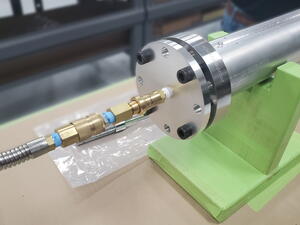
Nine down and one to go! The plasma heating team at US ITER has begun production of nine of 10 major components of the electron cyclotron heating transmission lines. As of September, manufacturing is complete for the direct-current (DC) breaks, which have been delivered and accepted by the ITER Organization. Eight other major components are now in production, with some deliveries already shipped to the ITER site: waveguides, 140-degree miter bends, 90-degree miter bends, expansion units, pumpouts, and adapters that ensure vacuum-tight connections between matching optics units and transmission lines.  For the remaining major components, shipping is expected to begin for switches and radio frequency load components in the coming months, with the polarizer miter bend, the final component, to begin testing in 2027. â€œAfter years of design and prototyping, it’s fulfilling for our team to be at this stage of manufacturing,” said Ben Hardy, US ITER’s plasma heating team manager. An electron cyclotron heating switch component under assembly at Keller Technology Corp. in Tonawanda, New York. Credit: US ITER/Keller Technology Corp. The technology that the United States is delivering supports the full ITER electron cyclotron resonance heating system. This system helps to initiate and control the plasma by delivering high-intensity beams of microwave radiation using a unique range of power, pulse length, and microwave frequency.  The US-built lines will carry the high-intensity beams between the power sources and vacuum vessel port plugs and are designed to minimize power losses and microwave mode changes.“To get here, our team has tackled complex engineering challenges, working closely with our manufacturers across country, from South Carolina to Ohio to California,” Hardy said. “The precision manufacturing capability that we’ve developed has enabled world-leading performance and is laying the groundwork for fusion in the United States.”Industry contributors across the United States have fabricated prototypes, provided specialized materials, and manufactured components. Next steps for the US ITER electron cyclotron transmission line team are to finalize prototyping and testing of the polarizer miter bend while continuing manufacture and shipment of the remaining major components, as well as smaller parts, which number in the thousands—such as the 20,000 coupling bolts needed for assembly. A truckload of miter bends, expansion units, and pumpout components leaves ARMEC Corp. in Oak Ridge, Tennessee. Credit: US ITER/AREMC Corp.

Research, engineering and industry converge

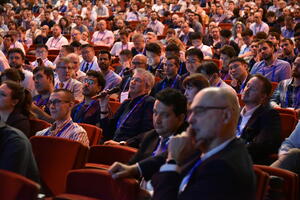
The fusion landscape has changed considerably since the Symposium on Fusion Technology (SOFT) last met in France, but the objective remains the same: turning decades of research and technology development into fusion power plants. That ambition was front and centre at the 34th edition of SOFT, held from 21 to 25 September in Aix-en-Provence, France, just 35 kilometres from ITER. Organized by the French Alternative Energies and Atomic Energy Commission's Institute for Magnetic Fusion Research (IRFM), the conference brought together 1,200 participants from 29 countries—including an estimated 20 percent of young researchers—for five days of exchanges about the technologies that will underpin future fusion machines.“Research, Engineering, Experimentation, Industry, Innovation” was the motto of SOFT 2026, reflected in a program of 84 thematic talks, 800 posters and 13 plenary presentations. Operating facilities such as WEST, Wendelstein 7-X, JT-60SA and KSTAR shared the stage with projects under construction or development, including ITER, IFMIF-DONES, STEP, SPARC and DTT. Twenty-five industrial exhibitors provided another indication that the fusion ecosystem that increasingly extends beyond research laboratories.“Clearly, fusion is having a moment,” said Michael Houry, chair of the conference’s International Organizing Committee, as he welcomed participants on Monday morning. Alongside established public programs, he noted, significant private investment and new approaches have entered the field. But the ultimate challenge is shared: “The goal is to transform all of this extraordinary technology into fusion power plants.” At the ITER stand, virtual reality glasses take visitors into the ITER machine. For ITER Director-General Pietro Barabaschi, who delivered an ITER status update during the opening session, ITER has an important role to play on the way to fusion power. He reported that the project had gained six months against its Baseline schedule, completed the repair of key machine components, and was targeting the installation of the final vacuum vessel sector module in April 2027.But his message extended beyond project progress. ITER, he stressed, is integrating technologies and accumulating experience that can serve the wider fusion community—particularly as the project moves progressively toward commissioning. Results from the testing of ITER's toroidal field coils is one example of the kind of learning that can come from ITER assembly and commissioning. Another is ITER's work with the French nuclear regulator to develop criteria and monitoring arrangements for the vacuum vessel that are better adapted to the specific characteristics of a fusion device.With competition increasing across the fusion sector, Barabaschi argued for a healthy balance between competition and collaboration—and for openness about the challenges that remain. “I’m for not creating excessive expectations,” he told participants, urging the community to consider carefully how fusion technology is presented to the public.The expanding role of industry was another strong theme of SOFT 2026. A dedicated session examined opportunities and challenges for the fusion supply chain, while the annual SOFT Innovation Prize recognized technologies with potential applications both within and beyond fusion.And with the ITER and WEST projects just a bus trip away, conference participants had the opportunity during the week to connect discussion with reality. 

From exoplanets to ITER: Michel Mayor on the value of science

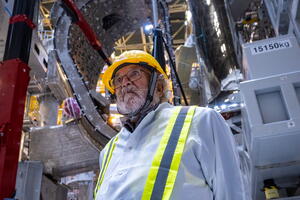
The discoverer of the first exoplanet orbiting a Sun-like star, Nobel Prize-winning astrophysicist Michel Mayor, urges humanity to invest in bold scientific projects and protect the planet we call home. As an astrophysicist, Nobel Prize-winner Michel Mayor has spent his career probing the immensity of the universe and searching for planets in solar systems light years away. Yet even he was struck by the vast scale and ambition of ITER during his visit to the project last week.“My first impression was almost one of shock at the sheer scale of an experiment like this,” Mayor said. “It’s beautiful and extraordinarily complex physics. There is something to the glory of humanity in the fact that we concern ourselves with questions like these.”Mayor is a Swiss astrophysicist and professor emeritus at the University of Geneva. In 1995, Mayor and his doctoral student Didier Queloz announced the discovery of 51 Pegasi b, the first planet found orbiting a Sun-like star beyond our solar system. Using the ELODIE spectrograph at the Haute-Provence Observatory, about 40 kilometres from ITER, Mayor and Queloz detected tiny, regular changes in the motion of a star some 50 light years away, caused by the gravitational pull of an orbiting planet. The discovery helped launch the modern study of exoplanets and the pair shared half of the 2019 Nobel Prize in Physics for their work. An artist’s rendering of the exoplanet 51 Pegasi b that was discovered by Michel Mayor and his doctoral student Didier Queloz in 1995. “The discovery of exoplanets has shown us that there is no shortage of potentially habitable rocky planets. Are any of them inhabited? That is one of the great questions for the future,” says Mayor. Credit: ESO/M. Kornmesser/Nick Risinger (skysurvey.org) On Thursday 24 September, Mayor toured ITER where he met Director-General Pietro Barabaschi and received an overview of the project from Alberto Loarte, the Head of the Science Division. His visit reflected a broader commitment to championing fundamental science and the major facilities that make it possible. That commitment has taken him to scientific projects around the world, including a recent visit to the Gran Sasso National Laboratory in Italy, home to experiments in dark matter and particle physics.“Sometimes people will ask me how we can justify the money we spend on these scientific projects and I need to remind them that all we need to do is stop a war for a few weeks and their budgets will be covered,” said Mayor.Mayor also believes that it is vital to honour the sites of great scientific achievements. Citing efforts to preserve the Mount Wilson Observatory in California, where astronomers gathered crucial evidence that the universe was expanding, Mayor expressed the hope that the heart of ITER would one day also be preserved as a monument to humanity's pursuit of fusion energy.Mayor’s passion for protecting these terrestrial achievements extends to Earth itself. While he has spent his career studying distant planetary systems, he is frustrated by suggestions that humanity could find a welcoming new home on Mars or another planet in the foreseeable future.“I have nothing against science fiction, but we have to distinguish science fiction from science,” Mayor said. “We are human beings and we are bound to this planet. We have to take care of it. That’s the message.” Michel Mayor at ITER on 24 September. From left to right: Guy Le Lay (Professor Emeritus at Aix-Marseille University), Pietro Barabaschi, Michel Mayor and his wife Françoise Mayor, and Alberto Loarte.
Press

ITER breeding blanket and tritium plant plans advance

https://www.ans.org/news/article-8435/iter-breeding-blanket-and-tritium-plant-plans-advance/

F4E helps experts to map critical fusion technologies

https://fusionforenergy.europa.eu/news/fusion-technology-mapping-reports/

AI energy demand accelerates China’s quest for nuclear fusion (paywall)

https://www.ft.com/content/e6f2c05a-ea91-458c-8842-25913d3e4cac

IFMIF-DONES construction enters a new phase with the start of site works

https://ifmif-dones.es/dones-updates/ifmif-dones-construction-enters-a-new-phase-with-the-start-of-site-works/