
A remarkable chapter draws to a close
THE MACHINE
Vacuum Vessel

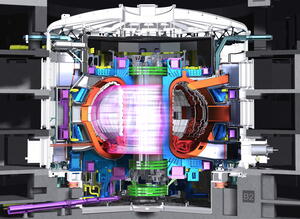
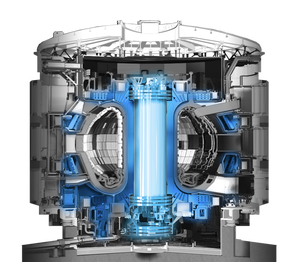
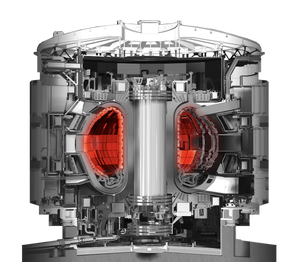
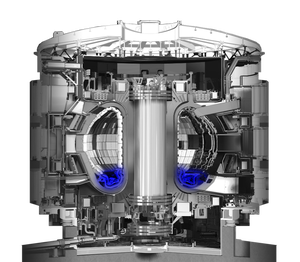
The ITER experiments will take place inside the vacuum vessel, a hermetically sealed, double-walled steel container that houses the fusion reactions and acts as a first safety containment barrier. In its doughnut-shaped chamber, or torus, the plasma particles spiral around continuously without touching the walls.
The vacuum vessel provides a high-vacuum environment for the plasma, improves radiation shielding and plasma stability, acts as the primary confinement barrier for radioactivity, and provides support for in-vessel components such as the blanket and the divertor. Cooling water circulating through the vessel's double steel walls remove the heat generated during operation. Forty-four openings, or ports, in the vacuum vessel provide access for remote handling operations, diagnostics, heating, fuelling and vacuum systems.
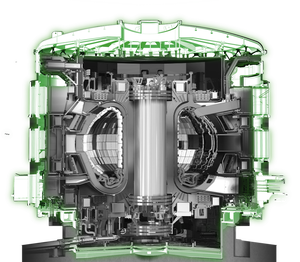
Actively cooled blanket modules lining the inner surfaces of the vessel will provide shielding from the high-energy neutrons produced by the fusion reactions. (Some blanket modules will also be used at later stages to test materials for tritium breeding concepts.) Along with the magnet systems, the ITER vacuum vessel is entirely enclosed in a large vacuum chamber called the cryostat.
In a tokamak device, the larger the vacuum chamber volume, the easier it is to confine the plasma and achieve the type of high energy regime that will produce significant fusion power. The ITER vacuum vessel, with an interior volume of 1,400 m³, will provide an absolutely unique experimental arena for fusion physicists: the volume of the plasma contained in the centre of the vessel (840 m³) is fully six times larger than that of the largest operating tokamak in the world today. The ITER vacuum vessel will measure 19.4 metres across (outer diameter), 11.4 metres high, and weigh approximately 5,200 tonnes. (After the installation of the blanket and the divertor, the vacuum vessel will weigh 8,500 tonnes.)


© F4E/Walter Tosto

In-wall shielding
Approximately 55 percent of the space between the double walls of the vacuum vessel will be occupied by in-wall shielding in the form of modular blocks, weighing up to 500 kg each. Made of borated and ferromagnetic stainless steel, the blocks will provide shielding from neutron radiation for components situated outside of the vacuum vessel (such as the magnets) and contribute to plasma performance by limiting a type of perturbation known as toroidal field ripple.
Two-thirds of the vacuum vessel's 9,000 in-wall shielding blocks will be set into place during vacuum vessel sector fabrication; others will be delivered to the ITER construction site for installation during assembly. (Photo: At a factory in Europe, in-wall shielding blocks are stacked into the spaces between the structural ribs of a vacuum vessel segment.)


Thermal shielding
Two layers of thermal shielding are interposed between the vacuum vessel and the cryostat to minimize heat loads transferred by thermal radiation and conduction from warm components to the components and structures that operate at 4.5K (such as the magnets). Reduction of these heat loads by over two orders of magnitude is compulsory to ensure that the residual heat load can be removed by the ITER cryoplant with reasonable capacity.
The thermal shield consists of stainless-steel panels that are either highly polished or coated with silver for low emissivity. They are actively cooled by helium gas flowing inside of a cooling tube welded on the panel surface; during plasma operation, the temperature of the helium gas ranges from 80 K to 100 K.
One layer of thermal shield will be installed between the vacuum vessel and the superconducting magnets; another will be installed between the magnets and the cryostat. The thermal shield covers a surface area of approximately 5,000 m². Once assembled, it will stand 25 metres at its highest point.
Videos

2:39

11 APR 2022
MANUFACTURING AND TRANSPORT
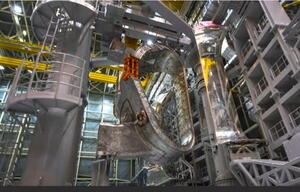
A third vacuum vessel sector arrives from Korea (making of)
0:55
10 JAN 2022
ON THE FLY
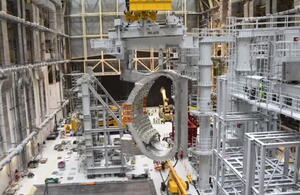
Bringing a vacuum vessel sector into tooling
1:43
13 APR 2021
MACHINE ASSEMBLY
First vacuum vessel sector safely docked

1:52
30 MAR 2021
MANUFACTURING AND TRANSPORT
Inside the ITER vacuum vessel factory (Fusion for Energy)

0:08
5 MAR 2018
STOCK SHOTS
The ITER Tokamak (©ITER Organization/Polarmedia)
The other components
Please note that all images are for illustrative purposes only.