Logo
You're currently reading the news digest published from 12 January 2026 to 19 January 2026.
Featured (4)
Press (8)
Featured

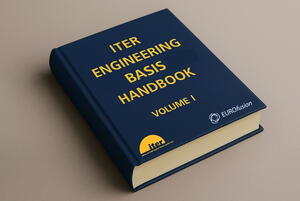
Compendium of ITER design principles taking shape

The first chapters of the ITER Engineering Basis Handbook, Volume 1, have been released and more will follow soon. “The idea,” said ITER Director-General Pietro Barabaschi when he launched the project in 2023, “is to document the full range of acquired ITER know-how in the domains of engineering, fabrication, assembly, safety, and licensing—including insights from retired experts, without whom this knowledge would otherwise be lost.”Some of the 80 authors who are contributing to the editorial effort behind the ITER Engineering Basis Handbook were part— like the Director-General himself—of the Engineering Design Activities for ITER in the 1990s. Others contributed their expertise to the earlier Conceptual Design Activities phase or, further down the road, had positions of responsibility at the ITER Organization.  All share something of value: they were in the room at key moments when engineering decisions were made that contributed to shaping ITER. Preserving this institutional knowledge—not only the reasons behind key choices, but also the alternatives that were considered and ultimately set aside over nearly four decades of ITER planning and construction—is essential for future generations and for the wider fusion community.Under the editorial lead of EUROfusion and its Programme Manager Gianfranco Federici, the ITER Engineering Basis Handbook is coming together as a stand-alone compilation of ITER design principles, the underlying technical design basis and its evolution from conception to construction, together with the technical, scientific, and regulatory rationale behind major decisions. The first chapters of Volume 1, “Genesis, Design and Evolution,” are now available on a dedicated ITER webpage under ITER Technical Reports. Additional chapters will be released in the coming weeks. By late 2026, the seven chapters of Volume 2, “Anatomy of the Plant,” are expected to be available.The project delivery team comprises an editorial team (see list below), a coordination unit, and specific chapter authors, together with subject matter experts and senior retired experts. Acting as the bridge between ITER and the editorial board are Jesús Izquierdo, Deputy Head of the ITER Central Integration Division, and Esmeralda Moscatelli, Knowledge Management Coordinator. Layout and publication are supported by Barry Prescott, Martina Olcese, Virginie Marchal, and Valentyna Kovtun from the Data Configuration Management Section.“ITER will generate not only megawatts of fusion power but also a vast amount of engineering knowledge that we have the obligation to preserve for the good of mankind,” concludes Jesús. “We are on it!”Download the first chapters of the ITER Engineering Basis Handbook here.

Redundancy achieved: spare solenoid module arrives at ITER

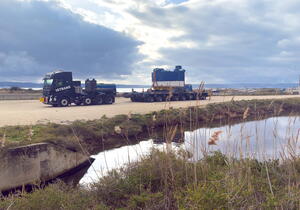
As the last highly exceptional load from the United States, the transport of the solenoid module was a momentous occasion carried out with the usual high-level logistics, rigorous security… and respect for frogs. Sometimes peace of mind weighs 110 tonnes and gets delivered by a massive flatbed trailer truck.The spare central solenoid module arrived safely at the ITER site on Friday 16 January after a weeks-long journey by boat and truck from the United States. The central solenoid magnet is the 18-metre-tall component located at the very centre of the ITER tokamak that plays an important role in starting and controlling the plasma. Currently, five of the six magnets are stacked and connected in the Assembly Hall, with the installation of the last module scheduled for March 2026. As part of ITER’s strategy to build redundancy into mission-critical systems, a full spare solenoid module was manufactured to reduce technical and schedule risk and will only be deployed if a problem emerges with one of the six installed components.The spare solenoid module was manufactured by General Atomics in San Diego and first travelled by road to Houston, where it was loaded onto a ship for the south of France. After arriving at the port of Fos-sur-Mer, it was taken by barge to a staging area in Berre l’Étang before making the final leg of the journey along the ITER itinerary by trailer truck. The spare solenoid module is the final American-made component qualified as a “heavy exceptional load” to be delivered to France. Marking the milestone are (left to right): Colonel Arnaud Estebe, François Genevey (Daher), Ines Bollini (Daher), Taka Omae (ITER), Jeff Parrott (US ITER), Jessica Huaracayo (US Consulate General), Loïc Borrelly (Daher), Sébastien Deceglie (Daher), Yanis Abdou (Esurveys), and Major Jean-Marc Rocher. As the last highly exceptional load (HEL) coming from the United States, the solenoid module’s journey was an occasion to recognize American contributions to the project. The US Consul General in Marseille, Jessica Huaracayo, participated in the departure of the convoy from Berre l’Étang to learn more about the delivery logistics for American-made components. “It is very impressive and exciting to witness the international coordination involved with transporting this massive American-built module all the way from San Diego, through Houston, and finally to ITER,” she said.Jeff Parrott, the logistics and transportation coordinator for US ITER, was more accustomed to monitoring the central solenoid components when they departed from San Diego and were loaded at the Port of Houston. But because this was the last delivery for the central solenoid, he flew to France for the final leg of the journey. “It’s very satisfying to see the transport executed so smoothly but also somewhat bittersweet since this is the last highly exceptional load shipment planned for the US,” he said. “There will be other large components we deliver but none requiring the same specialized transportation logistics.”Indeed, more than 80 French police officers were mobilized to secure the convoy along the ITER itinerary. Planning for the operation also took environmental considerations into account. Although convoys travel as a general rule by night to limit traffic disruption, the first three-kilometre stretch is done during the daytime to respect the local ecosystem. The staging area in Berre l’Étang is classified as a Natura 2000 reserve (a European network of important ecological sites) and heavy transportation activities are limited at night to protect the frog population. After a three-day journey travelling mostly at night along the ITER itinerary, the spare central solenoid module is lowered onto pedestals at ITER before being moved into a building for storage.

A novel way of measuring fusion power

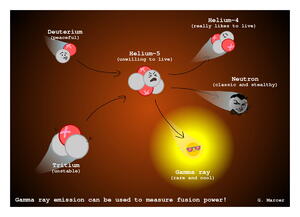
The fusion of hydrogen isotopes deuterium (D) and tritium (T) acts predictably most of the time, producing a helium atom and a neutron that is released at high speed. Yet every once in a while—if only for an instant—DT fusion produces a gamma ray. A research team in Milan is proving that this rare, but predictable, occurrence can offer a fresh way to take the pulse of the plasma.  We all know how the deuterium-tritium (DT) reaction works. Don’t we? Deuterium (hydrogen-2) and tritium (hydrogen-3) collide, producing helium-4 and a free neutron, which escapes from the plasma and heats up the fusion chamber wall. But there is another—much rarer—reaction that also takes place.This rare reaction produces helium-5 and a gamma ray. In a flash, the helium-5 then disassembles into the "usual reaction," producing helium-4 and one neutron.“This is interesting—but it is also super-important,” says Giù Marcer, a young researcher from Valenza, a small hilltop town in the Italian Piedmont region, who now works in the Neutron-Gamma Ray Group at Italy’s National Research Council (CNR) in Milan. “Because gamma rays can provide a cost-effective way of measuring the power in fusion reactors, including ITER.”The key to unlocking this potential is to know the branching ratio—the proportion of nuclear fusion reactions that produce a gamma ray to the number that produce neutrons. If we know the branching ratio, we could have an alternative metric for measuring the fusion rate, and therefore the reactor’s power output. And that’s what groundbreaking new research has delivered.“This isn’t a new idea,” says Marco Tardocchi, the director of the Neutron-Gamma Ray Group, comprising around 20 staff and students at CNR and at Milan’s Bicocca University. “In fact the first estimates we have for the branching ratio were published over sixty years ago, in 1963, by the Nuclear Division Group of the Max Planck Institute for Chemistry in Mainz, Germany.”Tardocchi’s work on fusion goes back a long while. He did his PhD in Uppsala in Sweden with the famous nuclear scientist Jan Källne and went on to work with Källne’s team on the Joint European Torus (JET). Tardocchi was then part of the JET campaign that still holds the absolute record for fusion power, 16.7 MW, which was achieved in 1997.“The subject of the branching ratio has always fascinated me,” says Tardocchi, “and we’ve been working on it for years. But the results of estimates have—up to now—varied substantially, with a factor of 10-30 times variance.”As a result, Tardocchi encouraged Marcer to make the branching ratio the main topic of her doctoral thesis in Milan, having already supervised her Master’s degree in plasma physics.“Of course it was a huge team effort,” says Marcer. “And we are just delighted to have come up with the first number for the branching ratio in tokamaks, and—most importantly—the best branching ratio measurement with spectroscopic information. This makes it the most ‘complete’ measurement to date.” Giù Marcer and Marco Tardocchi from the Neutron-Gamma Ray Group at Italy’s National Research Council (CNR). So, what is the ratio?It turns out that around one in 42,000 reactions produces a gamma ray—which is relatively easily measurable in a fusion reactor as big as ITER, designed as it is to produce an enormous number of fusion reactions.“We made the branching ratio measurements at the Joint European Torus (JET),” says Marcer. “We determined the total DT gamma yield by integrating the measured gamma-ray spectrum and modelling the transport of gammas to and through the detector. JET provided the neutron yield, allowing us to obtain the ratio between the two yields, in other words, the branching ratio. We then benchmarked our results at the Frascati Neutron Generator (FNG) near Rome.”More detail can be found in the paper below and its associated references. â€œSometimes research produces real gems, and this is one of those amazing cases,” says Michael Walsh, the head of ITER’s Fusion Technology and Instrumentation & Control Division. Walsh was part of the committee that saw Marcer defend her PhD thesis in Milan last year.“This new measurement technique shows great potential on the basis of what’s already been demonstrated at JET,” says Marcer. “And as ITER moves forward, with far greater fusion power to be measured, gamma rays may prove to be a robust complementary metric in terms of determining the power being produced by a burning plasma.”“Gamma-ray measurements could offer a fresh way of following the pulse of the plasma,” says Walsh. “It’s a bit like adding another gauge to the dashboard—one that helps you see what’s happening under the hood while the engine’s running. It won’t steer the machine, but it will make the view clearer and the response sharper.”The Neutron-Gamma Ray Group in Milan is now working on further validation of the branching ratio for ITER.“We still need to review any uncertainty,” says Marcer, “so that by the time ITER needs it we will have a proper value for the branching ratio.” Paper reference for more information: G. Marcer et al., “Absolute measurement of the deuterium–tritium reaction gamma-ray emission in magnetic confinement fusion plasmas” https://iopscience.iop.org/article/10.1088/1741-4326/adeea7/meta

Closing the lid, testing the juice

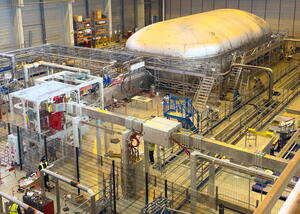
A view of magnet cold test facility progress. The magnet cold test facility is getting closer to operations. The cryostat was closed around toroidal field coil #7 in December and now high-voltage commissioning of the power converter is underway to be sure the systems are ready to test the magnet at 4 K (minus 269 degrees Celsius). High-voltage commissioning involves the 68kA power supply that will power the facility via the busbar seen in the foreground of the image. Commissioning began on 15 January and the facility should be fully operational at the end of February or the beginning of March 2026.
Press

Forum Fusion 2026: Rekordbeteiligung beim Branchentreffen in Garching

https://www.ipp.mpg.de/forumfusion2026-de

Forum Fusion 2026: Record attendance at industry meeting in Garching

https://www.ipp.mpg.de/forumfusion2026-eng?c=5594164

DIADEM programme to explore additive for UK fusion

https://www.theengineer.co.uk/content/news/new-additive-programme-to-support-uk-fusion

EUROfusion sets new records and collaborations in 2025

https://euro-fusion.org/eurofusion-news/recap-2025/

EAST breaks fusion density limit

https://www.neimagazine.com/news/east-breaks-fusion-density-limit/

Nuclear Fusion awards laudation 2025

https://iopscience.iop.org/article/10.1088/1741-4326/ae203e

How fusion energy and AI can power the next era of energy demand

https://www.weforum.org/stories/2026/01/how-fusion-with-ai-can-help-defeat-the-coming-electricity-crunch/

Fusion power still may save the world (paywall)

https://www.bostonglobe.com/2026/01/11/opinion/climate-fusion-power-mit-overshoot/