
A novel way of measuring fusion power
The fusion of hydrogen isotopes deuterium (D) and tritium (T) acts predictably most of the time, producing a helium atom and a neutron that is released at high speed. Yet every once in a while—if only for an instant—DT fusion produces a gamma ray. A research team in Milan is proving that this rare, but predictable, occurrence can offer a fresh way to take the pulse of the plasma.
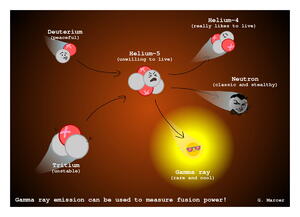
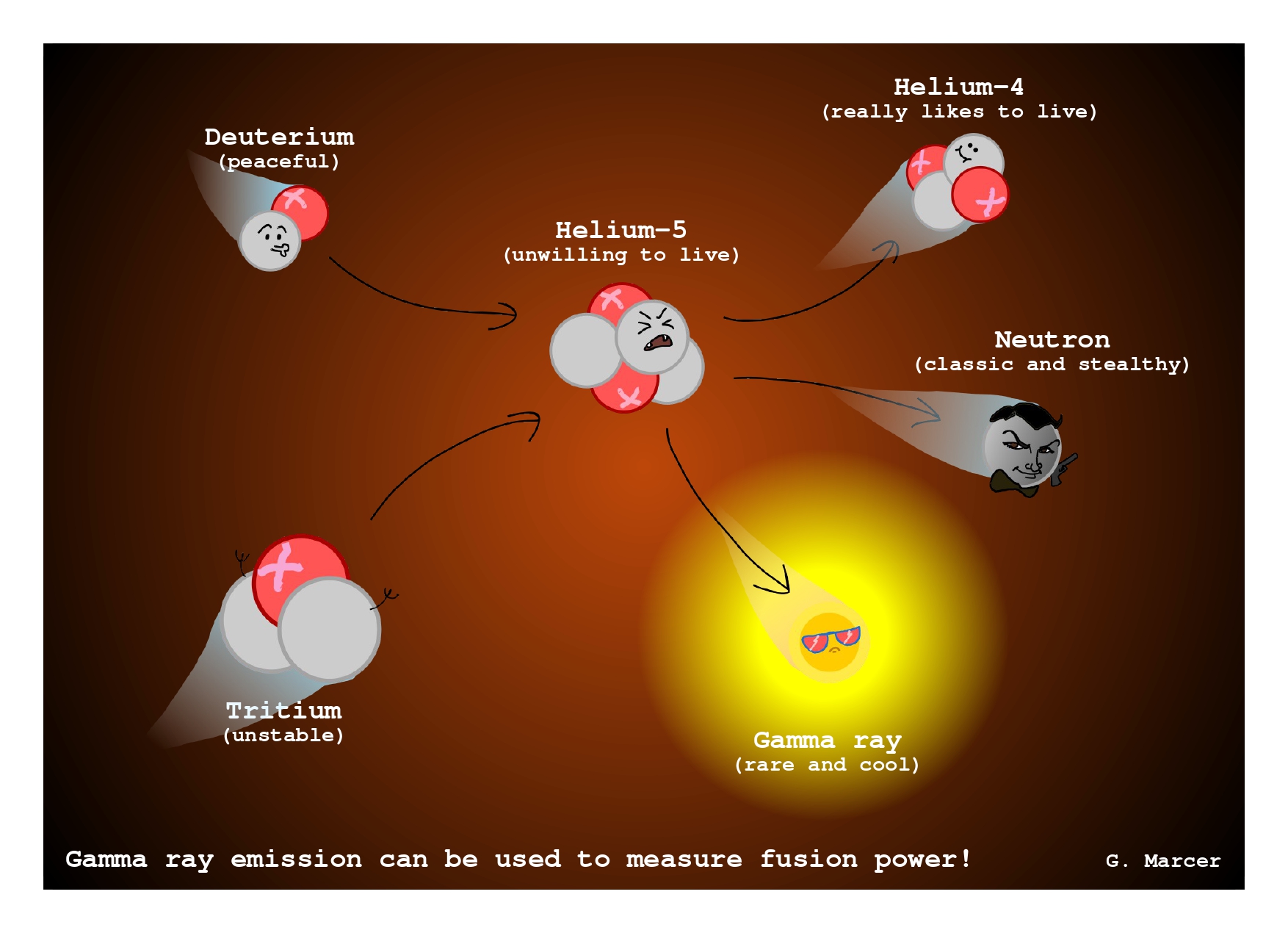
We all know how the deuterium-tritium (DT) reaction works. Don’t we? Deuterium (hydrogen-2) and tritium (hydrogen-3) collide, producing helium-4 and a free neutron, which escapes from the plasma and heats up the fusion chamber wall.
But there is another—much rarer—reaction that also takes place.
This rare reaction produces helium-5 and a gamma ray. In a flash, the helium-5 then disassembles into the "usual reaction," producing helium-4 and one neutron.
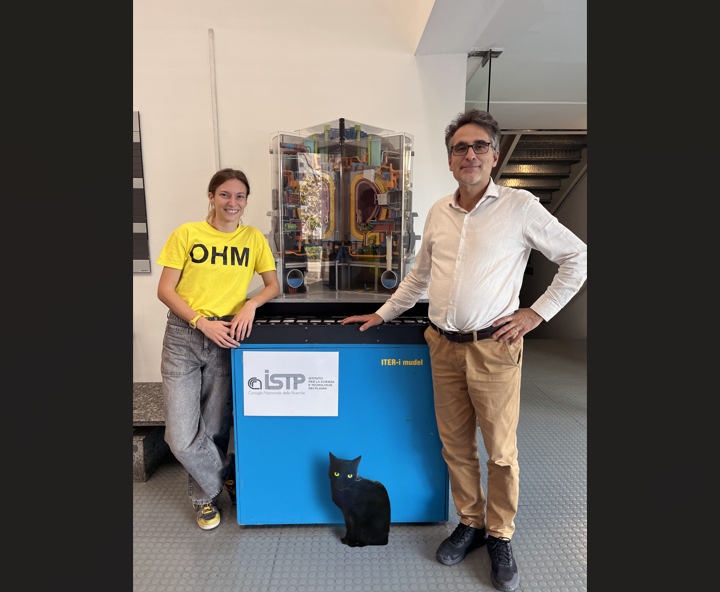
“This is interesting—but it is also super-important,” says Giù Marcer, a young researcher from Valenza, a small hilltop town in the Italian Piedmont region, who now works in the Neutron-Gamma Ray Group at Italy’s National Research Council (CNR) in Milan. “Because gamma rays can provide a cost-effective way of measuring the power in fusion reactors, including ITER.”
The key to unlocking this potential is to know the branching ratio—the proportion of nuclear fusion reactions that produce a gamma ray to the number that produce neutrons. If we know the branching ratio, we could have an alternative metric for measuring the fusion rate, and therefore the reactor’s power output. And that’s what groundbreaking new research has delivered.
“This isn’t a new idea,” says Marco Tardocchi, the director of the Neutron-Gamma Ray Group, comprising around 20 staff and students at CNR and at Milan’s Bicocca University. “In fact the first estimates we have for the branching ratio were published over sixty years ago, in 1963, by the Nuclear Division Group of the Max Planck Institute for Chemistry in Mainz, Germany.”
Tardocchi’s work on fusion goes back a long while. He did his PhD in Uppsala in Sweden with the famous nuclear scientist Jan Källne and went on to work with Källne’s team on the Joint European Torus (JET). Tardocchi was then part of the JET campaign that still holds the absolute record for fusion power, 16.7 MW, which was achieved in 1997.
“The subject of the branching ratio has always fascinated me,” says Tardocchi, “and we’ve been working on it for years. But the results of estimates have—up to now—varied substantially, with a factor of 10-30 times variance.”
As a result, Tardocchi encouraged Marcer to make the branching ratio the main topic of her doctoral thesis in Milan, having already supervised her Master’s degree in plasma physics.
“Of course it was a huge team effort,” says Marcer. “And we are just delighted to have come up with the first number for the branching ratio in tokamaks, and—most importantly—the best branching ratio measurement with spectroscopic information. This makes it the most ‘complete’ measurement to date.”
So, what is the ratio?
It turns out that around one in 42,000 reactions produces a gamma ray—which is relatively easily measurable in a fusion reactor as big as ITER, designed as it is to produce an enormous number of fusion reactions.
“We made the branching ratio measurements at the Joint European Torus (JET),” says Marcer. “We determined the total DT gamma yield by integrating the measured gamma-ray spectrum and modelling the transport of gammas to and through the detector. JET provided the neutron yield, allowing us to obtain the ratio between the two yields, in other words, the branching ratio. We then benchmarked our results at the Frascati Neutron Generator (FNG) near Rome.”
More detail can be found in the paper below and its associated references. “Sometimes research produces real gems, and this is one of those amazing cases,” says Michael Walsh, the head of ITER’s Fusion Technology and Instrumentation & Control Division. Walsh was part of the committee that saw Marcer defend her PhD thesis in Milan last year.
“This new measurement technique shows great potential on the basis of what’s already been demonstrated at JET,” says Marcer. “And as ITER moves forward, with far greater fusion power to be measured, gamma rays may prove to be a robust complementary metric in terms of determining the power being produced by a burning plasma.”
“Gamma-ray measurements could offer a fresh way of following the pulse of the plasma,” says Walsh. “It’s a bit like adding another gauge to the dashboard—one that helps you see what’s happening under the hood while the engine’s running. It won’t steer the machine, but it will make the view clearer and the response sharper.”
The Neutron-Gamma Ray Group in Milan is now working on further validation of the branching ratio for ITER.
“We still need to review any uncertainty,” says Marcer, “so that by the time ITER needs it we will have a proper value for the branching ratio.”
Paper reference for more information:
G. Marcer et al., “Absolute measurement of the deuterium–tritium reaction gamma-ray emission in magnetic confinement fusion plasmas” https://iopscience.iop.org/article/10.1088/1741-4326/adeea7/meta