Logo
You're currently reading the news digest published from 26 January 2026 to 2 February 2026.
Featured (3)
Video (1)
Press (11)
Featured

Extreme vigilance, successful installation

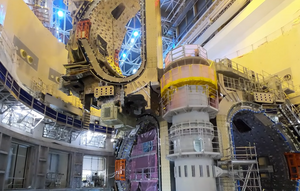
The fourth of nine sector modules has been successfully lowered into place using an approach that treats each installation as a first-of-its-kind operation to ensure readiness for any eventuality. The two-day operation tested, once again, the accuracy of the metrology system and the navigation skills of the assembly team.No two major lifts are alike. For sector module #8, the largest challenge was the small gap that existed between the top of the load and the support beam above it—a gap that would narrow with the pressures of the lift from just a few millimetres to as little as 0.4 mm.“This was an excellent chance to confirm the reliability of our sensors and our ability to adapt to small margins of manoeuvrability,” said Mathieu Demeyere, the principal construction manager who supervised the operation for ITER. “As we move forward with assembly, we will need to move components through the tightest of spaces and now we know we can adjust to extremely narrow margins.”The operation to insert the 1,300-tonne sector module #8 into the tokamak pit began with pre-job briefings on the morning of 28 January and ended with the landing of the component on the evening of 29 January. From the very beginning, supervisors warned of overconfidence and urged their teams not to fall into a routine after the efficient placement of three modules last year. This proved vital as sensors began reporting the gap between the component and the support beam was shrinking and the teams had to take extra precautions to ensure there was no contact. ITER Director-General Pietro Barabaschi checks in on the pre-lift preparations on the afternoon of 28 January. “Vacuum vessel assembly is moving quickly and we have a record of success—this is a situation where you need to be especially vigilant,” said Gael Hardy, the lift engineer from Framatome who has helped manage all the sector module installation operations to date. “By guarding against overconfidence, you are able to detect weak signals and adapt to any differences that emerge, just as we did with sector module #8.”The same vigilance is applied to safety during the operation. The two-day task of sector module installation is carried out by two separate teams that work on alternating 12-hour shifts. Each shift is overseen by a health, security, and environment (FSE) expert to minimize risks to team members.“We treated sector module #8 as the fourth first-of-its-kind operation,” said Clément Vautrin, the FSE officer who oversaw two of the 12-hour shifts. “We have achieved a clean safety record so far by considering that each installation is unique.” Two of four modules are visible from this angle: sector module #8 on the left (not quite in its final position) and sector module #5 on the right. Over the coming weeks, a few final adjustments will be made to the sector module. First, a radial shift will to push it 140 mm closer to the central column. Then, the intercoil structure connections that link sector module #8 to the adjacent sector module #7 will be completed.With the installation of sector module #8, the plasma chamber is now almost half complete. Sector module #7, sector module #6, and sector module #5 were inserted in 2025, and the schedule for 2026 is even more ambitious, with a total of four insertion operations scheduled. The lessons learned during the installation of sector module #8, notably the ability to navigate incredibly tight tolerances, will be especially valuable as space in the tokamak pit decreases and as a sector module will for the first time have to be installed between two sectors later this year—an operation requiring the kind of pinpoint accuracy that was demonstrated last week. 

Robots, tools and teams playing in unison

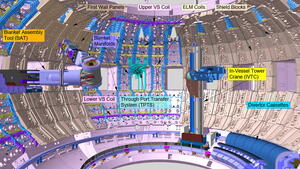
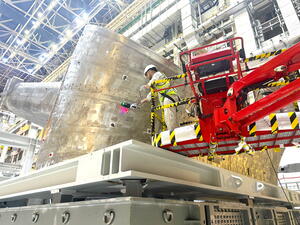
In an on-site building originally designed for beryllium-related activities and now dedicated to assembly preparation, as well as in factories in India and Japan, a major “project within the project” is taking shape. Its objective is to develop the robots and tooling that will enable the installation of nearly 20,000 components—large and small, and for the most part individually customized—on the inner wall of the plasma chamber. The challenge is immense: from coils, manifolds, or blanket modules attached to the vacuum vessel’s inner surface, to first-wall panels directly facing the plasma, no fewer than half a dozen “system layers,” each comprising thousands of components, are superimposed like the skins of a steel onion. Like finely tuned instruments in a symphonic orchestra, robots, tooling and their operators will follow a detailed music sheet—an updated, streamlined work organization based on the parallelization, rather than the succession, of tasks.“Specialized teams and assembly tools will move from one part of the vacuum vessel to the next to install a specific ‘layer’ of components. As they advance, another team moves in to install the next layer,” explains Raphaël Hery, an expert in remote handling and robotics in harsh environments like the French inertial fusion installation Laser Mégajoule and the IRIS deep-sea inspection system. Raphaël says that this strategy, which he calls the Rolling Waves concept, significantly reduces installation time and co-activity risks.Some of the instruments that will perform the Rolling Waves in-vessel symphony already exist and will be optimized but most still need to be developed. This is where Godzilla will play a key role.  Standing 4 metres tall, with an arm that extends up to 5 metres, Godzilla is the most powerful industrial robot commercially available. For ITER, it is a platform for the development and integration of the tools and technologies that will be used by the actual robots performing in-vessel assembly activities. “Godzilla” is the nickname of an industrial robot—the most powerful currently available on the market—installed in the basement of the Tokamak Assembly Preparation Building. Standing an impressive 4 metres tall with an arm that extends up to 5 metres, it is capable of lifting and moving loads of up to 2.3 tonnes. Despite its mighty strength, however, Godzilla is not destined to handle in-vessel components, some of which weigh in excess of 4 tonnes. Instead, it will act as a platform for the development and integration of the tools and technologies that will be used by robots tasked with performing in-vessel assembly activities.One of the tools being tested currently on the Godzilla platform is a partial prototype of a “tool changer,” which, as its name indicates, will enable assembly robots to quickly and safely switch from one tool to another in accordance with work sequences. As more than 30 types of specific tools will be necessary during in-vessel assembly (for handling, bolting, welding, inspecting, cutting…), this capability is a critical time-saver. Industrial “off the shelf” robots have brains, arms, joints and muscles but they lack two essential human abilities—the sense of sight and the sense of touch. The bespoke robots that will operate inside the ITER vacuum vessel will have both. Equipped with a vision system initially developed by the European Domestic Agency, Fusion for Energy, they will be capable of precisely aligning each tool with the vacuum vessel installation targets. As for the sense of touch, it will be provided by a “force and torque sensor” that will allow the robots inside the ITER vacuum vessel to “feel” and control the movements, pressure and forces exerted on a component or an attachment interface. â€œIn the restricted and densely packed environment the assembly robots will be operating in, the sense of sight and touch will be essential to ensuring precise and secure movement that does not damage the vacuum vessel or nearby components,” says Raphaël. Beginning in March, Godzilla will test the tools under development on mockups and interfaces representative of the in-vessel environment.  Beginning in March, Godzilla will test the tools under development on mockups and interfaces that are representative of the in-vessel environment. Once validated on the Godzilla platform, the tools and technologies whether developed in-house or by the Japanese Domestic Agency, will be transferred and integrated into the robots that are designed to carry out the in-vessel assembly tasks—one, the in-vessel tower crane, originally produced and delivered by CNIM, will be adapted and optimized; the other, the blanket assembly transporter, a 36-tonne monster three times the size of Godzilla, is currently in the detailed design phase prior to fabrication by Larsen & Toubro Ltd in India.In the current Rolling Wave approach, two heavy-duty blanket assembly transporters and one in-vessel tower crane (with a second as backup) will operate in parallel, while operators on bespoke mobile elevation work platforms, equipped with “zero gravity arms” also under development, will perform manual operations.  An extension of the former Cryostat Workshop is currently under construction to accommodate one of the two 1:1 bare-bones steel structures representing one-third of the ITER vacuum vessel. Preparing the in-vessel assembly phase, however, covers a broader scope than what is presently happening in the Tokamak Assembly Preparation Building, at Larsen & Toubro Ltd in India, at the Naka Institute for Fusion Technology in Japan, or in other Domestic Agencies (Europe, for example, is procuring the in-vessel divertor remote handling system). On site, two 1:1 “bare-bones” steel structures—each representing one-third of the ITER vacuum vessel (see illustration)—will allow operators to practice their skills with the actual assembly robots. One, located inside the former Cryostat Workshop, will accommodate an in-vessel tower crane; in an adjacent building, currently under construction, a similar installation will host a blanket assembly transporter and other heavy equipment dedicated to the ferrying, handling and installation of blanket modules. In anticipation of still more works to come, space is being reserved in other buildings on the ITER platform.“Developing robust systems and processes to prepare for in-vessel assembly is a truly colossal task,” says Raphaël. “And although actual operations are still years away, the teams are under a very tight schedule.” When everything is set up and ready, the Rolling Wave symphony will be performed—almost without intermission—24 hours a day, 6 days a week for an anticipated two years.

No pause in action

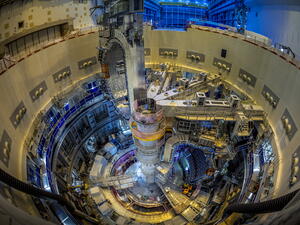
Careful planning by the construction teams ensures that the giant tools used to assemble vacuum vessel modules are never idle for long. The twin sector sub-assembly tools in the ITER Assembly Hall are engaged in a sprint.Erected and tested between 2017 and 2019, the tools have been working almost continuously for the past 18 months. In another year and a half they will have fulfilled their mission: producing sector modules ready for installation in the tokamak pit by pairing each of the nine ITER vacuum vessel sectors with its thermal shield and two toroidal field coils. With every successive sub-assembly operation, a little time is saved. Lessons learned from earlier sector assemblies, combined with streamlined work organization, improved procedures, and the dependability and performance of upgraded tools, have reduced the time required to finalize these strategic “building blocks" of the ITER machine by days, weeks and even months.Sector #1, shown in this photo, was moved into the building in advance of last week's transfer operation for sector module #8, ready to take its place in the sector sub-assembly tool and leaving as little downtime as possible. It will be upended to vertical on Wednesday and transferred shortly thereafter to the waiting tool.
Video

Vacuum vessel assembly: and then there were four

Press

Kiinnostus fuusioenergiaa kohtaan kasvaa

https://www.automaatiovayla.fi/artikkelit/kiinnostus-fuusioenergiaa-kohtaan-kasvaa/

Five Reasons the Clean Energy Transition Needs Nuclear Power

https://www.iaea.org/newscenter/news/five-reasons-the-clean-energy-transition-needs-nuclear-power

Generalized Economics Model (GEM) for Fusion Technology Available for Download

https://lift.llnl.gov/resources/gem

Fusion Power Associates honor NIF target innovator Abbas Nikroo

https://www.llnl.gov/article/53951/fusion-power-associates-honor-nif-target-innovator-abbas-nikroo

STELLAR-AI fusion platform launched

https://www.neimagazine.com/news/stellar-ai-fusion-platform-launched/

EU, India commit to collaboration on ‘peaceful uses’ of nuclear power

https://www.thehindu.com/news/national/eu-india-commit-to-collaboration-on-peaceful-uses-of-nuclear-power/article70557634.ece

EU lawmakers back declaration urging the bloc to lead in commercial fusion energy

https://www.euronews.com/my-europe/2026/01/27/eu-lawmakers-back-declaration-urging-the-bloc-to-lead-in-commercial-fusion-energy

ITER组织正式发布 《ITER工程基础手册》第一卷

https://www.iterchina.cn/picnews/info/2026/14194.html

Drone test flights prove possibilities for use in fusion

https://www.world-nuclear-news.org/articles/drone-test-flights-prove-possibilities-for-use-in-fusion

В России успешно испытали сверхпроводящий провод рекордной термостойкости для термоядерных установок

https://www.oborudunion.ru/publications/releases/5960266

Record-breaking high-temperature superconductor wire for nuclear fusion tested by Russia

https://interestingengineering.com/energy/russia-record-superconductor-wire