Logo
You're currently reading the news digest published from 2 March 2026 to 9 March 2026.
Featured (3)
Of interest (1)
Press (12)
Featured

A finger on the installation’s pulse

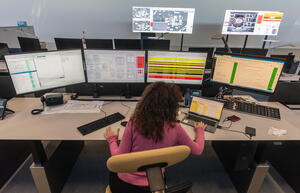
Facing four large screens on her desk, plus an extra one on her laptop, Rossella Rotella has her finger on the installation’s pulse. Besides being in charge of the Tritium Breeding Blanket Project, Rossella is one of a dozen specialists from different ITER units who devote part of their time to managing shift operations in the ITER control room. A few desks away from her, principal shift operator Vladislav Kim keeps a close watch on a variety of systems, some already active, others still in the commissioning phase. Besides them, the 750-square-metre space on the first floor of the Control Building is empty. Progressively, as the temporary control rooms scattered throughout the installation are folded into one single “nerve centre,” more and more operators will be sitting at desks in the control room. At the peak of ITER's scientific activity they will be close to 80, monitoring millions of plasma, tokamak and plant system parameters.Rossella’s mission, as shift operation manager, is twofold. One is to monitor the beat and pulse of the installation’s systems and, in case of a warning or an alarm flashing on one of the screens, authorize the shift operator sitting at the nearby desk to intervene. Depending on circumstances this can mean remotely starting or stopping a system, or adjusting its parameters to respond to a client’s need. Based on instructions from the shift operation manager, principal shift operator Vladislav Kim can remotely start or stop a system, or adjust its parameters to respond to a client’s need. The other is to ensure that the works being conducted on the ITER site—sometimes in or close to “operational areas”—do not present safety risks and do not interfere or generate issues with the systems in operation. “There is a coordination meeting every morning with the responsible officers or their representatives to consolidate the site configuration and discuss the expected activities that will impact it,” explains Rossella. “But there are also unplanned activities. In that case, the system responsible officer must inform the shift operation manager, who takes the appropriate decision, like issuing the ‘permit to work,’ or delaying or refusing it.” Communication between the “nerve centre” and the field relies on a series of redundant tools: the dashboards on the computer screens, telephone and email, talkie-walkies. and even—in case of emergency—a public address system with loudspeakers located in different areas of the installation. The changing of the guard: as Rossella’s shift ends, Fabienne (left) takes over. In addition to their Control Room responsibilities, shift operation managers are on call at night every two weeks, and on-call during the weekend every quarter. It is nearing 1:00 p.m. and Rossella’s five-hour shift will soon end. After a short briefing Fabienne Kazarian, a radiofrequency engineer, takes over. Both women are specialists in their respective fields, have accumulated deep experience in systems integration, and have an intimate knowledge of the workings of the ITER installation—precious background when it comes to “balancing priorities while giving absolute priority to the safety of personnel” at a time when ITER is in the last phases of construction while already operating dozens of industrial systems.

Getting the full once-over

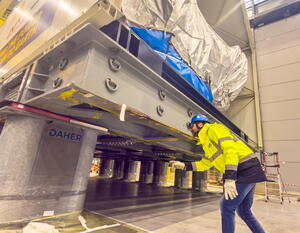
When you receive a package, it’s always a good idea to give it a quick inspection to make sure it wasn’t damaged in transit. But what if the package is a 400-tonne vacuum vessel sector? In that case, that “quick inspection” is going to take a few days. Vacuum vessel sector #9 arrived at ITER early on the morning of Friday 6 March after a long journey from Italy—first by sea and then by road along the 104-kilometre ITER itinerary. Once carefully removed from its protective transport housing, the component will be placed on stooling, its thermal bag will be removed, and it will undergo a site acceptance test. This multi-day visual inspection ensures there have been no scratches, dents, or other abnormalities since the component passed its factory acceptance test last year following the completion of manufacturing.“It is a very thorough inspection. Our teams go up in cherry pickers and work underneath to examine the vacuum vessel sector from every possible angle,” says Gabriel Pruna, the ITER Assembly Technician overseeing the inspection. “This is an important first step in the assembly process and it is essential to verify the component is in the right condition before we move forward.” The component moves into the former Cryostat Building on 7 March 2026, where the inspection will take place and the first assembly work will be done. Once the site acceptance test is completed, the component will begin its preparation for assembly. Bosses, studs, and clips will be welded onto the inner and outer shells, the component will be scanned so customized padding can be made to protect it during the upending, and other work will be carried out.After this phase is completed, vacuum vessel sector #9 will be moved into the Assembly Hall sometime in June. First the side panelling is removed. Next, the housing will be lifted about ten centimetres so that the component and its transport frame can be pulled out from underneath using a self-propelled modular trailer (SPMT).

Expanding opportunities in fusion

To mark International Women’s Day, ITER staff held a discussion on careers in science and engineering, with several employees sharing their professional experiences and career paths. In recent years, ITER has introduced expanded policies aimed at improving recruitment and career development, and between 2022 and 2025 the proportion of female applicants increased from 12% to 23%, while the share of women among new hires rose from 14% to 26%. Data presented at the event also indicated strong promotion and retention rates among women in professional roles.
Of interest

ITER in "Nuclear Fusion": progress, key objectives and the larger ecosystem

https://www.iter.org/of-interest?id=34094
In a comprehensive new article in Nuclear Fusion, ITER Director-General Pietro Barabaschi and colleagues outline the progress of ITER and reaffirm the project’s central role in bringing fusion energy from experimental science to industrial reality. After a period of restructuring, contract adjustments, and technical recovery, the project is now advancing under a revised plan known as Baseline 2024, designed as a realistic and achievable path to the first experiments, deuterium operation, and ultimately deuterium-tritium fusion with a gain of Q ≥ 10. Over the past two years, the organization has reported its strongest performance to date, maintaining schedule and cost targets while accelerating assembly and manufacturing activities. Major milestones include completion of all superconducting magnets, start of series production of tungsten plasma-facing components, and renewed progress in tokamak assembly following successful repairs to key elements. Large plant systems such as the cryogenic infrastructure are operating, and critical test facilities are coming on line as the project transitions from construction to integrated commissioning. The authors describe how, despite the emergence of new fusion actors, ITER’s mission is unchanged: to demonstrate integrated, industrial-scale fusion and provide the knowledge and technology needed for future power plants. In that sense, they argue, ITER is not competing with the expanding fusion ecosystem—it is laying its foundation. Barabaschi, P., Artola, F. J., Oliva, A. B., Carannante, G., Coblentz, L., Encheva, A., Giniiatulin, R., Grillot, D., Hunt, R., Jachmich, S., Kamada, Y., Kim, S., Loarte, A., Marquez, A., Merola, M., Noh, C. H., Nunes, I., Orlandi, S., Perrier, G., . . . Veltri, P. (2026). Progress of ITER and its importance for fusion development. Nuclear Fusion. https://doi.org/10.1088/1741-4326/ae4d5c

Press

ITER项目真空室扇段X射线无损检测 有序推进

https://www.iterchina.cn/picnews/info/2026/24218.html

Nuclear energy, the virtuous path of the public-private alliance

https://en.ilsole24ore.com/art/nuclear-energy-virtuous-path-of-the-public-private-alliance-AIV47WlB?refresh_ce=1

中国首家!新奥受邀加入ITPEA聚变合作机制

https://www.enn.cn/newsdetail.html?id=1629

F4E delivers all magnetics diagnostic equipment for ITER

https://fusionforenergy.europa.eu/news/f4e-delivers-all-magnetics-diagnostic-equipment-for-iter/

ITER项目完成首款专用辐射防护屏蔽 砂浆浇筑 构筑辐射防护新屏障

https://www.iterchina.cn/picnews/info/2026/24216.html

US takes step to solidify rules on nuclear fusion energy (paywall)

https://www.reuters.com/legal/litigation/us-takes-step-solidify-rules-nuclear-fusion-energy-2026-02-26/

“太陽”を生み出せるか 史上最大の核融合計画 (viewable in Japan only)

https://www.web.nhk/tv/an/special/pl/series-tep-2NY2QQLPM3/ep/V94VJJWX8L

AI boost for UK fusion

https://www.neimagazine.com/news/uk-fusion-gets-ai-boost/

IEA Features Fusion in State of Energy Innovation 2026 Report

https://www.fusionindustryassociation.org/iea-features-fusion-in-state-of-energy-innovation-2026-report/

A “roadmap” on the challenge of component damage caused by plasma due to decoupled electrons in tokamaks

https://irfm.cea.fr/en/2026/03/une-feuille-de-route-sur-le-defi-de-l-endommagement-des-composants-face-au-plasma-par-les-electrons-decouples-dans-les-tokamaks-anglais/

National report supports measurement innovation to aid commercial fusion energy and enable new plasma technologies

https://www.pppl.gov/news/2026/national-report-supports-measurement-innovation-aid-commercial-fusion-energy-and-enable

Decommissioning and Waste Management Considerations for Fusion Facilities

https://www.iaea.org/publications/16013/decommissioning-and-waste-management-considerations-for-fusion-facilities