Registration for the 16th ITER International School in Bengaluru, India, on "Tokamaks as Fusion Reactors" has been extended through 3 September 2026. CLICK HERE FOR ALL INFORMATION.
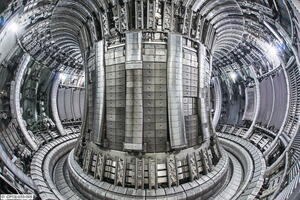
The Joint European Torus (JET) operated for 40 years before entering decommissioning in 2023. It was the last tokamak capable of operating with deuterium-tritium (D-T) fuel until devices like ITER begin their own D-T research, which makes the datasets generated in JET’s final campaigns effectively irreplaceable.
The outcome of its final experiments between 2022 and 2023 was presented as an Overview contribution to the last IAEA Fusion Energy Conference in Chengdu and was recently published in Nuclear Fusion. These results are already validating predictive models, contributing to shared international databases, and informing the design of first-of-a-kind fusion power plants.
The results speak for themselves. JET set a new fusion energy record of 69 MJ in tritium-rich hybrid plasmas and achieved long-pulse H-mode operation up to 60 seconds. The team also demonstrated ITER-relevant integrated scenarios and generated critical data informing the pellet injection mechanisms for ITER’s disruption mitigation system. JET’s comprehensive fuel-retention studies will also act as a precedent for how ITER may track and manage its tritium inventory.
Beyond the physics, JET’s final years leave behind decades of operational experience in handling tritium and nuclear-grade components will directly shape how ITER and future power plants are safely operated.
JET’s results are further described in an article published by EUROfusion and in the newly published scientific paper.
To create fusion, you need a very different world to the one we live in. It needs to be six orders of magnitude hotter and six orders of…
Six orders of magnitude
To create fusion, you need a very different world to the one we live in. It needs to be six orders of magnitude hotter and six orders of magnitude less dense — and the result is six orders of magnitude more energy than most everyday processes. The EFDA web site has the whole story here...