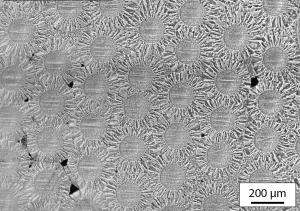
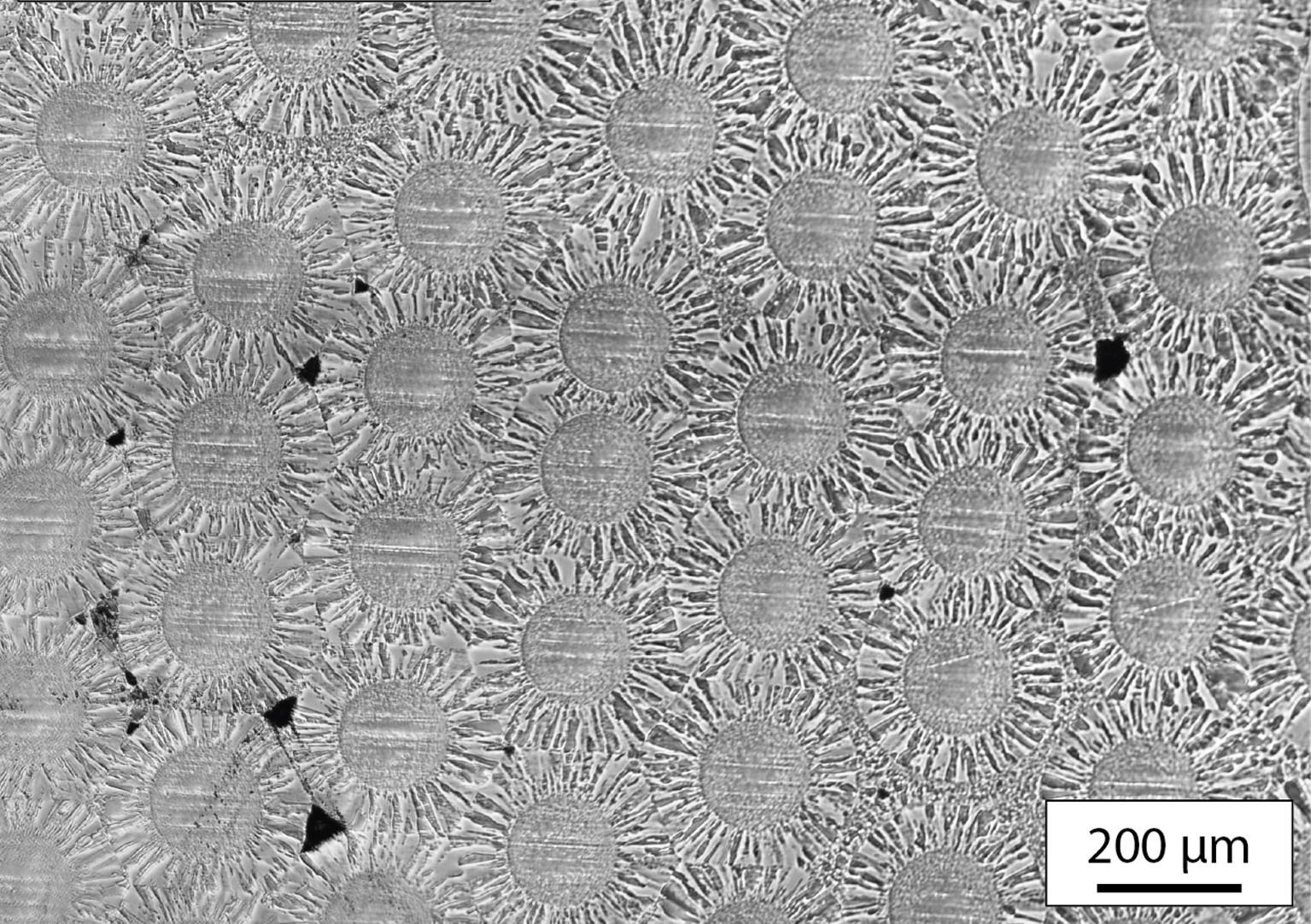
The first step was to produce the new material. A tungsten matrix had to be reinforced with long coated fibres consisting of extruded tungsten wire thin as hair. The wires, originally intended as luminous filaments for light bulbs, where supplied by Osram GmbH. Various materials for coating were investigated at IPP, including erbium oxide. The completely coated tungsten fibres were then bunched together, either side by side or braided. To fill out the gaps between the wires with tungsten Johann Riesch and his co-workers then developed a new process in conjunction with English industrial partner Archer Technicoat Ltd.
Whereas tungsten workpieces are usually pressed together from metal powder at high temperature and pressure, a more gentle method of producing the compound was found: the tungsten is deposited on the wires from a gaseous mixture by applying a chemical process at moderate temperatures. This was the first time that tungsten-fibre-reinforced tungsten was successfully produced, with the desired result—the fracture toughness of the new compound had already tripled in relation to fibreless tungsten after the first tests.
The second step was to investigate how this works. The decisive factor proved to be that the fibres bridge cracks in the matrix and can distribute the locally acting energy in the material. Here the interfaces between fibres and the tungsten matrix, on the one hand, have to be weak enough to give way when cracks form and, on the other, be strong enough to transmit the force between the fibres and matrix. In bending tests this could be observed directly by means of X-ray microtomography demonstrating the basic functioning of the material.
Decisive for the material's usefulness, however, is that the enhanced toughness is maintained when it is applied. Johann Riesch checked this by investigating samples that had been embrittled by prior thermal treatment. When the samples were subjected to synchrotron radiation or put under the electron microscope, stretching and bending them also confirmed in this case the improved material properties. If the matrix fails when stressed, the fibres are able to bridge the cracks occurring and stem them.
The principles for understanding and producing the new material are thus settled. As a prerequisite for large-scale production, samples are now to be produced under improved process conditions and with optimized interfaces. The new material might also be of interest beyond the field of fusion research.