
China's HT-7 retires after 11,800 plasma shots
4 Jun 2013
-
Shaohua Dong, ASIPP
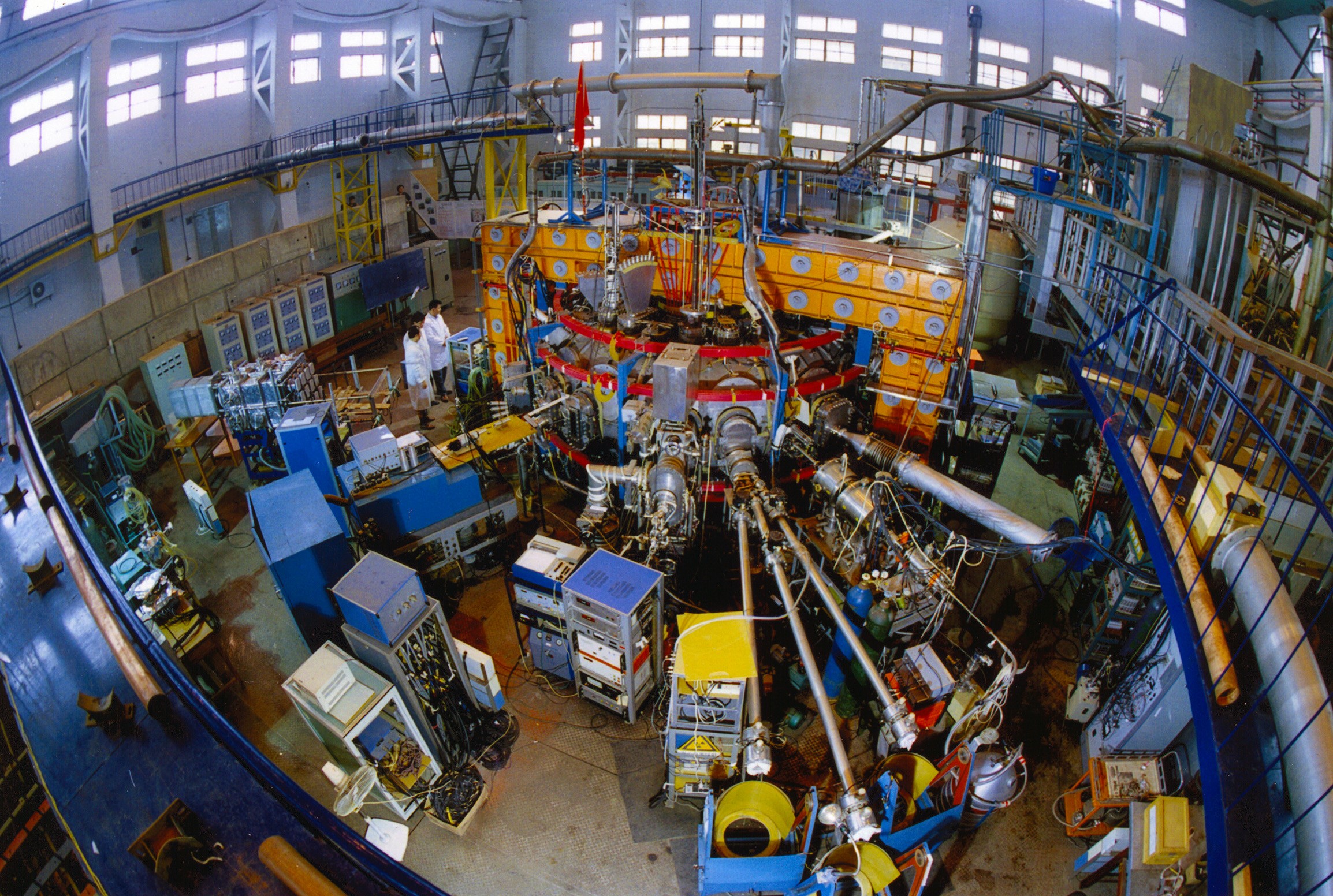
HT-7, the world's fourth—and China's first—superconducting tokamak entered service in 1995 and has fulfilled all of its scientific missions, nurturing three generations of Chinese fusion scientists.
Next time you want to see HT-7 you will have to go see it in its new home, ASIPP's new energy centre in Huainan (80 km west of Hefei). It will ultimately become a museum exhibit, showcasing an important period of history and bearing witness to fusion research developments in China over the past two decades.
Recently the HT-7 tokamak was officially endorsed for retirement by the Chinese Academy of Sciences and the Ministry of Environmental Protection after a three-month review of the feasibility of retirement and the retirement plan that included an assessment of scrap equipment and environmental impact. This is the first mega-science device that has ever been taken out of service in China.
HT-7, the world's fourth—and China's first—superconducting tokamak entered service in 1995 and has fulfilled all of its scientific missions, running nearly 20 rounds of experiments, discharging 11,800 plasma shots, nurturing three generations of Chinese fusion scientists and achieving a 400-second record in long plasma discharges.
Its story dates back to early 1990 when Academician B. Kadomtsev, the former director of the Kurchatov Institute in Moscow, expressed his Institute's willingness to transfer the T-7 tokamak to ASIPP as a gift.
After discussing logistical, management and technical considerations with his colleagues, as well as the engineering and physics challenges, Academician Huo Yuping (the director of ASIPP at that time) made a quick and bold decision to accept the offer. This decision received strong support from the Chinese Academy of Sciences and other government authorities.
From 1991 to 1994 T-7, together with its subsystems, was transported to Hefei. Despite economic hardship at that time, ASIPP—with the participation and assistance of Russian scientists—pooled its human and financial resources to rebuild the T-7 tokamak, which was renamed "HT-7" (the "H" stands for Hefei).
After commissioning in March 1995 HT-7 was put into operation the same year, a milestone marking the entry of China (after Russia, France and Japan) into the circle of nations possessing a superconducting tokamak.
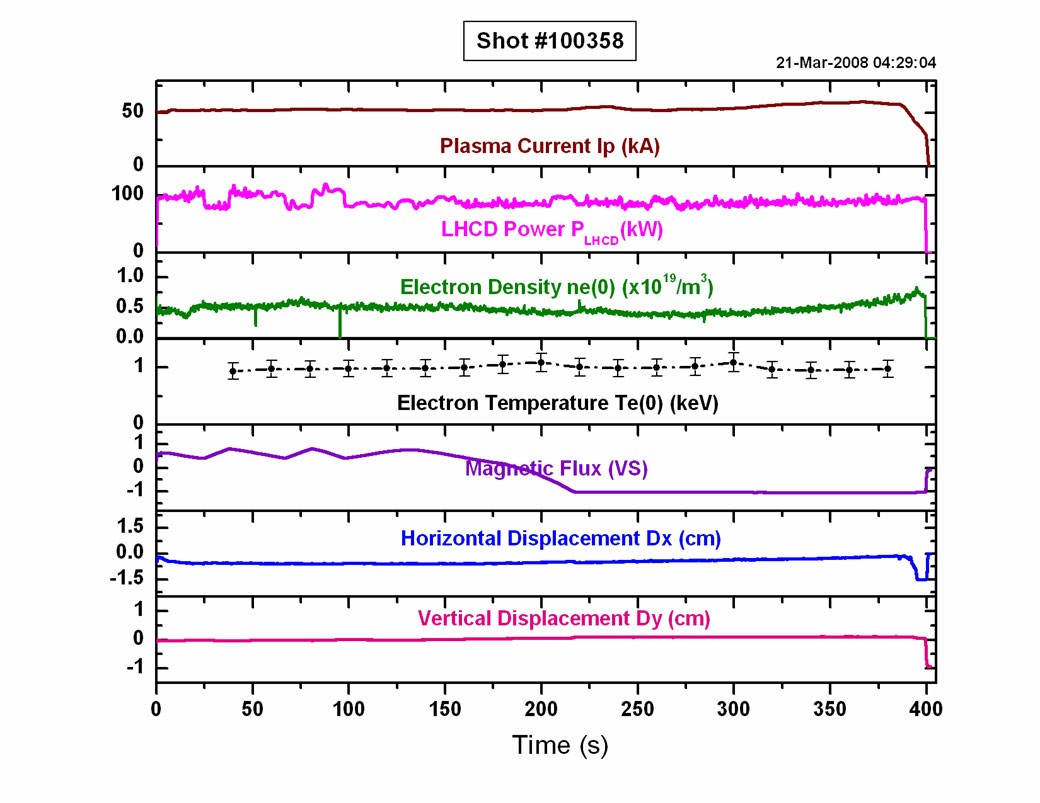
On 21 March 2008, HT-7 achieved a 400-second plasma record, with central electron temperature of twelve million degrees, and central plasma density 0.5×10¹⁹m-3.
In order to conduct long-pulse high-performance plasma operation and related physics research on HT-7, ASIPP developed dozens of systems and technologies such as radio frequency wall conditioning, a water-cooled graphite limiter, a1.5 MW/20-110 MHz radio frequency heating system, real-time multi-variable feedback plasma control, 2.45GHz/1.2MW lower hybrid current drive, and a 30 MW thyristor convertor in same phase anti- parallel connection with 4-quadrant circulating current operation mode.
In total, 11,8000 shots were discharged in nearly 20 HT-7 experiment campaigns, which explored graphite limiter operation mode, high parameter plasma characteristics with wave heating and drive, and long-pulse high-performance operation modes. On 21 March 2008, HT-7 achieved a 400-second plasma record with central electron temperature of twelve million degrees and central plasma density of 0.5×10¹⁹m-3.
Because of HT-7 construction and operation, ASIPP has greatly enhanced its R&D capabilities and cultivated a team of engineers and scientists willing to brave hardship and challenges, a trustworthy "team of accomplishments." In addition, ASIPP has promoted extensive international cooperation.
The valuable experience and manpower training resulting from HT-7 exploitation paved the way for the successful construction and operation of EAST and has laid a solid foundation for China's contribution to ITER. It is also a valuable source of information for the future fusion research and projects.
To those who have worked for and on HT-7, the tokamak represents a huge part of their lives—a legend of tears and laughter. The day of 12 October 2012 will always be a day to remember for ASIPP staff: three generations of ASIPP scientists gathered in the HT-7 tokamak control room to witness the last plasma discharge of this beloved machine and to say goodbye. HT-7 did not let them down, putting a beautiful full stop to its career by giving a mighty and last shot amid thunderous cheers and applause.
At last! Time to rest, old pal.