
Powering up
Taming the enormous power of the French electrical grid and delivering precisely controlled direct current to ITER’s superconducting magnets requires a complex network of transformers and converters. High-voltage testing of the delivery chain for a poloidal field coil has shown the system is up to the task.
Electricity from the French national grid arrives at ITER as alternating current (AC) at a high voltage of 400 kV and a relatively low current as measured in amperes. However, ITER’s superconducting magnets require direct current (DC) delivered at a much lower voltage and a much higher current that reaches 55 kA for poloidal field coils and 68 kA for toroidal field coils.
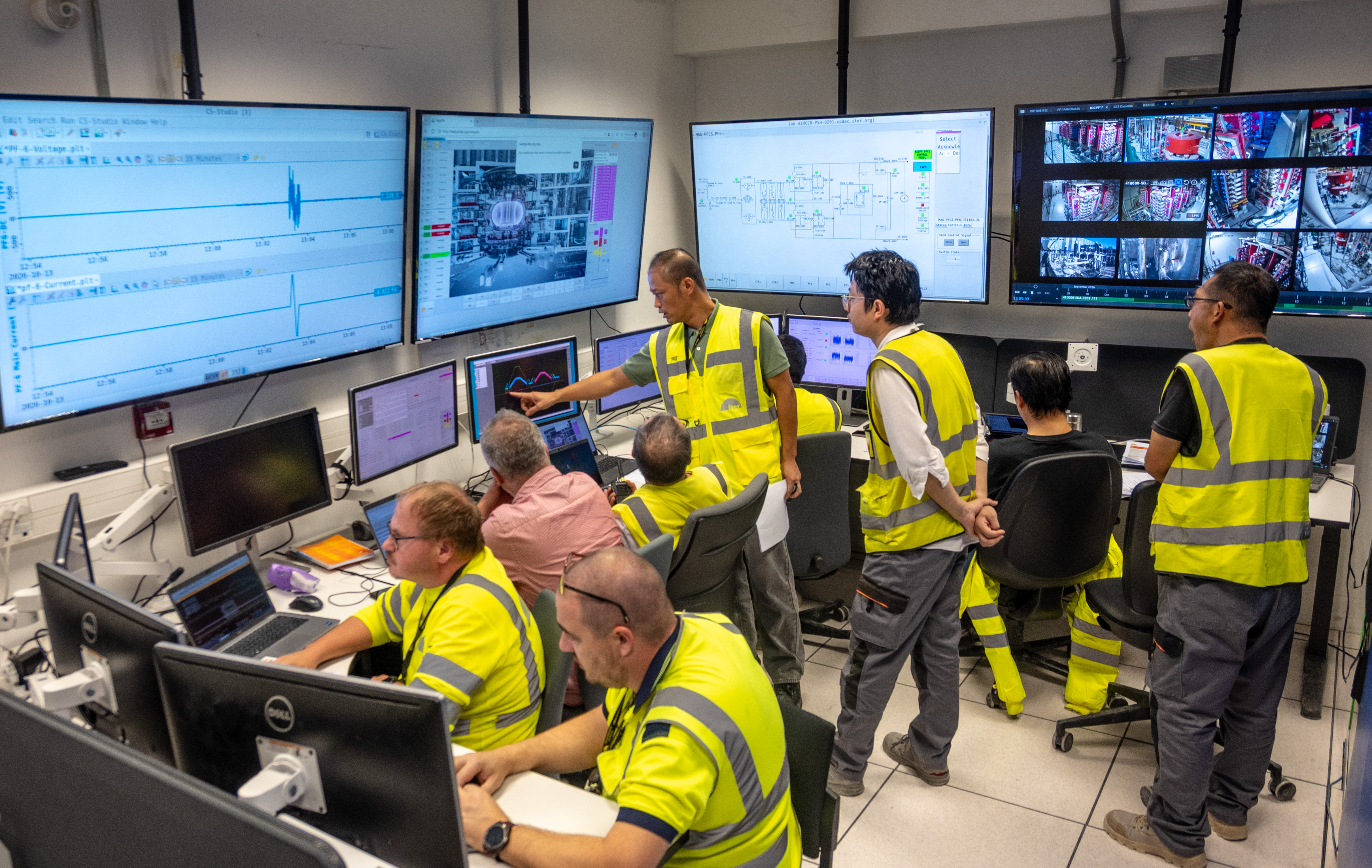
To bridge this gap, ITER has been working with the Domestic Agencies and industrial partners to design, manufacture and install a sophisticated network of transformers, power converters, DC switches, busbars, and associated electrical equipment. In a full-current test of the power converters for poloidal field coil #1 and #6, the team demonstrated that delivery chain of equipment could work together to provide the current the coil will need during tokamak operation.
“The commissioning gives us great confidence the system can provide the power that is needed for plasma operations,” says Fan Renjing, the ITER project leader who oversaw the activities. “There is still significant work ahead, including the verification of the power delivery systems for the other magnets, but this achievement provides a strong foundation for the next stage of commissioning.”
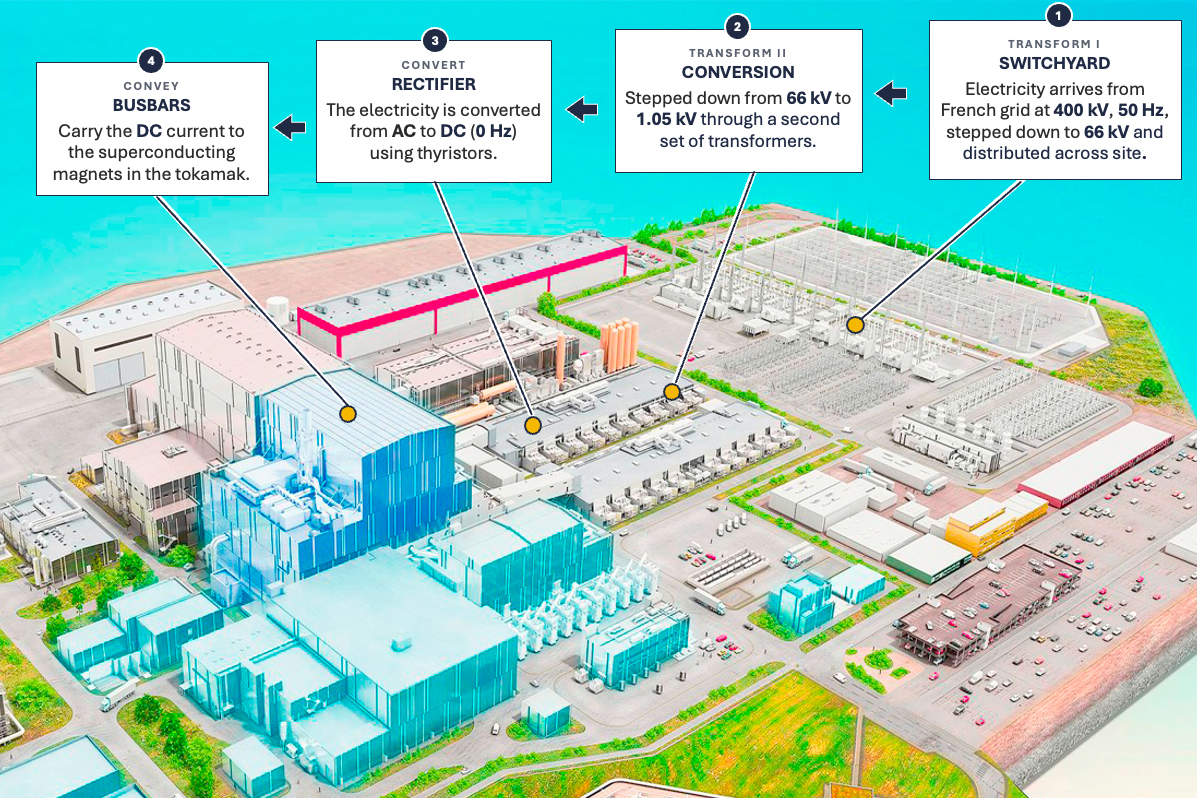
At ITER, getting power from the grid to the magnets comes down to three steps: transform, convert, and convey.
First, there is the transformation of the alternating current electricity that comes into the ITER switchyard from the grid at 400 kV and 50 Hz (this means the current flows back and forth, completing 50 cycles per second). This process requires transformers that first brings the electricity down from 400 kV to 66 kV, and the second from 66 kV to 1.05 kV. For a given amount of power, lowering the voltage allows a higher current, so the 1.05 kV has a current that can reach the needed amperage.
Next, rectifiers convert the alternating current to direct current. This is done in the conversion buildings where the current is passed through electronic switches called thyristors to control when current flows, thus producing a controllable output that flows in one direction.
Finally, this direct current is conveyed to the magnets through thick, water-cooled aluminium busbars.
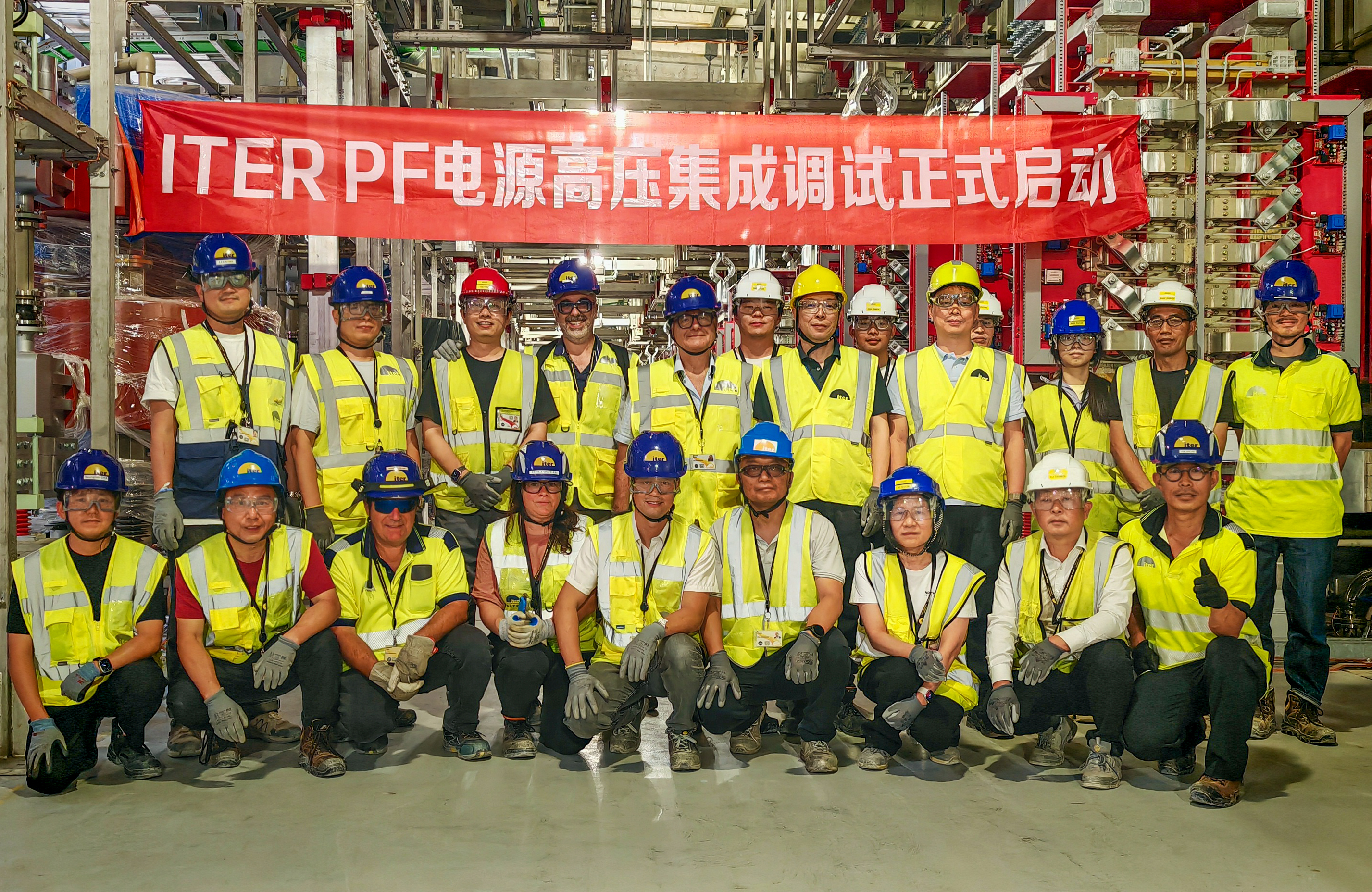
The components needed to prepare the electricity for the magnets are being procured through the Chinese, Russian and Korean Domestic Agencies. Earlier this year, the team commissioned 32 power converters supplied by China and Korea at low voltage and tested them under light loads. That work laid the groundwork for this autumn’s full-current test of the power supply chain supplied by China that serves poloidal field coil #1 and #6. The team transformed the voltage, converted the current and conveyed 55 kA to a dummy load designed to mimic the coil’s electrical behaviour during the test.
“We are very happy to have validated the performance of the system as well as the safety framework,” says Julien Petit, the electrical commissioning engineer who is the technical responsible officer for the project. “We've demonstrated that the equipment and the procedures work and that’s the greatest success of this milestone.”
ITER carried out the commissioning in partnership with ITER China and Institute of Plasma Physics of the Chinese Academy of Sciences (ASIPP), which developed ITER’s poloidal field converters. The next round of testing, scheduled for December, will focus on the power supply chain for poloidal field coil #2.