
Wendelstein 7-X: ten years of world-leading fusion research
The team at the Max Planck Institute for Plasma Physics in Greifswald, Germany, is celebrating ten years of science on the Wendelstein 7-X stellarator.
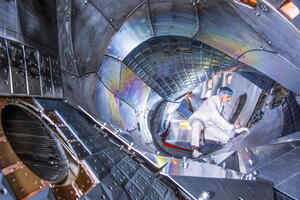

It started in December 2015 with just one milligram of helium gas, pumped into the strangely twisted plasma chamber of the Wendelstein 7-X stellarator and heated with microwaves to a temperature of one million degrees.
The plasma pulse that resulted may have only been one-tenth of a second long, but it signalled that nine years of construction work, more than a million assembly hours, and one year of integrated testing was over and experimental operation to investigate the stellarator concept as an alternative design for the fusion power plants of the future could begin.
Ten years and several upgrades later, Wendelstein 7-X has put milestone after milestone on the books and now forms the basis for the power plant projects of several start-up companies. The device maintained a plasma for more than eight minutes for the first time in 2023, a world record for stellarators, and routinely achieves ion temperatures of 40 million degrees Celsius in the plasma. In May of this year, Wendelstein 7-X reached a record triple product in long plasma discharges.
See this report on ten years of operation at Wendelstein 7-X. The device is currently undergoing a one-year maintenance phase and will resume operation in September 2026.