
“The repair campaign obliged us to rethink the way we work”
With the completion this autumn of a multiyear campaign to repair key tokamak components, ITER is closing a difficult chapter in its construction history. But the experience has also prompted important changes in the way the project approaches engineering, industrial partnerships and machine assembly. Construction Project head Sergio Orlandi reflects on a turning point for ITER—and the lessons that will guide the next phase of construction.
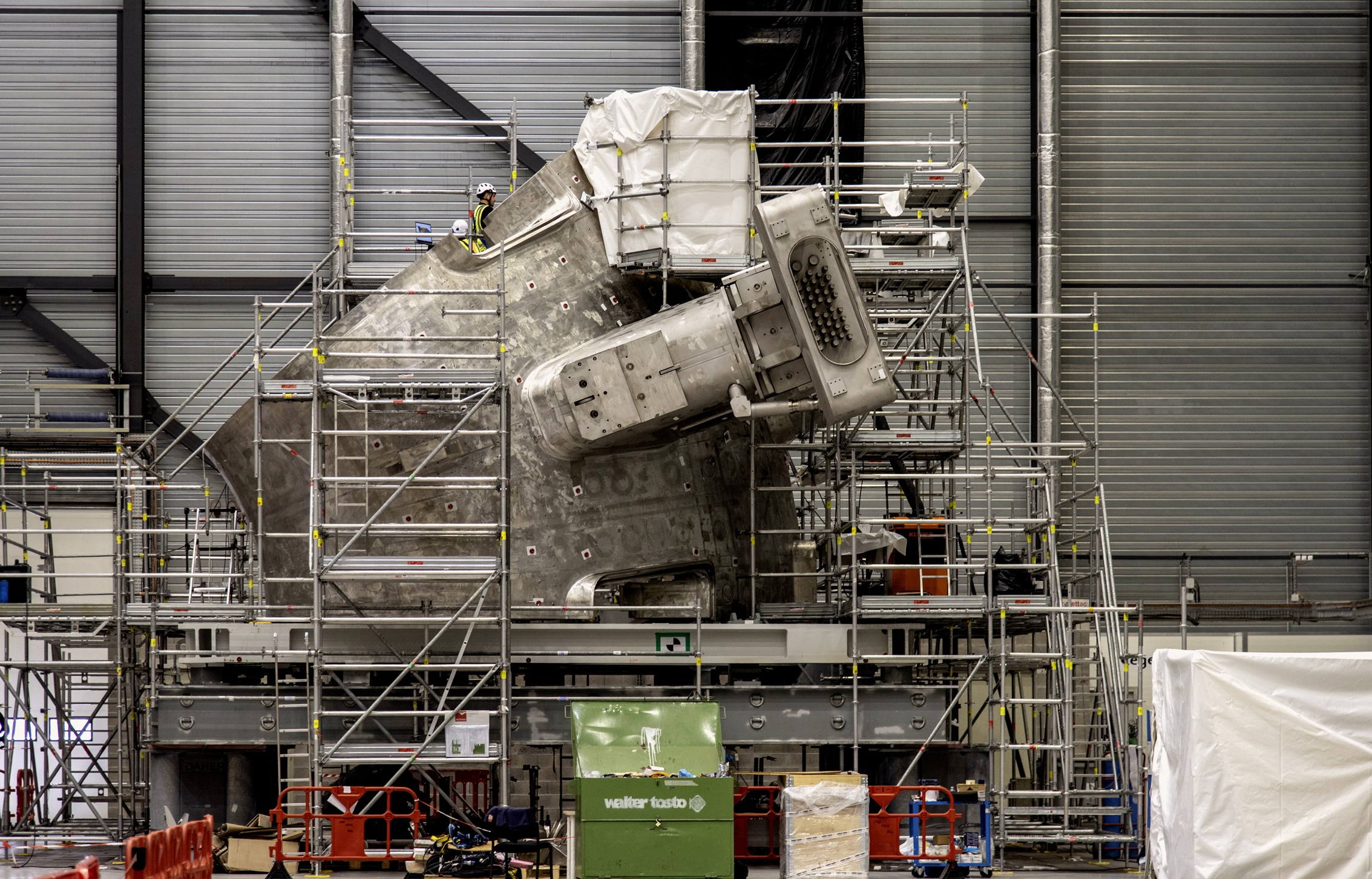
When the first “piece” of the vacuum vessel—sector module #6—was lowered into the tokamak pit in May 2022, ITER was already becoming aware of problems affecting key components. Looking back, how significant was that moment?
I see May 2022 as a dividing line between two periods in ITER's construction history. Lowering the first sector module into the pit was an important demonstration of our technical capabilities, but at the same time some fundamental problems were coming into focus.
We were facing two distinct challenges. We had found corrosion in some thermal shield cooling pipes, which raised concerns about the condition of other panels. And the vacuum vessel sectors were affected by dimensional deviations in the bevel regions, where adjacent sectors would eventually be welded together.
I saw an even more fundamental issue related to the overall integration of the nine sectors: even if a sector is manufactured within its specified tolerances, it requires adjustment to fit precisely with its neighbours. It was urgent to move beyond a focus on the individual components and consider the entire assembly process and every interfacing part. We also had to bring the assembly sequences under control in terms of duration and cost.
It was clear we needed a different approach—not only to repairing the components, but also to organizing and managing the work that lay ahead. That is why, when I think of this critical juncture, I think of a “before” and an “after.”
How did ITER move from identifying the problems with key tokamak components to developing and qualifying the repair solutions?
Our first priority was to establish whether the components could be repaired. In July 2023, we removed sector #6 from the tokamak pit—an operation that was considerably more than an “installation operation in reverse,” requiring additional engineering and modifications to tooling. Once the sector was accessible to metrology, we understood how much its bevel joints deviated from an acceptable configuration for integration with other sectors.
In parallel, we sought advice from specialist organizations including welding institutes in France and Italy, research institutes such as the French Alternative Energies and Atomic Energy Commission (CEA), and CERN for the thermal shield. Over a period of one year, we worked with industrial companies to develop mockups, test different approaches for the repair of both types of defects, and qualify welding, material build-up and machining procedures for bevel repair.
The overall conclusion was that we could repair the components, but there were uncertainties and differing technical opinions along the way. The breakthrough came when we stopped considering each sector in isolation and focused instead on how it could be adjusted to fit with its neighbours. This guided the bevel repair strategy: depending on the location, material had to be added, removed through machining, or both.
Working with ITER specialists, external experts and industrial partners, we established qualified procedures for the repair (or refabrication) of all thermal shield sets and for the repair of the sector bevel joints, with appropriate nuclear safety oversight. By autumn 2023, we had selected the companies and contracts were in place.
How did the experience of the repair campaign influence the way ITER organizes construction activities and works with industrial contractors?
Repairs obliged us to rethink the way we work. Beyond the immediate work of recovery, we had to ask: what could be improved going forward? One of the most important lessons was that ITER needed to take greater ownership of the engineering and planning of construction activities. In the past, some contracts had been awarded with a relatively broad description of the work, leaving much of the detailed engineering and organization to be developed during execution.
Today, we develop detailed engineering work packages before launching the competitive bid to select an industrial partner. This allows companies to prepare realistic proposals and gives ITER a stronger basis for evaluating performance. Also, where the original approach had been to rely on a single large contract to cover many different activities, now we divide the work into more clearly defined packages, each with its own engineering preparation and execution strategy.
The objective is not to tell contractors how to do everything, nor is it to hope they know as much as you. It is to establish a genuine industrial partnership in which ITER brings its knowledge of the machine and its requirements, while the contractor contributes its expertise in execution. ITER remains closely involved throughout the process.
Beyond contracting, what changed in the day-to-day organization of work on the ITER site?
During the first assembly of sector module #6 in 2021/2022, many activities had been carried out sequentially. Metrology was followed by engineering analysis, followed by further measurements and adjustments.
In our new approach, we began integrating metrology more closely with engineering and execution, identifying activities that could proceed in parallel and making better use of facilities and tooling. We believed we could significantly reduce the time required for each sector module, initially targeting eight or nine months for assembly and installation. With experience gained from each successive operation, our contractor CNPE is now completing the sub-assembly phase in just 5.5 months.
We have also strengthened the way we monitor progress and costs, with regular reviews of each contract and closer attention to the relationship between completed work and expenditure.
What are the most important lessons that ITER can carry forward into the next stages of machine assembly?
One of the most important lessons is that even the most complicated construction problems become more manageable when we break them down into clearly defined activities, understand the interfaces and bring together the right expertise. Construction is different from design. We must constantly adapt to the reality of the site, to the as-built configuration of components and to the constraints created by work already completed.
Experience being gained by our teams, including a new generation of younger program managers, is also an important legacy. Technical knowledge is essential, but managing interfaces between systems and components, coordinating contractors and maintaining control of schedules and costs are equally important skills. Much of that knowledge can only be acquired through practical experience.
We know that further challenges will emerge. What this experience has taught us is to approach them systematically, break them into manageable parts, and develop solutions that take account of the realities of construction. That is the approach we need to carry forward.