A recent public hearing organized by the Budgetary Control Committee of the European Parliament has shed a light on the significant impact of ITER in terms of economic benefits and job creation.
According to Massimo Garribba, Director at the Commission's Directorate-General for Energy, ITER has produced almost EUR 4.8 billion in gross value added and almost 34,000 "job years" over the period 2008-2017 through the award of over 900 contracts and grants in 24 countries of the European Union.
European companies report that working for ITER generates a new knowledge base, offers new business opportunities and increases their competitiveness and growth, helping to create additional jobs.
Read the details on the Fusion for Energy website.
28 Jan 2019
Plasma webcam among world's "most interesting"
Plasma webcam among world's "most interesting"
Thousands of live webcams throughout the world provide viewers with spectacular natural vistas, cityscapes and beaches, trendy bars and colourful markets in real time. Every year the EarthCam network, a website that collects webcams from thousands of sites across the globe, selects 25 of the most interesting views offered to the public.
As expected, webcam #1 in 2018 was pointed at a beautiful natural scene—the Arenal volcano in Costa Rica which, until a few years ago, was one of the most active in the world. There were also cats among the first tier of the awardees.
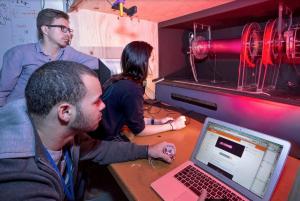
The surprise however came with webcam #18, the Remote Glow Discharge Experiment (RGDX) at the Princeton Plasma Physics Laboratory (PPPL), over which the EarthCam editors confessed they were "geeking out."
The RDGX allows viewers to turn on a plasma and change the gas pressure, the voltage, and the strength of the electromagnets from any place in the world.
Along with a webcam focused on a light bulb that has been shining at the Livermore, California, Fire Department for... 117 years ... and an interactive robot-controlling cam in Oakland, also in California, Princeton's RDGX is the only science- and technology-oriented webcam to make the first "25 most interesting webcams" in the world.