
Press release
36th ITER Council Meeting: Council welcomes continued strong project execution
The ITER Council welcomed the visit to the ITER worksite of President Emmanuel Macron of France and Prime Minister Narendra Modi of India, in February 2025, as well as recent visits from parliamentarians and ministerial-level delegations from other ITER Members.
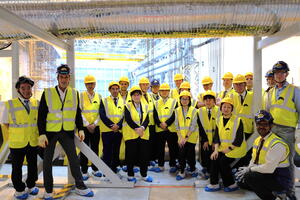
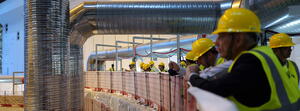
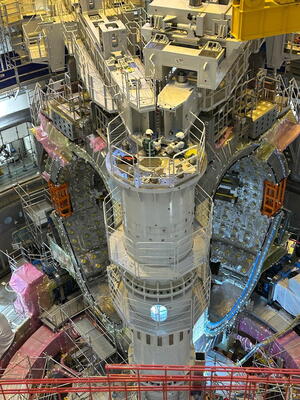
Continued strong project execution: At the Council’s thirty-sixth meeting on 18-19 June 2025, ITER Director-General Pietro Barabaschi reported on the progress of the ITER Project. The Council welcomed the installation of the first pre-assembled sector module ahead of schedule in April 2025. The Council had the opportunity to celebrate the installation of the second sector module by the Chinese-led industrial consortium, an operation completed just hours before the start of the meeting, approximately six weeks ahead of schedule. [See photos appended to the end of the press release.]
The Council also welcomed the completion of manufacturing and testing of the sixth module of the central solenoid by the United States, an achievement that received widespread recognition in the media, as it marked the completion of all of ITER’s required major magnets, a significant milestone reflecting broad and sustained collaboration among the ITER Members. Other achievements since IC 35—including delivery of the final Korean vacuum vessel sector and the second European vacuum vessel sector, steady progress on component repairs, continued positive interaction with the French nuclear safety regulator, and successful execution of strategies to increase the pace of tokamak assembly—were also welcomed.
Discussion of the project baseline: The Council reviewed the phased approach to the baseline proposed in June 2024, which prioritizes the start of substantial research operations as rapidly as possible. The ITER Organization will continue to execute according to Phase 1 of Baseline 2024, which will extend through the end of 2028.
Engagement with Private Sector Fusion Companies: The Council welcomed the continuing expansion of engagement with private sector fusion initiatives, including the second ITER workshop in April 2025 in sequence with the ITER Business Forum, the admission of the first private sector company to participate in the ITPA (International Tokamak Physics Activity), and the compilation and sharing of information on the global fusion supply chain. The Council recognized the value of this private-public collaboration for all Members.
ITER Member support: Council Members re-emphasized the strong value of the ITER mission and resolved to work together to facilitate ITER’s success. The Council noted the challenges and successes of this first-of-a-kind project and expressed appreciation that all ITER Members continue to support project success.
BACKGROUND TO THE PRESS RELEASE
ITER—designed to demonstrate the scientific and technological feasibility of fusion power—will be the world's largest experimental fusion facility. Fusion is the process that powers the Sun and the stars: when light atomic nuclei fuse together to form heavier ones, a large amount of energy is released. Fusion research is aimed at developing a safe, abundant and environmentally responsible energy source.
ITER is also a first-of-a-kind global collaboration that serves as the scientific backbone behind the growth of a fusion industry. As the host, Europe contributes almost half of the costs of its construction, while the other six Members to this joint international venture (China, India, Japan, the Republic of Korea, the Russian Federation and the United States), contribute equally for the remaining expenses. The ITER Project is under construction in Saint-Paul-lez-Durance, in the south of France.
For more information on the ITER Project, visit: http://www.iter.org/
Download the photos from this article.
CONTACT
Laban Coblentz
Laban.Coblentz@iter.org
+33 6 14 16 40 85