
Design review for tungsten divertor shows way ahead

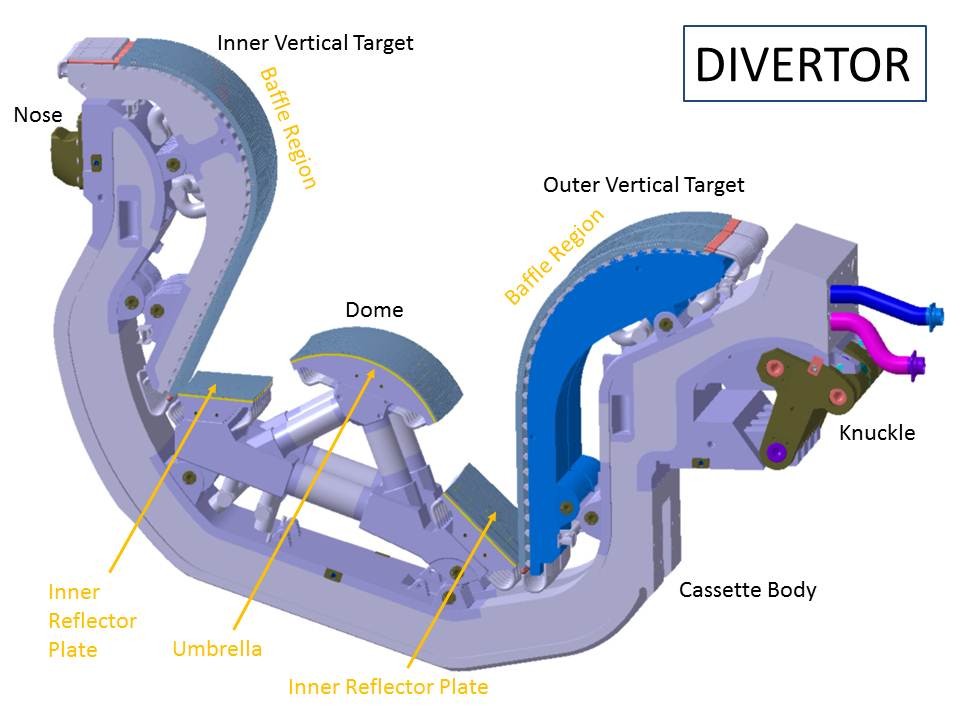
Carbon presented two major drawbacks as divertor armour material: it reacts chemically with the plasma fuel tritium and it traps the fuel like a sponge, leading to enhanced material erosion and unacceptable levels of tritium retention within the machine. Tungsten (W), on the other hand, has the advantage of not absorbing tritium, but at the same time it doesn't offer the same forgiving behaviour as carbon in terms of compatibility with the plasma.
Attention must also be paid to the global shaping of the upper baffle areas of a tungsten divertor, where off-normal events such as a sudden vertical displacement of the plasma are predicted to lead to extremely heavy heat loads. Through the slight tilting of the targets and through particular shaping of the outer baffle (very much like the shaping of the first wall of the blanket) some promising results have been obtained that were presented during the design review.
High heat flux tests performed last year at the newly completed ITER Divertor Test Facility in Russia—with prototypes manufactured by Japanese industry that were exposed to 10 MW/m² over 5000 cycles and 20 MW/m² over 1000 cycles—demonstrated no macroscopic cracks, de-bonding or traces of melting. Similar tests run for 300 cycles at 20 MW/m² have been performed by European industry with optimistic results.