
The different stages of US conductor fabrication
21 Jan 2013
-
Lynne Degitz, US ITER
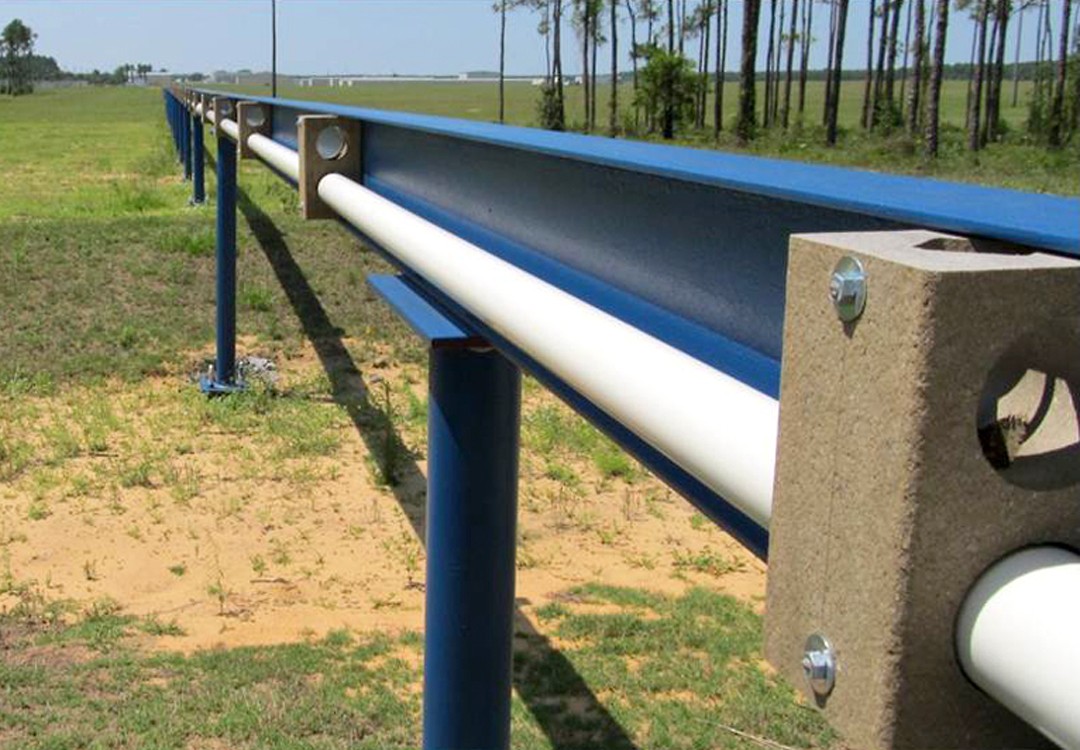
The 800-metre-long jacketing bench at High Performance Magnetics (Florida) runs parallel to a runway under renovation at the Tallahassee Regional Airport. Photo: High Performance Magnetics
US ITER and its vendors are moving into a new fabrication phase for the toroidal field magnet system for ITER. Cabling and conductor fabrication are now underway in New Hampshire and Florida for the niobium-tin wire produced in the US. All of this fabrication effort is in preparation for delivering the final product in 2015 to the European Union.
As part of its contributions to the ITER Project, the US is producing over 4 miles of cable-in-conduit superconductor; other ITER partners will provide the remainder of the conductor. This conductor will encircle the ITER Tokamak in a toroidal pattern, providing immense magnetic fields for confining 150-million-degree plasma into a doughnut-like shape.
Kevin Chan, a project engineer for the US ITER magnet systems, comments, "Cabling is a standard industrial process, but when dealing with the scale of the ITER conductor it becomes a much greater challenge."
New England Wire Technologies in Lisbon, New Hampshire acquired and then carefully refurbished a cabling machine that could handle the weight of the spools and conductor. While typical spools are 12 inches in diameter, 40 inches is needed for the toroidal field conductor. So far, New England Wire has shipped both 100-metre and 800-metre test cables to Tallahassee, Florida, where High Performance Magnetics will take on integrating the cable into the final cable-in-conduit conductor.
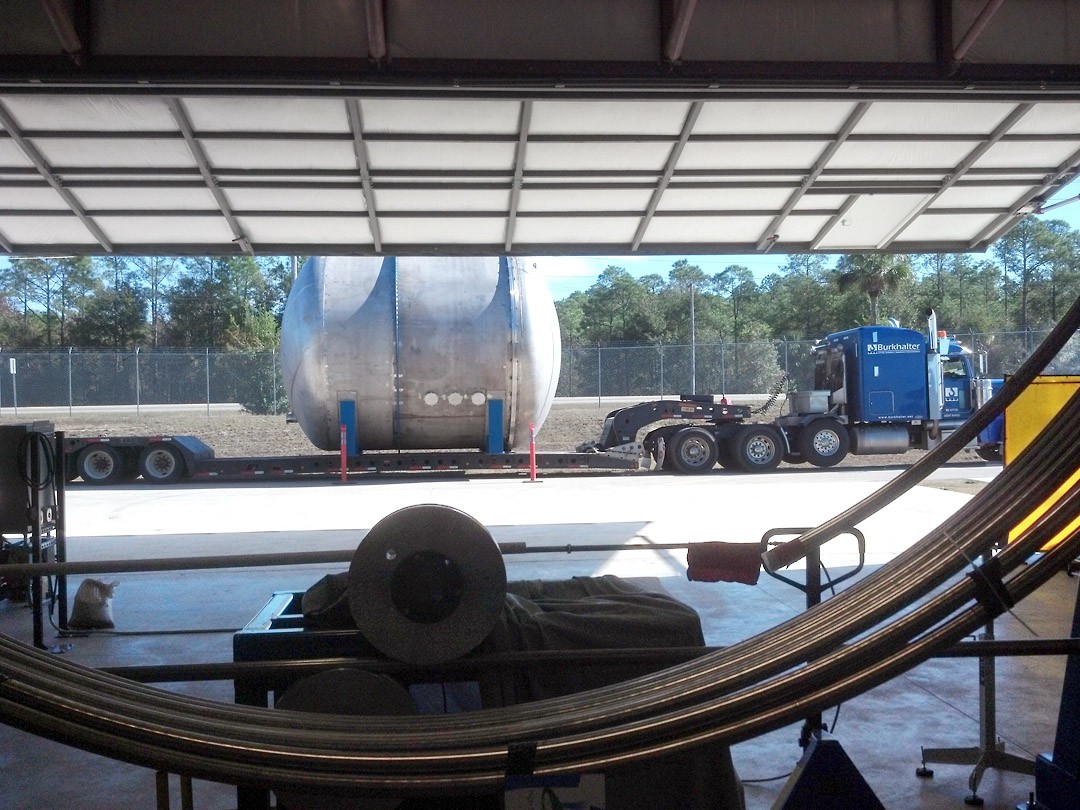
A vacuum vessel, produced by Alloy Fabrications (TN), was delivered to High Performance Magnetics for the leak testing of the conductor's central cooling channel. Photo: High Performance Magnetics
The integration process at High Performance Magnetics required the development of a unique facility. Located next to a runway at the Tallahassee airport, an 800-metre-long jacketing line was built to handle the insertion of cable into stainless steel tubing.
A vacuum vessel, produced by Alloy Fabrications in Clinton, Tennessee was delivered to High Performance Magnetics on 19 December 2012.
The next step is to test the final product for any leaks in the narrow channel in the middle of the conductor that permits helium to be pumped through the magnets for cooling. To perform this test, HPM received delivery of a large vacuum vessel from Alloy Fabrications in Clinton, Tennessee on 19 December.
So far, High Performance Magnetics has successfully demonstrated compaction and spooling of a 100-metre sample length. The company is now preparing to test their process for the 800-metre lengths required by ITER. To achieve success, the jacketing line must maintain alignment and avoid excessive deformities as the tube is squeezed onto the cable. Past performance suggests that this is well within reach.
"High Performance Magnetics (HPM) is using a novel, more economical, approach to the jacketing line. For quality assessment, HPM uses computer radiometry. Early tests of the jacketing process through the PVC pipes have shown great alignment. In contrast, more elaborate approaches, such as roller lines for moving the cable, present some challenges and increase costs," said Chan.
A vacuum vessel, produced by Alloy Fabrications in Clinton, Tennessee was delivered to High Performance Magnetics on 19 December 2012.
The next step is to test the final product for any leaks in the narrow channel in the middle of the conductor that permits helium to be pumped through the magnets for cooling. To perform this test, HPM received delivery of a large vacuum vessel from Alloy Fabrications in Clinton, Tennessee on 19 December.
"This is an important accomplishment—shipping the vacuum vessel from Tennessee to Florida. It is 15 feet in diameter and required special routing to make its destination," observes Chan.