
The heart of NSTX-U arrives in Princeton
Earlier this month, the Princeton Plasma Physics Laboratory celebrated a key milestone in the National Spherical Torus Experiment-Upgrade (NSTX-U) Recovery Project: the arrival of the central magnet bundle from Bilbao, Spain.
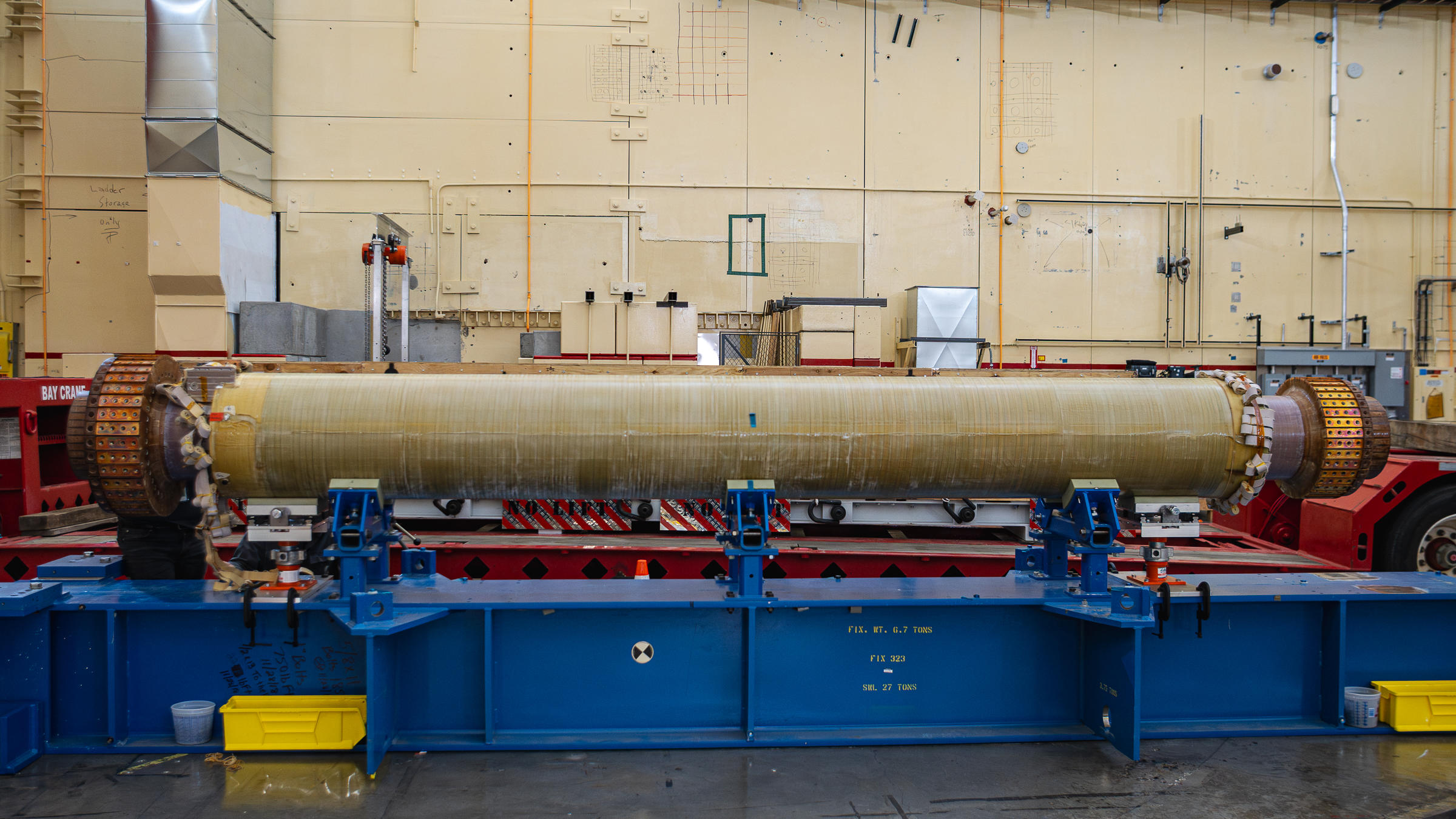
The bundle includes two components, both assembled by Elytt Energy. A pillar-shaped, toroidal field coil serves to create most of the magnetic fields that stabilize and confine the plasma. An ohmic heating coil wraps around it—much like thread on a bobbin—to drive a current and provide heating. This bundle will be the last major component installed before NSTX-U begins machine commissioning, followed by the start of experiments in 2027.
NSTX-U is a spherical tokamak—a more compact fusion device than traditional tokamaks like ITER. Its shape better resembles a cored apple than a donut, a design that offers both technical and financial advantages. Namely, spherical tokamaks can achieve higher plasma pressures at a given magnetic field, and with lower construction costs. Data from NSTX-U will help ITER optimize conditions for a self-sustaining burning plasma and investigate whether the spherical design could be viable at reactor-scale.
This device succeeds the former NSTX, which operated from 1999 to 2012. Although the earlier machine advanced plasma physics research, it did not run at fusion-relevant conditions. PPPL upgraded the device to double the toroidal field strength, plasma current, and auxiliary heating power, while quintupling the pulse durations. NSTX-U launched in 2016, but the failure of an inner poloidal field coil prematurely ended the campaign.
Over the past ten years, PPPL has worked to restore the device, and the central magnet bundle is critical to that effort. “The magnet bundle is at the heart of the project—literally and figuratively,” said NSTX-U Project Director Dave Micheletti in an interview from 2024.
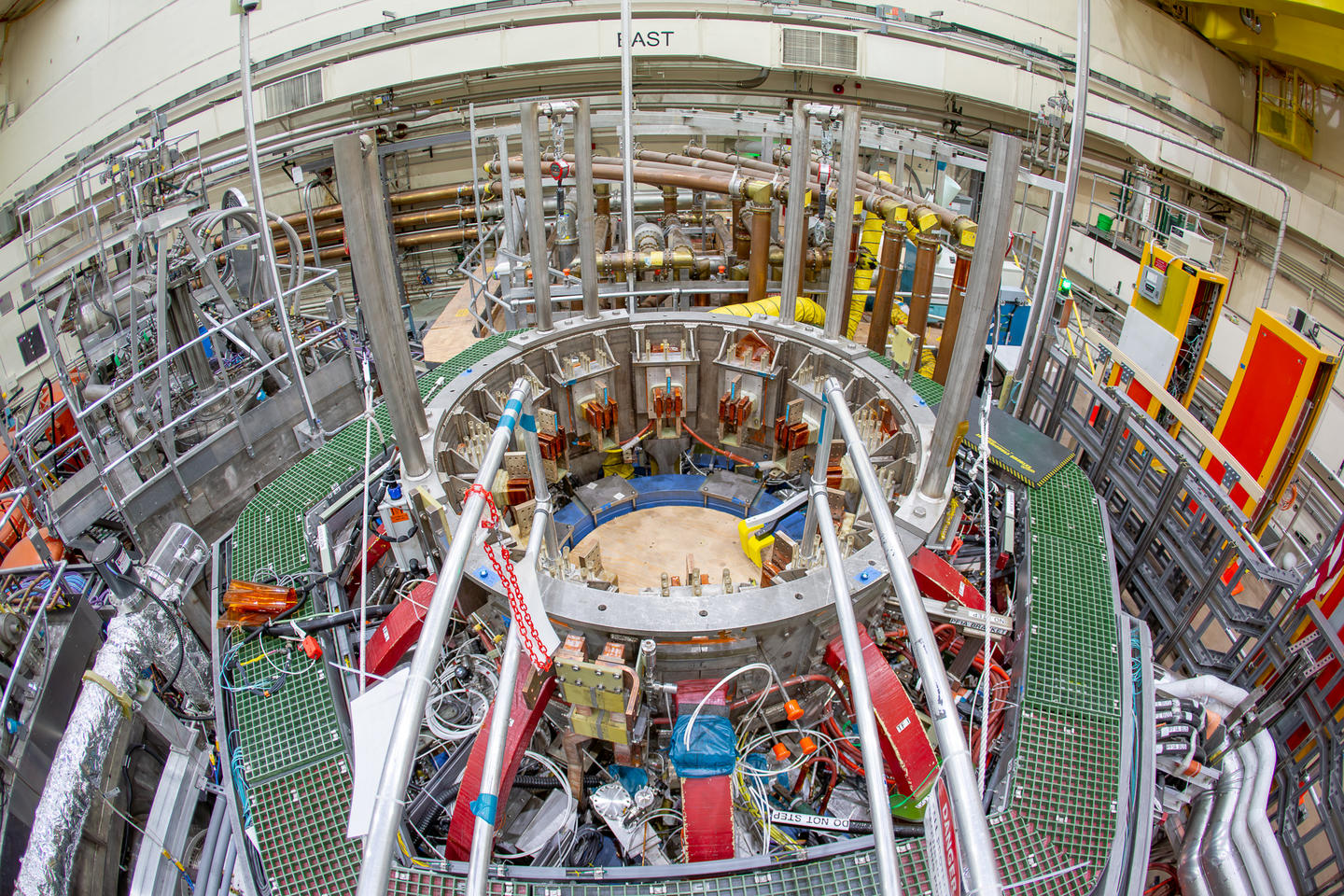
Next, engineers will lower a carbon-studded shield around the bundle to protect it from the plasma’s heat. Technicians will install the magnet in the centre of NSTX-U, hook up the power sources, and finalize any outstanding systems. That includes attaching the cooling system’s hoses, affixing the last heat-protectant tiles inside the vacuum vessel, and preparing the bakeout system to remove all residual contaminant particles. The team can then proceed with commissioning, or the final verification of machine components before experimentation.
Soon, a new generation of plasma physicists, engineers, and technicians will have access to this fusion research device. “I welcome all fusioneers everywhere to this amazing research opportunity and encourage them to use this facility to help advance humanity’s understanding of plasma and fusion energy,” said Jonathan Menard, PPPL’s deputy director for research. “What a thrilling moment—for PPPL, the nation and the world.”
See the full report from PPPL: Delivery of magnet bundle signals a new age of fusion research.