
New program published
The updated agenda for ITER’s 3rd Public-Private Fusion Workshop, newly published today, marks a clear evolution from the broad thematic framing first described in Newsline in February as “Fusion: a Joint Quest” to a fully articulated program. It offers a sharper picture of how collaboration across the fusion ecosystem is taking shape in practice. Workshop participants will experience a stimulating sequence of sessions ranging from how to incorporate advanced technology domains (robotics and AI) to familiar fusion challenges (high-temperature superconductor magnet scale-up; first wall materials; tritium breeding), as well as lessons learned from ITER and best practices driving public-private partnerships.

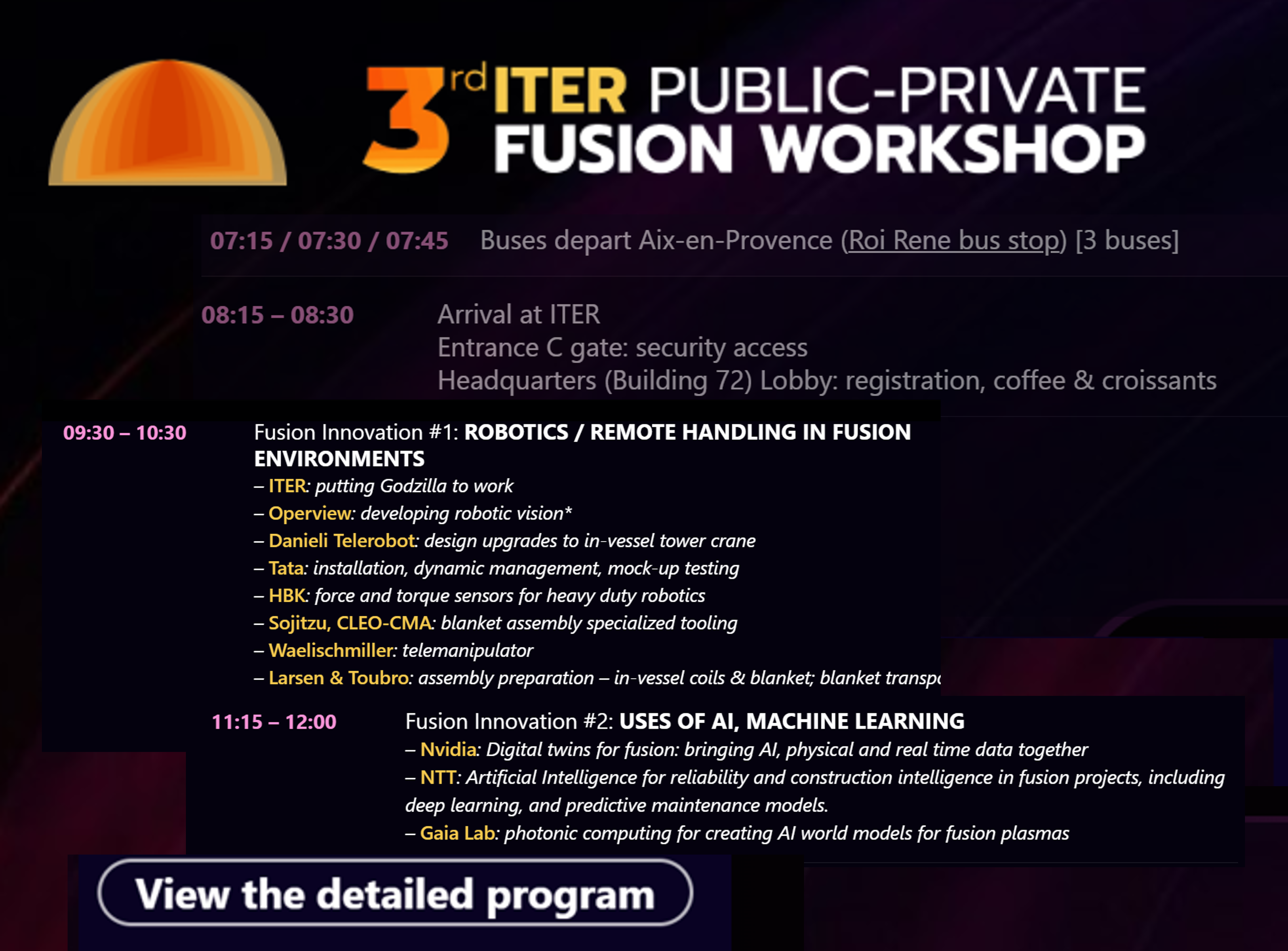
The opening “Fusion Innovation” session on robotics highlights the complexity of remote handling inside the demanding environment of a tokamak, with multinational contributions ranging from ITER’s use of large-scale robots to specialized tooling, sensing technologies, and telemanipulation. This is complemented by a dedicated session on AI and machine learning, where major technology players such as Nvidia and NTT join emerging innovators to explore digital twins, predictive maintenance, and new computational paradigms for plasma modelling. Together, these sessions illustrate the practical value of the shift toward data-rich, autonomous, and highly integrated approaches to fusion R&D.
The program also expands in its international and institutional scope. The inclusion of the China Fusion Energy Company roadmap and additional contributions from Chinese institutes introduces a more explicit view of how public and private fusion efforts are being coordinated in China, adding an important dimension to the global discussion. This is reinforced on the second day through sessions on high-temperature superconducting magnets and technology development at major research institutes, offering insight into parallel advances across different fusion ecosystems.
The workshop places significant emphasis on technology barriers and breakthroughs: how different actors are trying to create the enabling conditions for fusion deployment. A featured evening session introduces the prospect of a fusion-focused competition modelled on the XPRIZE, conceived as both an incentive structure and a recognition mechanism that could accelerate progress. This forward-looking perspective is paired with a panel on supply chain challenges and advancements—as well as an exhibition—where companies will address manufacturing constraints, materials production, and scaling strategies essential for moving from prototype devices to industrialized systems.
The second day deepens the discussion through a dedicated session on best practices in public-private partnerships, bringing together perspectives from government agencies, established fusion companies, and emerging initiatives. These exchanges reflect a growing recognition that realizing fusion depends not only on technical breakthroughs, but also on effective, sustained models of collaboration, funding, and risk-sharing.
Taken together, the program reflects a maturing fusion landscape in which innovation, both public and private, is increasingly shaped by industrial capability and cross-sector collaboration. By bringing these elements into direct conversation, the workshop reinforces ITER’s role not only as a scientific project, but as a platform for structured engagement across the global fusion community. The emphasis throughout is practical: aligning capabilities, identifying gaps, and accelerating the transition from experimental success to deployable systems.
The workshop is free but filling up, and registration will close as of this Friday 17 April. Follow this link to register.