
A tiny bit of fission in the giant fusion machine
4 Apr 2012
-
Robert Arnoux
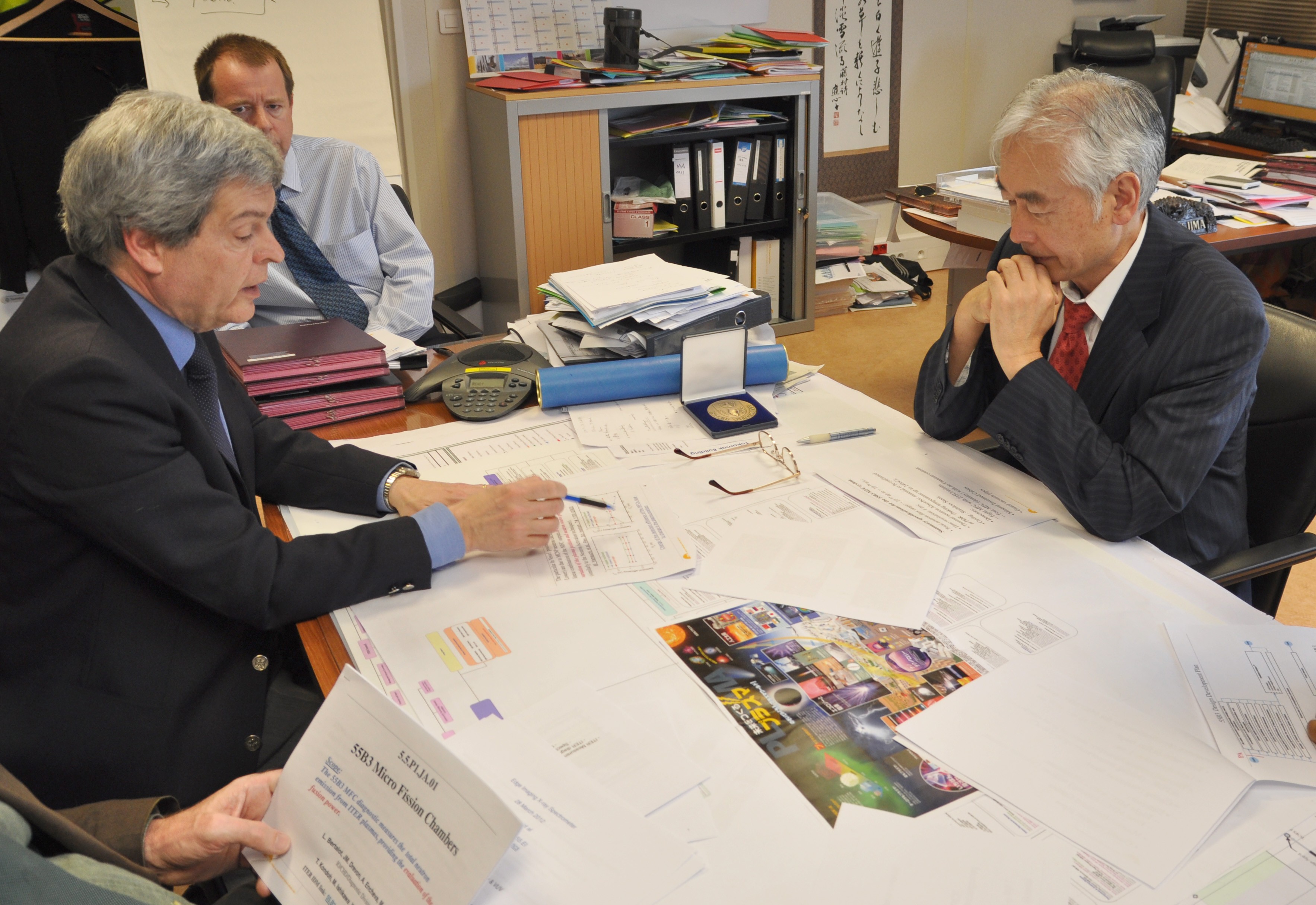
Luciano Bertalot, technical responsible officer for the Micro Fission Chamber Procurement Arrangement, explaining the characteristics of the device in detail to ITER Director-General Osamu Motojima.
Counting the number of neutrons produced by fusion reactions inside a burning plasma gives a precise indication of how much fusion power is being generated.
But how do you count neutrons?
Previously, fusion installations such as TFTR in the US, JET in Europe and JT-60 in Japan have relied on a device based on the physics of fission: the fission chamber.
A fission chamber is a gas-filled container, whose walls are coated with a thin layer of fissile material such as uranium 235 (U235). When a neutron hits an atom of fissile material the atom splits and a fixed amount of energy is released. Measuring the total energy that is released within the device gives a clear indication of how many neutrons have hit the U235 layer. The number of neutrons, in turn, reveals the quantity of fusion power produced.
In previous tokamaks, fission chambers were rather large and installed outside the vacuum vessel. In ITER, their size will not exceed that of a pencil—hence the term "micro fission chamber."
Four units—containing three micro fission chambers each—will be fitted into the gap between the blanket shield modules and the vacuum vessel. The units' locations have been carefully chosen so that the incoming neutrons can be monitored in all circumstances, whatever the plasma position.
Operating in a burning plasma environment, the ITER micro fission chambers will be necessarily different from those installed in previous fusion machines. Vacuum is one the design challenges: since the argon-filled "pencils" will be placed inside the vacuum vessel, they must be perfectly leak-proof. Temperature must also be taken into consideration, as the vacuum vessel will be "baked" to a temperature of 200 °C prior to plasma shots.
Previous tokamaks did not operate with the fusion fuels deuterium and tritium (or only very briefly). ITER will produce long-duration plasma discharges, submitting the micro fission chambers, like all in-vessel components, to an intense neutron flux.
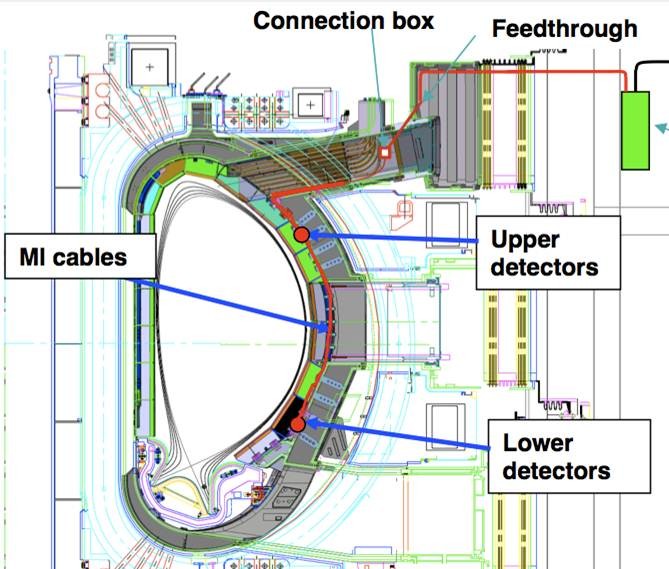
Four micro fission chamber units will be installed on ITER, two in sector #1 of the vacuum vessel; two in sector #6.
"The technology is challenging but feasible," says Luciano Bertalot, technical responsible officer for the Micro Fission Chamber Procurement Arrangement signed last week. "The system is designed to hold for the twenty years of ITER operation time. It is 'redundant,' which means that even if one of micro fission chamber units fails, we will still be able to measure neutron emission and evaluate the fusion power that ITER produces."
The Procurement Arrangement documents for the ITER micro fission chambers were signed last Wednesday 28 March by the ITER Organization and countersigned by the Japan Atomic Energy Agency (JAEA) on 4 April. "We are looking forward to making this project a reality," said Yoshinori Kusama, head of diagnostics at the Japanese Domestic Agency (JA-DA) on this occasion.
Staff members from the JA-DA took an active part in the Concept Design phase that preceded the signature. Now, the R&D and prototype development phase will begin in Japan.
The Procurement Arrangement documents for the ITER micro fission chambers were signed last Wednesday 28 March by the ITER Organization and countersigned by the Japan Atomic Energy Agency (JAEA) on 4 April. "We are looking forward to making this project a reality," said Yoshinori Kusama, head of diagnostics at the Japanese Domestic Agency (JA-DA) on this occasion.
Staff members from the JA-DA took an active part in the Concept Design phase that preceded the signature. Now, the R&D and prototype development phase will begin in Japan.