Facts & Figures
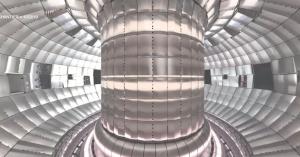
If you haven't heard about ITER, the facts and figures on this page will surprise you. The scale and scope of the ITER project rank it among the most ambitious science endeavors of our time. Machine assembly is underway at the centre of the ITER scientific installation in Saint Paul-lez-Durance, France. Scroll down to learn more.
100,000 Kilometres
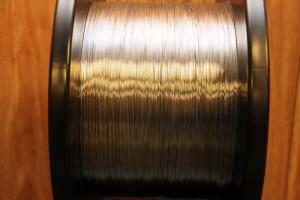
100,000 kilometres of niobium-tin (Nb3Sn) superconducting strands were necessary for ITER's toroidal field magnets. Fabricated by suppliers in six ITER Domestic Agencies—China, Europe, Japan, Korea, Russia and the USA—production began in 2009 and ended in 2014. Over 400 tonnes of this multifilament wire were produced for ITER at a rate of about 150 tonnes/year, a spectacular increase in worldwide production capacity (estimated, before the scale-up for ITER, at a maximum of 15 tonnes/year). Stretched end to end, the Nb3Sn strand produced for ITER would wrap around the Earth at the equator twice.
104 Kilometres
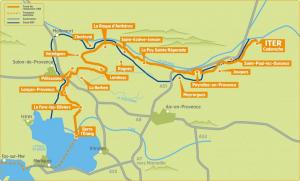
The heaviest components of the ITER machine are shipped to the nearest Mediterranean port and then transported along 104 kilometres of specially modified road known as the ITER itinerary. The dimensions of these components are impressive: the heaviest weighs nearly 900 tonnes including the transport vehicle; the largest is approximately four storeys—or 10.6 metres—high. Some measure 9 metres across; others are 33 metres long.
150 Million °C
The temperature at our Sun's surface is 6,000 °C, and at its core—15 million °C. Temperature combines with density in our Sun's core to create the conditions necessary for the fusion reaction to occur. The gravitational forces of our stars can not be recreated here on Earth, and much higher temperatures are necessary in the laboratory to compensate. In the ITER tokamak, temperatures will reach 150 million °C—or ten times the temperature at the core of our Sun.

259,335 Visitors
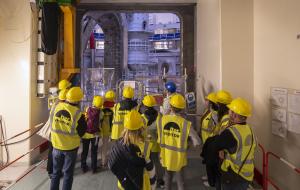
The latest figures are in: 259,335 people have visited the ITER site since work began in 2007 to clear and level land for the future scientific installation. In 2025, 19,444 people were welcomed on site.
Visits are open to all (more information here). Virtual visits are also available in English and French.
23,000 Tonnes
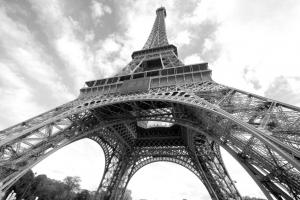
The ITER machine will weigh 23,000 tonnes. The metal contained in the Eiffel Tower (7,300 tonnes) can't compare... the ITER tokamak will be as heavy as three Eiffel Towers. The vacuum vessel alone, with its ports, blanket and divertor, weighs 8,000 tonnes. Approximately one million components will be integrated into this complex machine.
2x The Thrust of a Space Shuttle Lift-off
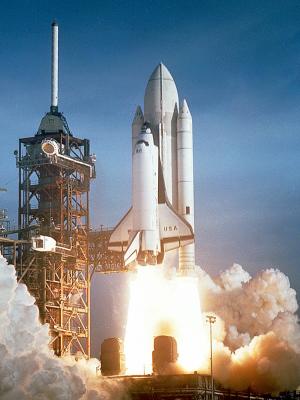
The structure of the ITER central solenoid—the large, 1,000-tonne electromagnet in the centre of the machine—must be strong enough to contain a force equivalent to twice the thrust of the Space Shuttle at take-off. That's 60 meganewtons, or over 6,000 tonnes of force.
310 Tonnes
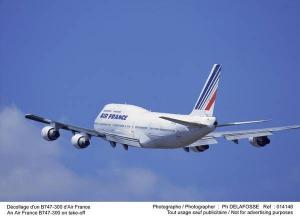
Every one of the ITER tokamak's 18 D-shaped toroidal field coils weighs aproximately 310 tonnes—the approximate weight of a fully loaded Boeing 747-300 airplane. Each toroidal field coil is 17 metres high and 9 metres wide.
400,000 Tonnes
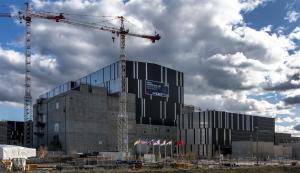
Some 400,000 tonnes will rest on the lower basemat of the Tokamak Complex, including the buildings, the 23,000-tonne machine and equipment. 400,000 tonnes—that's more than the weight of New York City's Empire State Building.
42 Hectares
The main feature of the 180-hectare ITER site in Saint Paul-lez-Durance, southern France, is a man-made platform that was completed in 2009. This 42-hectare platform measures 1 kilometre long by 400 metres wide, and compares in size to 60 soccer fields. Building began in August 2010; today, the buildings of the scientific installation are nearly complete. See Building ITER for the status of ITER construction.
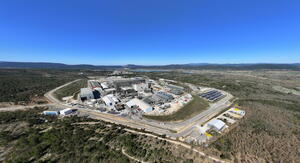
Photo: ITER Organization/EJF Riche
5,000 People
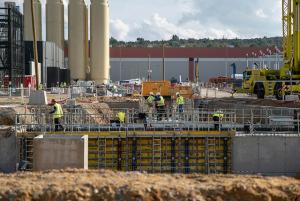
Whereas approximately 1,400 people worked in the offices and on the ITER worksite in 2014, today that number has risen to approximately 5,000.
500 MW
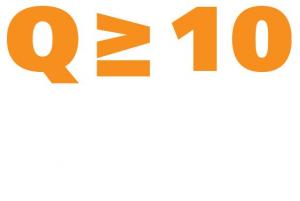
ITER has been designed for high fusion power gain. For 50 MW of power injected into the tokamak via the systems that heat the plasma it will produce 500 MW of fusion power for periods of 400 to 600 seconds. This tenfold return is expressed by Q ≥ 10 (ratio of heating input power to thermal output power). The current record for fusion power gain in a tokamak is Q = 0.67 held by the European JET (now retired), which produced 16 MW of thermal fusion power for 24 MW of injected heating power in the 1990s.
60 Metres
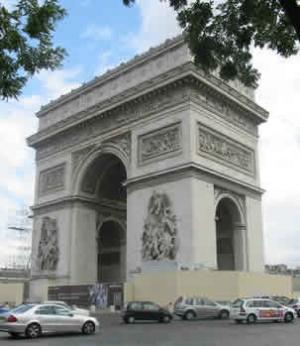
The Tokamak Building is slightly taller than the Arc de Triomphe in Paris. Measuring 73 metres (60 metres above ground and 13 metres below), it is the tallest structure on the ITER site.
830 Cubic Metres
The ITER tokamak will be the largest ever built, with a plasma volume of 830 cubic metres. The maximum plasma volume in tokamaks operating today is 100 cubic metres (in the Europe/Japan tokamak JT-60SA). ITER's huge plasma volume will enable it to produce, for the first time, a "burning plasma" in which the majority of the heating needed to sustain the fusion reaction is produced by the alpha particles generated during the fusion process itself. The production and control of such a self-heated plasma has been the goal of magnetic fusion research for more than 50 years.